
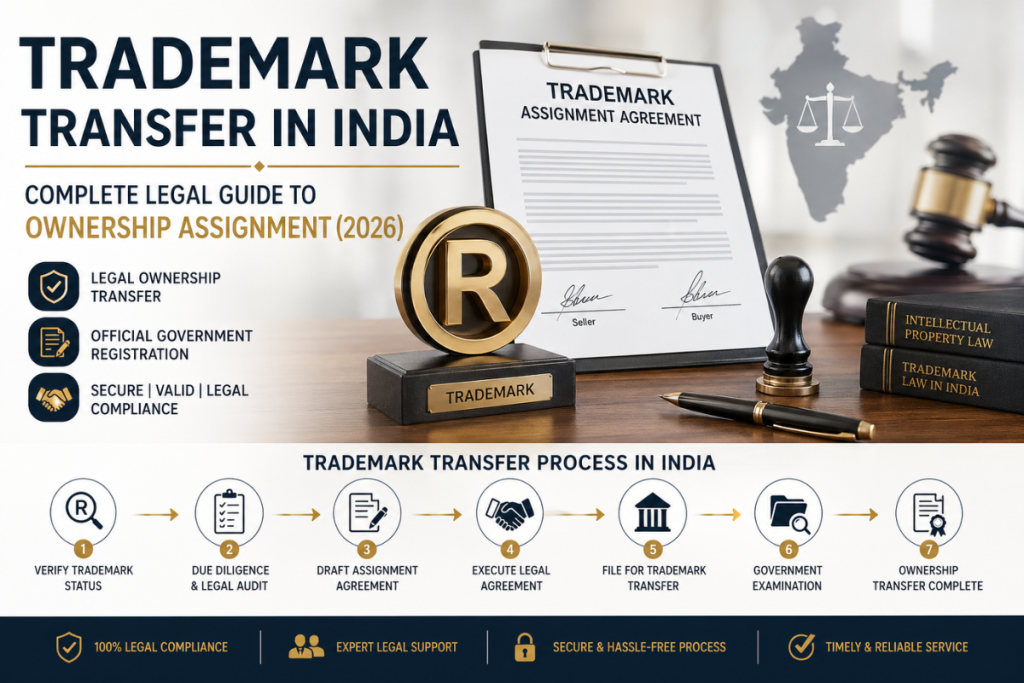
Transferring ownership of a trademark is a legally sensitive process. In India, a trademark cannot simply be “sold informally” or handed over verbally. It must follow a structured legal process known as trademark assignment.
That’s why many business owners search for:
- how to transfer trademark ownership in India
- trademark transfer India
- how to sell trademark in India
- trademark assignment India
If done incorrectly, the transfer can become invalid, leading to legal disputes, financial loss, or rejection by authorities.
This guide explains the ultra-legal, step-by-step process of trademark transfer in India, including documentation, legal risks, and compliance requirements.
What is Trademark Transfer in India? (Legal Definition)
A trademark in India is an intellectual property asset registered under the Controller General of Patents, Designs and Trade Marks.
Trademark transfer (assignment) means:
👉 The legal transfer of ownership rights from one person or entity to another.
Once completed:
- The buyer becomes the legal owner
- The seller loses all rights
- The trademark record is updated officially
Types of Trademark Transfer in India
Understanding the legal structure is critical.
1. Full Assignment (Complete Transfer)
- Entire ownership is transferred
- Seller has no remaining rights
2. Partial Assignment
- Only specific goods/services transferred
- Common in large brand portfolios
3. Assignment with Goodwill
- Brand value + reputation included
- Most common in business sales
4. Assignment without Goodwill
- Only legal rights transferred
- Brand reputation not included
Step-by-Step: How to Transfer Trademark Ownership in India
Step 1: Verify Trademark Status
Before transfer, ensure:
- Trademark is registered or valid
- No ongoing disputes
- Ownership is legally clear
This is essential under trademark law in India governed by the Controller General of Patents, Designs and Trade Marks.
Step 2: Due Diligence (Legal Audit)
A proper trademark transfer requires legal verification:
Check:
- Registration certificate
- Renewal status
- Pending objections
- Litigation history
👉 This step prevents future legal challenges.
Step 3: Draft Trademark Assignment Agreement
This is the most important legal document.
It must include:
- Full details of seller & buyer
- Trademark registration number
- Transfer type (full/partial)
- Payment terms
- Jurisdiction clause
- Effective transfer date
⚠️ Without this, transfer is not legally valid.
Step 4: Execute Legal Agreement
Both parties must:
- Sign assignment deed
- Witness signatures (recommended)
- Notarize document (strongly advised)
This ensures legal enforceability.
Step 5: Apply for Trademark Transfer (Official Filing)
Now you file the assignment with the government authority.
This process is commonly searched as:
- trademark transfer India
- how to transfer trademark ownership in India
You must submit:
- Assignment deed
- Application form
- Supporting documents
Filed with the Controller General of Patents, Designs and Trade Marks.
Step 6: Government Examination
Authorities verify:
- Legal validity of assignment
- Ownership clarity
- Compliance with trademark laws
If everything is correct → approved.
Step 7: Official Update of Ownership
Once approved:
🎉 Trademark ownership is transferred
🎉 New owner is recorded in official registry
🎉 Legal rights are fully assigned
Documents Required for Trademark Transfer
To complete trademark assignment in India, you need:
- Trademark registration certificate
- Assignment deed
- Identity proof (buyer & seller)
- Power of attorney (if applicable)
- Application form
Legal Risks in Trademark Transfer (Important)
Improper transfer can cause:
❌ Invalid ownership claims
❌ Legal disputes
❌ Rejection by authority
❌ Financial fraud risk
Common Mistakes in Trademark Transfer
❌ No written agreement
❌ Skipping government filing
❌ Transferring pending trademarks
❌ Incorrect ownership details
❌ Not checking legal disputes
Trademark Transfer Timeline in India
Typical process duration:
- Agreement drafting: 1–3 days
- Filing: 2–5 days
- Examination: 1–3 months
- Final approval: 2–6 months
Cost of Trademark Transfer in India
Costs vary depending on:
Government Fees:
- ₹1,000 – ₹5,000 per trademark
Legal Fees:
- ₹5,000 – ₹25,000+ depending on complexity
Trademark Transfer vs Trademark Sale
| Factor | Transfer | Sale |
| Legal Process | Mandatory | Includes agreement |
| Ownership | Changes | Changes |
| Payment | Optional | Required |
👉 Sale = Commercial transaction
👉 Transfer = Legal execution
Why Trademark Transfer is Legally Sensitive
Because a trademark is not just a name—it is:
- Intellectual property
- Brand identity
- Business goodwill
- Legal asset
That’s why strict compliance is required under Indian IP law.
Who Needs Trademark Transfer Services?
- Startup acquisitions
- Business mergers
- Franchise expansion
- Brand investors
- International companies entering India
Ultra Legal Tip (Expert Insight)
To ensure maximum legal protection:
✔ Always notarize assignment deed
✔ Always file with official authority
✔ Always verify ownership chain
✔ Always include goodwill clause if applicable
Alternative: Trademark Licensing Instead of Transfer
Instead of full transfer, you can:
- License trademark usage
- Retain ownership
- Earn royalties
This is common in franchise models.
Final Thoughts
Trademark transfer in India is a highly legal process that must be done correctly to avoid disputes.
If you are planning to:
- Sell your trademark
- Buy an existing brand
- Transfer ownership legally
Then understanding the trademark transfer India process is essential.
A properly executed assignment ensures:
✔ Legal security
✔ Clean ownership
✔ Business continuity
Need Help with Trademark Transfer in India?
We provide:
- Legal assignment drafting
- Ownership transfer filing
- Buyer-seller coordination
- Full compliance handling