
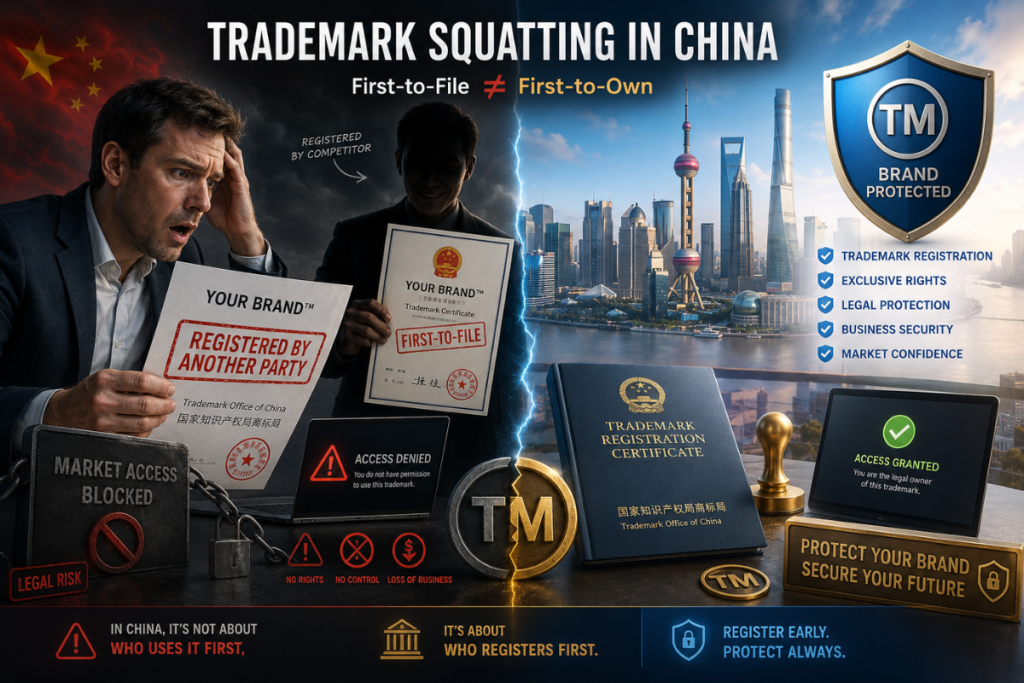
If your business plans to enter China, there is one major legal risk you cannot afford to ignore:
China trademark squatting.
Every year, thousands of foreign businesses lose control of their brand names in China because someone else registers their trademark first.
This happens because China follows a strict first-to-file trademark system, meaning trademark rights usually belong to the first person or company to file—not the first to use the brand.
For international companies, Amazon sellers, exporters, startups, and global brands, understanding how to protect your trademark in China is essential.
This guide explains:
- What China trademark squatting is
- Why it happens
- How it affects foreign businesses
- How to prevent it
- What to do if someone already registered your trademark
What Is China Trademark Squatting?
Trademark squatting happens when someone registers a trademark they do not genuinely own or use.
Their goal is usually to:
- Sell it back to the rightful brand owner
- Block market entry
- Demand high transfer fees
- Exploit the brand’s reputation
In China, this is a serious concern because of the country’s first-to-file trademark law.
Even if your brand is famous internationally, another party may still gain legal ownership in China if they file first.
That is why trademark protection in China must happen before market expansion.
Why Trademark Squatting Happens So Often in China
China is one of the world’s largest trademark filing markets.
Because registration is based primarily on filing date, opportunistic applicants monitor foreign brands and register them early.
This creates opportunities for:
- Local competitors
- Trademark investors
- Third-party speculators
- Unauthorized distributors
They often target:
- Growing international brands
- Amazon sellers
- Exporters entering China
- Businesses launching new products
Why Foreign Companies Are Most at Risk
Foreign businesses often assume that owning a trademark in their home country automatically protects them in China.
This is incorrect.
A trademark registered in:
- Germany
- India
- United States
- UK
- EU
does not automatically provide trademark rights in China.
Without local filing, your brand remains vulnerable.
This is why many businesses search:
can foreigners register trademark in China
The answer is yes—but many wait too long.
Common Examples of China Trademark Squatting
Trademark squatting usually happens in several ways.
1. Exact Brand Name Registration
Someone files your exact trademark.
This blocks your legal use in China.
2. Chinese Character Version Registration
A third party registers the Chinese translation of your brand.
This can damage local branding.
3. Similar Trademark Registration
Applicants file confusingly similar versions.
This creates legal disputes.
4. Multi-Class Blocking
Squatters register your trademark across multiple classes.
This increases buyback costs.
How Trademark Squatting Hurts Your Business
The consequences can be severe.
Market Entry Delays
You cannot legally operate under your brand.
Expensive Buybacks
You may need to purchase your own trademark.
Legal Disputes
Challenging ownership can take months or years.
Forced Rebranding
You may need a completely new brand identity.
Marketplace Restrictions
Amazon and e-commerce platforms often require valid trademark ownership.
Why China’s First-to-File System Creates This Risk
Unlike first-use systems, China grants rights primarily based on who files first.
This means:
Even if your business has used a brand for years internationally, someone filing first in China may gain legal rights.
This legal structure is why early trademark registration in China is essential.
How to Protect Your Brand Before It’s Too Late
The good news:
Trademark squatting is preventable.
1. Register Your Trademark Early
The best protection is immediate filing.
Do this before:
- Manufacturing in China
- Selling products
- Marketing to Chinese customers
- Working with distributors
Early registration is your strongest legal defense.
2. Conduct a China Trademark Search
Before filing, perform a China trademark search.
This checks:
- Existing registrations
- Similar marks
- Potential conflicts
It helps avoid rejection and surprises.
3. Register Both English and Chinese Versions
Many businesses only protect English branding.
This is a mistake.
Register:
- Original brand name
- Chinese character equivalent
- Common transliterations
This prevents third-party capture.
4. File Across Relevant Trademark Classes
China uses class-based registration.
Protect all important categories.
Examples:
- Class 25 – Clothing
- Class 35 – Retail / Advertising
- Class 9 – Software / Electronics
Filing too narrowly creates exposure.
5. Monitor New Trademark Applications
Ongoing monitoring allows early action against suspicious filings.
Early opposition is cheaper than later disputes.
What If Someone Already Registered Your Trademark?
If your brand has already been registered by another party, you still have options.
Option 1: Trademark Opposition
If the mark is still in publication stage, you can challenge it.
Option 2: Invalidation / Cancellation
You may challenge bad-faith registration.
Option 3: Negotiate Purchase
Sometimes buying the trademark is faster.
Option 4: Rebranding
Usually the least desirable option.
Registering vs Buying an Existing Trademark
Foreign companies entering China often compare:
Register New Trademark
Pros
- Lower upfront cost
- Full brand customization
Cons
- 8–12 months timeline
- Risk of conflict
Buy Existing Registered Trademark
Pros
- Immediate ownership
- Faster market entry
- Lower uncertainty
Cons
- Higher initial investment
For urgent expansion, acquisition often makes more business sense.
Why This Matters for Amazon Sellers
Trademark ownership supports:
- Amazon Brand Registry
- Listing protection
- Anti-counterfeit tools
- Marketplace trust
Without registration, your business may face major restrictions.
This is why many sellers prioritize trademark registration in China before product launch.
How Long Does Trademark Registration Take?
Typical process:
| Stage | Time |
| Trademark Search | 1–2 weeks |
| Filing Review | 1 month |
| Examination | 4–6 months |
| Publication | 3 months |
| Final Approval | 1–2 months |
Average:
8–12 months
This is why early action matters.
Why Work With Trademark Experts
China trademark law is highly specialized.
Professional guidance reduces risk.
At Trademark Buy Sale, we help businesses:
- Register trademarks in China
- Conduct trademark searches
- Acquire existing trademarks
- Transfer ownership legally
- Protect brands against squatting
With support from Stefan Geisler, businesses gain strategic protection for China market entry.
China trademark squatting is real.
And for foreign businesses, the cost of waiting can be enormous.
The best way to protect your brand is simple:
Register early.
The sooner you secure your trademark, the safer your expansion into China becomes.
Ready to Protect Your Brand in China?
Whether you need:
- Trademark registration
- China trademark search
- Legal advisory
- Ready-to-transfer trademarks
Trademark Buy Sale can help.
Contact us today and secure your brand before someone else does.