
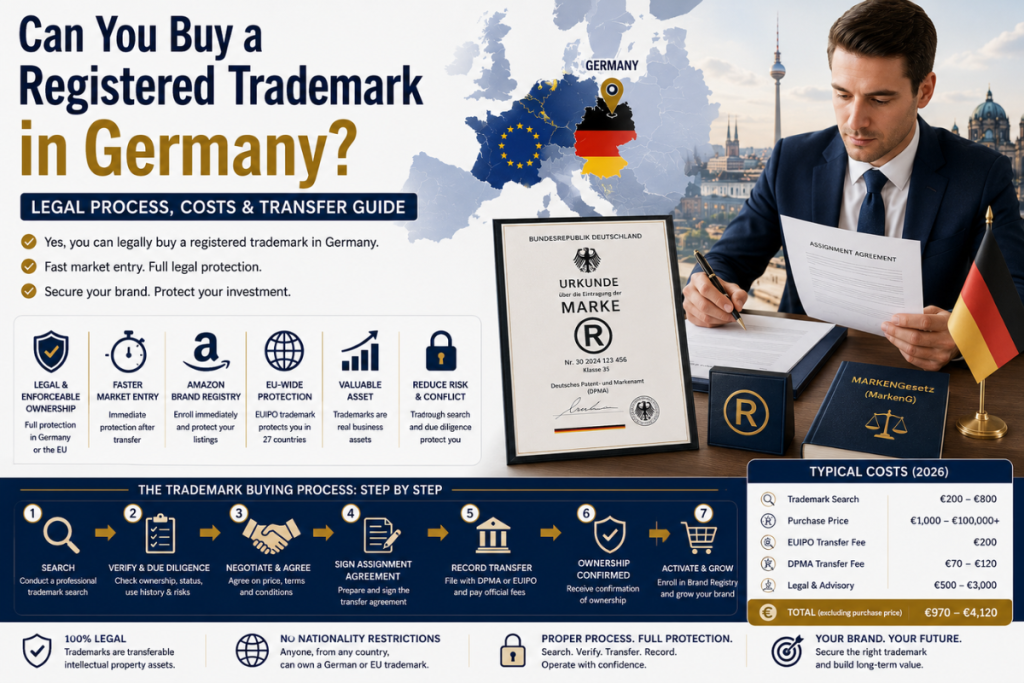
Buying a Trademark Is Possible — But Only If You Do It Right
Most people think trademarks are created, not bought.
The reality is different. Registered trademarks are intellectual property assets — and like any asset, they can be bought, sold, transferred, and acquired. In Germany and across the EU, trademark transactions happen every day between businesses, investors, startups, and international buyers.
But the process is not as simple as agreeing on a price and shaking hands. A trademark acquisition in Germany involves legal verification, formal assignment procedures, official recording with trademark authorities, and careful due diligence — all of which must be completed correctly for the transfer to be legally valid and commercially safe.
This guide answers every core question about buying a registered trademark in Germany: whether it is legal, who can do it, what the process looks like step by step, what it costs, and what risks to manage along the way. Whether you are a domestic buyer, an Amazon seller, a startup, or an international company entering the German market — this is the complete transfer guide for 2026.
Can You Legally Buy a Registered Trademark in Germany?
Yes — buying a registered trademark in Germany is entirely legal.
Under German trademark law (Markengesetz — MarkenG) and EU trademark regulations, trademarks are recognized as transferable intellectual property assets. A registered trademark can be:
- Sold outright — full ownership transferred from seller to buyer
- Licensed — rights to use the trademark granted to another party while ownership is retained
- Pledged — used as collateral for financing purposes
- Inherited — passed on as part of an estate
There are no nationality restrictions on trademark ownership in Germany or the EU. German nationals, EU citizens, and foreign companies and individuals from any country — including China, India, the United States, and the United Kingdom — can legally own and acquire registered trademarks in Germany.
The key legal requirement is that the transfer must be formally documented and recorded with the relevant trademark authority — either DPMA (for German national trademarks) or EUIPO (for EU Trade Marks) — to be legally recognized and enforceable against third parties.
What Types of Trademarks Can Be Bought in Germany?
Not all trademarks are identical in scope and structure. Understanding what you are buying matters before any transaction begins.
Word Marks (Wortmarken)
The most common type — a brand name, word, or phrase registered as a trademark. Word marks protect the text itself, regardless of font, color, or design. They offer broad protection and are the most commercially flexible type of trademark.
Example: A single brand name like “BOLT” registered for logistics services.
Figurative Marks (Bildmarken)
A logo, symbol, or graphic element registered as a trademark. The protection applies to the visual image, not the words.
Combined Marks (Wort-Bild-Marken)
A combination of a word and a graphic element — the most common format for branded businesses. Protection covers the specific combination of text and image.
3D Marks, Sound Marks, and Other Non-Traditional Marks
Product shapes, sounds, colors, and other distinctive marks can also be registered and transferred in Germany. These are less common but legally valid trademark assets.
DPMA vs. EUIPO Trademarks
When buying a trademark in Germany, you may be acquiring either:
- A DPMA trademark — a German national registration providing protection within Germany only
- A EUIPO trademark (EUTM) — an EU Trade Mark providing protection across all 27 EU member states, including Germany
Both types are fully transferable. The transfer process differs slightly depending on the authority, but both are equally valid routes to trademark ownership in the German market.
Why Buy a Trademark Instead of Registering a New One?
This is one of the first questions buyers ask. If I can register a new trademark, why would I buy an existing one?
The answer depends on your situation — but there are strong commercial arguments for acquisition over registration in many cases.
Speed of Market Entry
A new EUIPO trademark application takes 4–6 months under normal conditions — longer if oppositions are filed. An acquired trademark provides legal protection from the moment the transfer is recorded, which typically takes weeks, not months. For businesses with time-sensitive market entry plans, acquisition is significantly faster.
Amazon Brand Registry Access
Amazon Germany’s Brand Registry requires a registered trademark. With a new registration, you wait months before you qualify. With an acquired registered trademark, you can enroll immediately after transfer — protecting your listings, blocking hijackers, and accessing enhanced seller tools without delay.
Reduced Rejection Risk
New trademark applications face examination and potential opposition from existing rights holders. An already-registered trademark has already passed examination. Acquiring it avoids the registration process entirely, eliminating rejection risk.
Existing Brand Equity
Some trademarks come with commercial history — marketplace listings, customer recognition, search presence, or licensing revenue. Acquiring a trademark with existing equity provides a head start that a new registration cannot offer.
Competitive Positioning
In saturated markets, the most desirable trademark names and combinations may already be registered. Acquisition is sometimes the only path to owning the exact trademark asset you need.
Before You Buy: The Trademark Search Requirement
Buying a trademark without conducting a professional trademark search first is one of the most preventable — and most costly — mistakes in IP acquisition.
Here is why the search must happen before any purchase decision:
Existing Conflicts Are Not Always Visible
A trademark may be registered and active at DPMA or EUIPO but still carry conflict risk with other registered marks in overlapping categories. The registration itself does not certify conflict-free status — only a professional search analysis can confirm this.
Phonetic and Conceptual Similarities
Conflicts do not require identical names. A trademark that sounds similar to an existing registered mark, or shares a conceptual meaning with one, may face legal challenge even after purchase. Professional search includes similarity analysis that database checks alone cannot provide.
Class Coverage Gaps
A trademark registered in Class 25 (clothing) may look clean — but if you intend to use it for online retail (Class 35), that class may have conflicts. A thorough search covers all classes relevant to your intended use, not just the classes already registered.
Seller Representation Is Not Verification
A seller who tells you their trademark is “clean” and “conflict-free” is not a substitute for independent verification. Only a professional trademark search covering EUIPO, DPMA, and WIPO databases provides reliable confirmation.
The rule is simple: Search before you buy. Always.
The Legal Process for Buying a Trademark in Germany: Step by Step
Trademark acquisition in Germany follows a structured legal process. Each stage must be completed correctly for the transfer to be valid and fully protective.
Stage 1: Identify the Trademark
Identify the trademark you wish to acquire — whether through a marketplace, a direct approach to the current owner, or an advisory service. Confirm the basic details: trademark number, registration authority (DPMA or EUIPO), class coverage, and current ownership.
Stage 2: Conduct a Professional Trademark Search
Commission a search covering EUIPO, DPMA, and WIPO databases. The search evaluates:
- Identical and similar name conflicts
- Phonetic, visual, and conceptual similarities
- Class-specific conflict risks
- Current legal status of the trademark
Receive a risk report (Low / Medium / High) before proceeding.
Stage 3: Verify Ownership and Legal Status
Confirm the seller is the registered owner of record at DPMA or EUIPO. Verify:
- The trademark is currently active and in good standing
- Renewal fees are up to date
- No cancellation proceedings, opposition actions, or legal disputes are attached
- No existing licenses that would limit your use rights
Stage 4: Conduct Trademark Due Diligence
Beyond conflict and ownership checks, full due diligence includes:
- Reviewing the trademark’s commercial use history
- Confirming the trademark qualifies as genuinely used (non-use cancellation risk in EU trademark law applies after 5 years of non-use)
- Assessing whether the class coverage matches your intended business activities
- Verifying any attached agreements, pledges, or encumbrances
Stage 5: Agree on Price and Terms
Negotiate the acquisition price based on the trademark’s legal status, class coverage, commercial history, market comparables, and your specific intended use. A professional valuation supports evidence-based negotiation.
Key terms to agree on:
- Purchase price and payment structure
- Transfer timeline
- Representations and warranties from the seller
- NDA and confidentiality terms (if applicable)
- Post-transfer support obligations
Stage 6: Prepare the Trademark Assignment Agreement
The trademark assignment agreement is the legal contract that transfers ownership from seller to buyer. It must be:
- In writing (oral transfers are not valid for trademark assignments)
- Signed by both parties
- Specific about the trademark being transferred (registration number, authority, classes)
- Clear on the consideration (price) and effective date
This document is the legal foundation of the entire transaction. It should be prepared or reviewed by a qualified professional.
Stage 7: Record the Transfer with DPMA or EUIPO
The signed assignment agreement must be submitted to the relevant trademark authority for official recording. This is a critical step that many buyers overlook — the transfer is not legally effective against third parties until it is recorded.
For DPMA (German national trademarks):
- Submit a transfer application to DPMA
- Include the assignment agreement or a certified extract
- Pay the official recording fee
- Recording typically takes several weeks
For EUIPO (EU Trade Marks):
- Submit a transfer request through EUIPO’s online portal
- Provide the assignment agreement or a signed declaration
- Pay the EUIPO transfer recording fee (currently €200 for online submission per trademark)
- EUIPO records the transfer and updates the official trademark register
Stage 8: Receive Confirmation of Ownership
Once the transfer is recorded, you receive official confirmation from DPMA or EUIPO that you are the registered owner. This confirmation is your legal evidence of ownership.
Stage 9: Activate Amazon Brand Registry and Market Operations
With registered ownership confirmed, you can immediately:
- Enroll in Amazon Germany Brand Registry
- Activate brand protection on your marketplace listings
- Begin full commercial operations under your trademark in Germany and the EU
Trademark Transfer Costs: What to Budget in 2026
Understanding the full cost of a trademark acquisition in Germany requires accounting for several distinct cost categories.
1. Purchase Price (Trademark Asset Cost)
The price paid to the seller for the trademark itself. This varies enormously based on the trademark’s age, class coverage, commercial history, market presence, and negotiation dynamics.
Indicative ranges:
- Basic, newly registered trademark with no commercial history: €1,000–€5,000
- Established trademark with class coverage and clean legal status: €5,000–€25,000
- Trademark with active marketplace presence and commercial track record: €25,000–€100,000+
- High-value branded trademark with significant market recognition: €100,000 and above
These ranges are illustrative. Every trademark is unique and must be individually valued.
2. Trademark Search Costs
A professional trademark search covering EUIPO, DPMA, and WIPO typically costs between €200 and €800 depending on the scope and provider. This is non-negotiable investment — the cost of avoiding a conflicted acquisition.
3. Official Transfer Recording Fees
| Authority | Transfer Fee |
| EUIPO | €200 per trademark (online submission) |
| DPMA | €70–€120 per trademark (varies by submission method) |
If acquiring both DPMA and EUIPO registrations, both recording fees apply.
4. Legal and Advisory Costs
Professional assistance with the assignment agreement, due diligence review, and transfer coordination. Costs vary by complexity and provider. Budget €500–€3,000 for professional advisory support depending on the transaction scale.
5. Post-Transfer Costs
- Amazon Brand Registry enrollment: Free
- Trademark watch services: Optional ongoing monitoring, typically €200–€500 annually
- Renewal fees: EUIPO renewal costs approximately €850 per class for the first renewal period
Total Estimated Cost Summary
| Cost Category | Estimated Range |
| Trademark purchase price | €1,000–€100,000+ |
| Trademark search | €200–€800 |
| EUIPO transfer recording | €200 |
| DPMA transfer recording | €70–€120 |
| Professional advisory | €500–€3,000 |
| Total (excluding purchase price) | €970–€4,120 |
How Long Does a Trademark Transfer Take in Germany?
The timeline for completing a trademark transfer in Germany depends on the stage and the authority involved.
| Stage | Typical Timeline |
| Trademark search | 24–72 hours |
| Due diligence and verification | 3–7 business days |
| Negotiation and agreement | Variable (days to weeks) |
| Assignment agreement preparation | 3–5 business days |
| DPMA transfer recording | 4–8 weeks |
| EUIPO transfer recording | 2–4 weeks |
| Amazon Brand Registry enrollment | 1–5 business days after recording |
Total typical timeline from search to completed transfer: 6–12 weeks
For buyers with urgent market entry timelines, working with an experienced acquisition advisory service accelerates each stage and prevents delays from administrative errors or incomplete documentation.
Risks to Manage When Buying a Trademark in Germany
Even with proper process, certain risks require active management.
Non-Use Cancellation Risk
Under EU and German trademark law, a trademark that has not been genuinely used in the relevant market for 5 consecutive years is vulnerable to cancellation on the grounds of non-use. Before acquiring a trademark that has been dormant, verify its use history and assess this risk.
Hidden Licenses or Encumbrances
An existing license granted to a third party may transfer with the trademark — meaning the new owner inherits obligations to the licensee. Due diligence must identify and address any existing licensing arrangements before completion.
Seller Fraud and Ownership Disputes
In rare cases, sellers misrepresent ownership or attempt to transfer trademarks they do not fully own. Always verify ownership directly against the official DPMA or EUIPO register — do not rely solely on documentation provided by the seller.
Class Coverage Mismatch
Acquiring a trademark that does not cover all the classes you need for your business leaves gaps in your protection. Map your intended business activities against the trademark’s class coverage before finalizing the acquisition.
Post-Transfer Opposition
In some cases, third parties may oppose or challenge a trademark after transfer if they believe their rights are infringed. A clean trademark search before acquisition significantly reduces but does not entirely eliminate this risk.
Buying Ready-Made Trademarks: A Fast-Track Option
Ready-made trademarks — sometimes called shelf trademarks — are registered trademarks that have been specifically prepared for acquisition. They are registered in advance, maintained in good standing, and offered for transfer to buyers seeking immediate protection.
For buyers who need:
- Fast Amazon Germany Brand Registry enrollment
- Quick EU market entry without waiting for registration
- A clean, verified trademark with no commercial history complications
Ready-made trademarks offer a streamlined path. The same due diligence applies — search, verify, transfer — but the pre-registration work has already been completed.
Buying a Trademark for Amazon Germany: What Sellers Need to Know
For Amazon sellers expanding into the German market, trademark acquisition follows the same legal process — but marketplace-specific considerations add additional requirements.
Amazon Brand Registry Requirements for Germany:
- A registered trademark in Germany (DPMA) or the EU (EUIPO)
- The trademark must be a word mark or figurative mark
- The trademark must be active and in good standing
- The trademark must match the brand name used on Amazon listings
Important: Amazon accepts both DPMA national registrations and EUIPO EU Trade Marks for German Brand Registry enrollment. EUIPO registration is generally preferred as it provides broader geographic protection at no additional cost for the 27-country EU coverage.
After the trademark transfer is recorded and you have official ownership confirmation, Amazon Brand Registry enrollment typically completes within 1–5 business days.
Buying a Trademark in Germany
Can a non-German company or individual buy a trademark in Germany? Yes. There are no nationality or residency restrictions on trademark ownership in Germany or the EU. Any individual or company from any country can legally own a German or EU trademark.
Is a verbal agreement enough to transfer a trademark? No. Trademark transfers must be in writing to be legally valid. A signed assignment agreement is required before the transfer can be recorded with DPMA or EUIPO.
What happens if I buy a trademark but do not record the transfer? The transfer may be valid between the parties but is not enforceable against third parties until officially recorded. An unrecorded transfer leaves the seller’s name on the official register, which creates legal uncertainty and risk.
Can I buy just part of a trademark’s class coverage? Yes. A trademark can be partially transferred — for example, transferring rights in certain Nice Classification classes while the seller retains rights in others. This is called a partial assignment and must be clearly documented.
What if the trademark I want to buy is already licensed to someone else? Existing licenses may transfer with the trademark or require renegotiation. Full due diligence before acquisition will identify any existing licensing arrangements and their implications.
Can I buy an EU trademark and use it in Germany? Yes. An EU Trade Mark (EUIPO registration) covers all 27 EU member states, including Germany. It is fully valid for use, enforcement, and Amazon Brand Registry enrollment in Germany.
What is the difference between buying and licensing a trademark? Buying (assignment) transfers full ownership permanently. Licensing grants the right to use the trademark for a specified period and purpose while the original owner retains ownership. For buyers seeking full control and long-term protection, purchase is preferable over licensing.
Do I need a lawyer to buy a trademark in Germany? It is not a legal requirement, but professional guidance is strongly recommended — particularly for the assignment agreement, due diligence process, and transfer recording. Errors in these stages can invalidate the transfer or leave the buyer exposed to risk.
Buying a Trademark in Germany Is Legal, Structured, and Accessible
The answer to the question at the top of this guide is clear: yes, you can buy a registered trademark in Germany — and people do it every day.
What separates successful trademark acquisitions from costly ones is process. The buyers who protect their investment are the ones who search before they buy, verify before they sign, and record before they operate.
A trademark purchased through proper process — search, due diligence, assignment agreement, official recording — is a powerful commercial asset that provides legal protection across Germany or the entire EU, enables Amazon Brand Registry enrollment, and supports long-term brand building.
A trademark purchased without that process is a risk waiting to surface.
The good news is that the process is accessible, well-defined, and manageable with the right advisory support. Whether you are a domestic buyer, an Amazon seller, a startup, or an international company entering the German market — trademark acquisition is a legitimate and increasingly popular route to fast, secure brand ownership.
Ready to buy a registered trademark in Germany or the EU?
Start with a professional trademark search and acquisition advisory — and complete your transfer with full legal confidence.
👉 Book a Consultation | 👉 Find Your Trademark | 💬 WhatsApp Expert Support
This article is for informational and educational purposes only and does not constitute legal advice. For specific trademark transfer matters, consult a qualified intellectual property professional with German and EU expertise.