
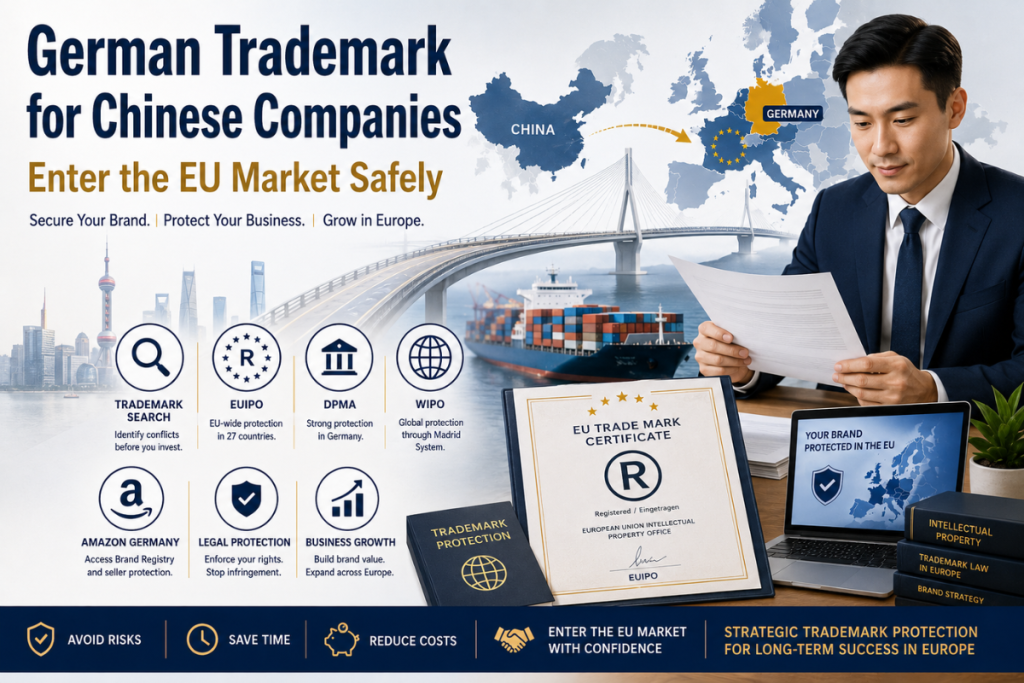
The EU Market Is Open — But Only for Prepared Brands
China is the world’s largest exporter. Germany is Europe’s largest economy and one of the most important gateways to the EU single market. The commercial logic of Chinese companies entering the German and EU market is clear.
What is less clear — and where many Chinese businesses make costly mistakes — is the legal foundation required to operate safely as a brand in Europe.
A product can cross a border. A brand cannot — not safely, not sustainably — without the right trademark protection in place.
This guide is written specifically for Chinese companies, entrepreneurs, and investors who want to enter the German and EU market in 2026. It explains how trademarks work in Germany and the EU, why Chinese brands face specific vulnerabilities without EU trademark protection, how to acquire or register a trademark safely, and how a structured trademark search protects your investment before you spend a single euro on market entry.
Why Germany Is the Entry Point for Chinese Brands in Europe
For Chinese companies expanding into Europe, Germany is the natural first market. Here is why:
Economic scale. Germany is the largest economy in the EU with a GDP exceeding €4 trillion. It is home to Europe’s most sophisticated consumer and B2B markets across manufacturing, technology, e-commerce, and consumer goods.
Logistics infrastructure. Germany’s port, rail, and road network — centered on hubs like Hamburg, Frankfurt, and Duisburg — makes it the primary distribution gateway for goods entering Europe from China.
Amazon Germany. Amazon.de is one of the largest e-commerce platforms in Europe. For Chinese sellers already operating on Amazon, entering Amazon Germany is a natural expansion — but it requires EU or German trademark registration to access Amazon Brand Registry and gain full seller protections.
EU market access. A trademark registered in Germany (DPMA) provides national protection. A trademark registered at EUIPO provides protection across all 27 EU member states simultaneously. Germany-based operations give Chinese companies a foothold from which to serve the entire European market.
The opportunity is significant. But without proper trademark protection, that opportunity comes with serious legal and commercial exposure.
The Trademark Problem Chinese Companies Face in Europe
Chinese companies entering the EU market encounter a trademark landscape that operates very differently from China’s system — and one that has historically been used against them.
Trademark Squatting in the EU
Trademark squatting — where a third party registers a brand name in a new market before the original brand owner arrives — is a well-documented problem for Chinese companies expanding internationally. In the EU, trademark rights are generally granted to the first to file, not the first to use.
This means a competitor, an opportunistic registrant, or even a former business partner can register your Chinese brand name at EUIPO or DPMA before you do — and then block your market entry, demand payment to release the mark, or use it themselves.
Chinese brands that have invested years building recognition in China can arrive in Germany to find their own name is already legally owned by someone else in the EU.
No Automatic Recognition of Chinese Trademarks
A trademark registered in China with CNIPA (China National Intellectual Property Administration) provides protection only within China’s borders. It does not transfer automatic protection to Germany, the EU, or any other territory.
Chinese companies often assume their home-country registration protects them globally. It does not. Each jurisdiction requires its own registration or an international filing through WIPO’s Madrid System.
EU Product Compliance and Brand Registry Requirements
Amazon Germany’s Brand Registry — essential for protecting listings, preventing counterfeit competition, and accessing enhanced seller tools — requires a registered trademark in the relevant marketplace jurisdiction. A Chinese trademark registration alone does not qualify.
Without an EU or German trademark, Chinese sellers on Amazon Germany have limited protection against listing hijackers and counterfeit competitors — a serious operational vulnerability.
Customs and Border Enforcement
EU customs authorities enforce intellectual property rights at the border. If a conflicting EU trademark exists for a brand that Chinese goods are sold under, those goods can be seized at the border — even if they are legitimately manufactured and legally exported from China.
Understanding the EU Trademark System: What Chinese Companies Need to Know
Before acquiring or registering a trademark in Europe, Chinese companies need to understand how the system is structured.
Two Systems, One Market
DPMA — Deutsches Patent- und Markenamt (Germany) Germany’s national trademark authority. A DPMA-registered trademark provides protection within Germany only. It is the right choice for companies whose initial focus is exclusively the German market.
EUIPO — European Union Intellectual Property Office The EU’s trademark authority. A trademark registered at EUIPO — called an EU Trade Mark (EUTM) — provides protection across all 27 EU member states with a single application. For Chinese companies planning to serve the full European market, EUIPO registration is typically the more efficient path.
WIPO — Madrid System The World Intellectual Property Organization’s Madrid System allows international trademark registration across multiple countries through a single application. Chinese companies can file through WIPO and designate Germany, the EU, and other territories simultaneously. This is particularly useful for companies with a broad international expansion plan.
Nice Classification System
All trademarks in Germany and the EU are registered under specific product and service categories defined by the Nice Classification system — an international standard with 45 classes. A trademark registered in Class 25 (clothing) does not automatically protect the same name in Class 9 (electronics) or Class 35 (retail services).
Chinese companies must register in every class relevant to their current and planned business activities. Gaps in class coverage leave doors open for competitors.
EU Trademark Duration and Renewal
EU trademarks are registered for 10-year periods and must be renewed to remain active. Non-renewed trademarks lapse and become available to others. Chinese companies acquiring existing EU trademarks should verify renewal status before any transaction.
Buying vs. Registering a Trademark: Which Path Is Right for Chinese Companies?
Chinese companies entering the EU market have two primary routes to trademark ownership: registering a new trademark or acquiring an existing registered trademark.
Registering a New Trademark
This is the traditional route — filing a new trademark application at EUIPO or DPMA for your brand name or logo.
Advantages:
- Full ownership from the start
- Trademark designed to fit your exact brand
- No transfer complexity
Challenges:
- EUIPO registration takes 4–6 months under normal conditions (longer if oppositions are filed)
- Risk of rejection if conflicts are found during examination
- No immediate protection during the registration period
- Cannot enroll in Amazon Brand Registry until registration is confirmed
Acquiring an Existing Registered Trademark
This route involves purchasing a trademark that is already registered and active — either a brand trademark aligned with your business or a ready-made trademark in the right class and jurisdiction.
Advantages:
- Immediate legal protection from the transfer date
- Amazon Brand Registry enrollment possible without waiting months
- Faster market entry
- Reduced rejection risk (mark is already approved)
- Potential brand equity if the trademark has market history
Challenges:
- Requires thorough trademark search before acquisition
- Transfer process must be formally completed at EUIPO or DPMA
- Due diligence needed to verify clean legal status
For Chinese companies prioritizing speed of market entry — particularly for Amazon Germany operations — acquiring an existing registered trademark is increasingly the preferred approach in 2026.
Why Trademark Search Is the Essential First Step for Chinese Buyers
Whether you are registering a new trademark or acquiring an existing one, a professional trademark search is the non-negotiable first step.
Here is why it matters specifically for Chinese companies:
Your Chinese Brand Name May Already Be Registered in the EU
Even well-known Chinese brands have discovered that their name has already been registered by a third party in Europe. A trademark search reveals this before you invest in market entry — saving enormous cost and legal complication.
Similar Sounding Names Create Conflict Risk
The phonetic translation or romanization of a Chinese brand name may closely resemble an existing EU trademark — even if the Chinese characters are entirely different. A professional trademark search includes phonetic similarity analysis that a DIY database check will miss.
Class Coverage Gaps Are a Common Problem
Many Chinese companies check only the most obvious trademark class and overlook related classes where conflicts may exist. A professional search covers all relevant Nice Classification classes and flags cross-class risks.
Marketplace Readiness Verification
A trademark search designed for market entry also checks Amazon Germany compliance readiness — confirming the trademark will support Brand Registry enrollment without conflict issues.
The Search Costs a Fraction of What Conflicts Cost
A trademark conflict discovered after market entry — through a legal claim, Amazon listing suspension, or customs seizure — costs orders of magnitude more than a professional search conducted before the first euro is invested.
How Trademark Search Works for Chinese Companies Entering Germany and the EU
A professional trademark search for Chinese companies entering the EU market covers the following:
Step 1: Brand Name and Logo Submission
You provide your brand name (including romanized versions and any logo), your industry sector, and your target markets within Europe.
Step 2: Multi-Database Screening
The search covers:
- EUIPO — all active EU Trade Marks
- DPMA — all active German national trademarks
- WIPO — international registrations designating the EU and Germany
Step 3: Similarity Analysis
Beyond exact name matching, the search evaluates:
- Phonetic similarity — how the name sounds in European languages
- Visual similarity — how the logo or word mark looks compared to registered marks
- Conceptual similarity — whether the name’s meaning conflicts with existing marks
- Industry overlap — whether similar marks exist in your specific product categories
Step 4: Nice Classification Conflict Check
All relevant trademark classes for your business are checked — not just the primary class. This prevents overlooked conflicts in adjacent categories.
Step 5: Risk Report Delivery
You receive a clear risk assessment within 24–72 hours:
| Risk Level | What It Means | Next Step |
| Low Risk | No significant conflicts found | Proceed with acquisition or registration |
| Medium Risk | Minor similarities detected | Review with advisory before proceeding |
| High Risk | Direct conflicts exist | Explore alternative marks or conflict resolution |
The Trademark Acquisition Process for Chinese Buyers: Step by Step
For Chinese companies choosing to acquire an existing registered EU trademark, the process follows these stages:
Stage 1: Trademark Identification
Identify a trademark that fits your brand strategy, industry, and target market. This may be a brand trademark with market history or a ready-made trademark in the right class and jurisdiction.
Stage 2: Trademark Search
Commission a professional search covering EUIPO, DPMA, and WIPO. Confirm the trademark is legally clean and acquisition-safe.
Stage 3: Due Diligence
Verify ownership, renewal status, class coverage, and any existing licenses or legal proceedings attached to the trademark. Request documentation from the seller.
Stage 4: Valuation and Negotiation
Establish a fair acquisition price based on the trademark’s legal status, class coverage, commercial history, and market comparables. Use valuation evidence to negotiate from an informed position.
Stage 5: Transfer Agreement
A formal trademark assignment agreement is prepared, signed by both parties, and recorded with EUIPO or DPMA. This is the legal document that transfers ownership from seller to buyer.
Stage 6: Official Recording
The assignment is submitted to EUIPO or DPMA for recording. Once confirmed, you are the registered owner of the trademark in the EU.
Stage 7: Amazon Brand Registry and Market Activation
With registered ownership confirmed, you can enroll in Amazon Brand Registry, activate marketplace listings under your brand, and begin full commercial operations in Germany and the EU.
Amazon Germany and Trademark Protection: What Chinese Sellers Must Know
Amazon Germany (Amazon.de) is one of the highest-priority targets for Chinese sellers expanding into Europe. But operating on Amazon Germany without trademark protection creates serious vulnerabilities:
Listing Hijacking: Without Brand Registry protection, competitors can attach their offers to your listings — including lower-priced counterfeits. Brand Registry blocks this.
Counterfeit Competition: Chinese sellers with strong products frequently face copycat competitors. Only registered trademark owners can file effective IP complaints through Amazon’s reporting system.
A+ Content and Storefront Access: Amazon’s enhanced brand content tools — A+ Content, Brand Storefronts, Sponsored Brand ads — are available only to Brand Registry members, which requires a registered trademark.
Amazon Brand Registry Requirements for EU:
- A registered trademark in an EU member state (DPMA) or an EU Trade Mark (EUIPO)
- The trademark must be in word mark or figurative mark format
- The trademark must be active and in good standing
A Chinese trademark registration alone does not qualify for Amazon Germany Brand Registry. EU or German registration is required.
Common Mistakes Chinese Companies Make When Entering the EU Market
Understanding the risks others have encountered helps you avoid the same path.
Waiting Too Long to Register or Acquire
The EU’s first-to-file system rewards speed. Every day you delay trademark protection is a day a competitor could file first. Chinese companies that wait until they are ready to launch — rather than securing trademark rights during planning — frequently encounter squatting situations.
Relying on Chinese Trademark Registration
Your CNIPA registration is valuable in China. It provides no protection in Germany or the EU. Many Chinese companies discover this only after a conflict arises — when reversal is expensive or impossible.
Choosing the Wrong Trademark Classes
Filing in only the most obvious class and missing adjacent categories is one of the most common errors. A clothing company that does not register in retail services. A technology company that overlooks software classes. These gaps create exploitable vulnerabilities.
Skipping the Trademark Search
The most preventable mistake of all. Investing in product development, logistics, packaging, and marketplace setup — and then discovering a trademark conflict blocks your brand — is a scenario that a €200–€500 trademark search would have prevented entirely.
Not Verifying the Seller in Acquisitions
Buying a trademark from an unverified seller without proper due diligence can mean purchasing a mark with hidden conflicts, lapsed renewal, or unclear ownership. Professional acquisition advisory protects against this.
Trademark Protection as a Long-Term EU Market Strategy
For Chinese companies thinking beyond their first EU product launch, trademark strategy is a long-term investment that compounds in value over time.
Geographic expansion. A single EUIPO trademark provides protection across all 27 EU member states. As your business grows from Germany into France, the Netherlands, Poland, and beyond, your trademark protection grows with you — without additional national registrations.
Licensing and revenue. A well-established EU trademark can be licensed to distributors, franchisees, or business partners across Europe — creating a royalty income stream that generates value independent of your direct sales operations.
Business valuation. Trademarks are balance sheet assets under EU accounting standards. A portfolio of registered EU trademarks increases the valuation of your business for financing, partnership, or eventual exit purposes.
Legal standing. A registered trademark gives you standing to enforce your rights against infringers, counterfeiters, and unauthorized users across the EU. Without registration, enforcement is significantly limited.
Chinese Companies and EU Trademarks
Can a Chinese company own a trademark in Germany or the EU? Yes. There is no nationality restriction on trademark ownership at EUIPO or DPMA. Chinese individuals and companies can own, acquire, and transfer EU and German trademarks freely.
Does my Chinese trademark protect me in Germany? No. A CNIPA registration provides protection within China only. Separate registration at EUIPO or DPMA is required for EU and German protection.
How long does it take to get an EU trademark? EUIPO registration typically takes 4–6 months if no oppositions are filed. Acquiring an existing registered trademark provides immediate protection after the transfer is recorded.
What is the cost of registering a trademark at EUIPO? EUIPO registration fees start at approximately €850 for one class (online application). Additional classes incur additional fees. Professional advisory and search costs are separate.
Can I register my Chinese brand name in European languages? Yes. You can register the romanized version of your brand name, translated versions, or an entirely different name for the European market. Each version requires its own trademark application.
What happens if someone has already registered my brand name in the EU? You have several options: negotiate acquisition of the existing mark, challenge the registration if it was filed in bad faith, develop an alternative brand name for the EU market, or seek legal advice on coexistence possibilities. A trademark search conducted before this situation arises prevents it entirely.
Do I need a local representative to register a trademark in the EU? Companies based outside the EU or EEA are required to appoint an EU-based representative for EUIPO trademark matters. Professional trademark advisory services handle this on your behalf.
Is an EU trademark valid in the UK after Brexit? No. Since Brexit, the United Kingdom is no longer covered by EUIPO registrations. UK protection requires a separate UK Intellectual Property Office (UKIPO) registration.
Enter the EU Market on Solid Legal Ground
The German and EU market represents one of the most significant commercial opportunities available to Chinese companies in 2026. The consumer base is large, purchasing power is high, and the infrastructure for cross-border commerce — including Amazon Germany — is mature and accessible.
But market entry without trademark protection is market entry on borrowed time.
A competitor can file your brand name at EUIPO before you do. A customs authority can seize your goods. Amazon can leave your listings unprotected. Legal costs can erase years of commercial investment.
The solution is straightforward: secure your trademark before you invest in market entry. Start with a professional trademark search covering EUIPO, DPMA, and WIPO. Understand what conflicts exist. Then acquire or register your trademark through the appropriate channel — and enter the EU market with full legal standing and commercial confidence.
The opportunity in Europe is real. Approach it with the legal foundation it deserves.
Ready to enter the German and EU market safely?
Start with a professional trademark search and acquisition advisory tailored for Chinese companies expanding into Europe.
👉 Book a Consultation | 👉 Find Your Trademark | 💬 WhatsApp Expert Support
This article is for informational and educational purposes only and does not constitute legal advice. For complex trademark matters specific to your situation, consult a qualified intellectual property professional with EU and cross-border expertise.