
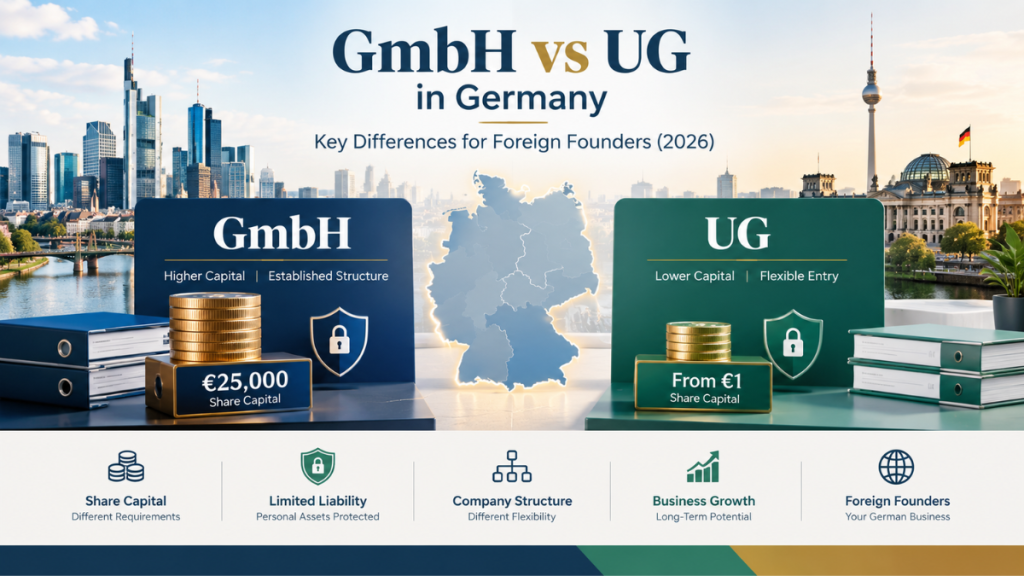
If you are comparing a GmbH vs UG in Germany, the main difference is the required share capital and the rules that apply to each company structure. A GmbH has a statutory share capital of €25,000, while a UG (haftungsbeschränkt) can be established below that threshold, including with €1 in share capital. Both provide limited liability, but they differ in capital requirements, profit retention, formation rules, costs, and how they may fit different business situations.
GmbH vs UG at a Glance:
| Feature | GmbH | UG (haftungsbeschränkt) |
|---|---|---|
| Minimum share capital | €25,000 | From €1 |
| Liability | Limited | Limited |
| Capital requirement | Higher | Lower |
| Profit retention | No special UG reserve rule | 25% of annual surplus under the statutory conditions |
| Foreign ownership | Possible | Possible |
| Shareholders | One or more | One or more |
| Suitable for | Businesses with higher starting capital | Businesses starting with lower capital |
| Legal status | German limited liability company | Special form of GmbH with lower capital |
| Can capital be increased? | Yes | Yes |
| Can UG rules end? | Not applicable | Yes, when share capital is raised to at least €25,000 |
The choice between a GmbH and a UG depends on the company’s available capital, expected business needs, financing requirements, and long-term structure.
What Is a GmbH in Germany?
A GmbH (Gesellschaft mit beschränkter Haftung) is one of Germany’s main limited liability company structures. Its statutory minimum share capital is €25,000.
The GmbH can have one or more shareholders, and shareholders’ liability is generally limited to the company’s assets, subject to the applicable legal rules.
For businesses that have sufficient starting capital, the GmbH provides a conventional corporate structure for operating in Germany.
If you want to understand the practical process of establishing this type of company, see our guide to GmbH company formation in Germany.
What Is a UG in Germany?
A UG (haftungsbeschränkt) is a German limited liability company structure that can be established with share capital below the €25,000 threshold required for a GmbH.
The statutory minimum share capital can be as low as €1. However, the available capital should be sufficient for the company’s expected initial expenses and business activities.
Unlike a GmbH, a UG is subject to a statutory reserve requirement. Under the relevant rules, part of the annual surplus must be transferred to a reserve until the company reaches the conditions for ending the special UG provisions.
Businesses considering a low-capital company structure can also review our guide to UG company formation in Germany.
What Does UG Mean in Germany?
UG stands for Unternehmergesellschaft (haftungsbeschränkt).
The term is commonly translated as an entrepreneurial company with limited liability. Legally, the UG is governed by the German Limited Liability Companies Act and operates as a limited liability company with special rules for companies whose share capital is below the €25,000 GmbH threshold.
The term “UG” therefore describes a specific German company structure rather than simply meaning a small or informal business.
GmbH vs UG Startup Capital:
Startup capital is one of the clearest differences between a GmbH and a UG.
A GmbH requires statutory share capital of €25,000. For a cash formation, at least half of the minimum share capital, generally €12,500, must be paid in before registration.
A UG can be established with share capital below €25,000, including €1. However, choosing the minimum possible capital does not necessarily mean that €1 is sufficient to operate a business.
The company may need money for:
- Notary and registration expenses
- Business banking
- Accounting
- Insurance
- Office or operating costs
- Software and technology
- Marketing
- Initial inventory
- Professional services
- Other startup expenses
Therefore, the legal minimum and the practical amount of startup capital are two different questions.
GmbH vs UG Liability:
Both the GmbH and UG are limited liability company structures.
This generally means that the company is responsible for its own obligations with its company assets, while shareholders are not normally personally liable simply because they own shares in the company.
However, limited liability is not an absolute protection in every situation. Personal liability can arise in circumstances covered by German law, such as certain breaches of directors’ duties or other legally defined situations.
The lower capital of a UG does not remove its limited-liability status. The key difference is that a UG begins with less share capital than a GmbH.
GmbH vs UG Annual Costs:
The annual operating costs of a GmbH and UG depend on the company’s activities, revenue, number of transactions, employees, accounting requirements, tax matters, and other factors.
Typical ongoing expenses may include:
- Accounting and bookkeeping
- Annual financial statements
- Tax filings
- Business banking
- Insurance
- Registered office or office costs
- Payroll administration
- Professional advice
A UG does not automatically have negligible annual costs simply because its minimum share capital can be low.
For a broader breakdown of formation and ongoing company expenses, see our Germany company formation cost breakdown.
GmbH vs UG Taxes:
GmbH and UG companies are generally subject to the German corporate tax framework applicable to limited liability companies.
Depending on the company’s circumstances, relevant taxes can include:
- Corporate income tax
- Solidarity surcharge
- Trade tax
- Value-added tax (VAT), where applicable
The main structural difference between GmbH and UG taxation is not that one is automatically a different tax category. Instead, the UG has an additional statutory reserve requirement that affects how part of its annual surplus is handled.
Actual tax liabilities depend on the company’s taxable income, location, activities, deductions, and other circumstances.
UG Profit Retention Requirement:
One important difference between a UG and a GmbH is the statutory reserve requirement.
Under the German Limited Liability Companies Act, a UG must generally place 25% of its annual surplus, after accounting for the relevant loss carryforward, into a statutory reserve.
The reserve is accumulated under the statutory conditions until the company can increase its share capital to at least €25,000.
This means UG shareholders may have less flexibility over distributing the full annual surplus compared with a company that is not subject to the special UG reserve rule.
Can Foreigners Own a GmbH or UG in Germany?
Foreign founders can establish and own German companies, subject to the applicable legal, registration, identification, tax, banking, and other requirements.
Foreign ownership is therefore not itself a reason that a founder must choose a UG instead of a GmbH.
The practical requirements can depend on the founder’s country of residence, documentation, company structure, business activity, and banking arrangements.
Foreign founders should also distinguish between owning a German company and having the right to personally live and work in Germany. These are separate issues.
If you are preparing a German company as a foreign founder, our guide to starting a business in Germany as a foreign company provides additional information.
GmbH vs UG for Startups:
Both structures can be used for startups.
A UG may be considered when founders want to establish a limited liability company while starting with less share capital than the €25,000 required for a GmbH.
A GmbH may be considered when founders already have sufficient capital and want to begin with the standard €25,000 share capital structure.
The appropriate structure depends on factors such as:
- Available startup capital
- Expected operating expenses
- Business model
- Financing plans
- Number of shareholders
- Expected revenue
- Long-term capital requirements
There is no universal structure that fits every startup.
GmbH vs UG for B2B Businesses:
Both GmbH and UG companies can operate in B2B markets.
However, companies should consider the commercial requirements of their particular industry and business partners.
Some suppliers, lenders, investors, or large corporate customers may have their own onboarding, financial, compliance, or documentation requirements.
Therefore, founders should not assume that choosing a UG will automatically create a problem with business partners or that a GmbH will automatically satisfy every commercial requirement.
The relevant question is whether the chosen structure provides the capital and legal framework required for the specific business.
UG to GmbH: Can a UG Become a GmbH?
A UG can increase its share capital to at least €25,000 and cease to be subject to the special UG provisions.
This can happen through retained reserves and/or additional capital contributions, subject to the applicable legal and registration requirements.
However, a UG does not automatically become a GmbH simply because its reserves reach €25,000.
The company may need to formally increase its share capital and complete the relevant corporate and registration steps.
The exact process depends on the company’s circumstances.
GmbH vs UG Formation Process:
The basic formation process for both structures involves several common steps.
These can include:
- Choosing the company structure
- Selecting the company name
- Preparing the articles of association
- Identifying shareholders
- Appointing the managing director
- Determining the share capital
- Notarizing the formation documents
- Opening a business bank account where required
- Paying the required share capital
- Registering the company with the commercial register
- Completing tax registration and other required registrations
The documentation required can vary depending on the founders, shareholders, managing directors, and company structure.
For an overview of the required documentation, see documents required for company formation in Germany.
GmbH vs UG: Key Differences:
| Factor | GmbH | UG |
|---|---|---|
| Minimum share capital | €25,000 | Below €25,000, including €1 |
| Liability | Limited | Limited |
| Special reserve rule | No UG-specific reserve rule | 25% annual surplus under statutory conditions |
| Starting capital | Higher | Lower |
| Capital flexibility | Higher initial requirement | Lower initial requirement |
| Foreign ownership | Possible | Possible |
| Company structure | Standard GmbH | GmbH structure with special UG rules |
| Capital increase | Possible | Possible |
| End of UG special rules | Not applicable | Possible after capital reaches at least €25,000 |
GmbH vs UG: What Should You Consider?
When comparing GmbH vs UG, consider these questions:
1. How much capital is available?
If you have €25,000 available for the company’s share capital, a GmbH is an available structure. If you want to establish the company below that amount, a UG may be an option.
2. How much money will the business need?
A company should have enough financial resources to cover its expected expenses. Legal minimum capital does not necessarily equal practical startup funding.
3. Will profits need to be distributed?
UG companies are subject to a statutory reserve requirement, which affects the amount of surplus that can be freely distributed.
4. Will the company need additional capital later?
If the business expects to require more capital as it grows, founders should consider how the company will be financed in the future.
5. Who will own the company?
Both structures can have one or more shareholders, including foreign shareholders, subject to the applicable legal requirements.
Common Mistakes When Comparing GmbH vs UG
Foreign founders should avoid several common assumptions.
Assuming €1 Is Always Enough for a UG
The legal minimum can be €1, but the business still needs sufficient funds to operate.
Assuming a UG Has No Ongoing Costs
A UG still has accounting, tax, banking, administration, and other operating expenses.
Assuming a UG Automatically Becomes a GmbH
A capital increase and the required corporate steps may be necessary before the special UG provisions cease to apply.
Assuming GmbH and UG Have Completely Different Tax Systems
Both are German limited liability company structures subject to the applicable German tax framework.
Choosing a Structure Only Because of the Minimum Capital
The minimum capital requirement is important, but founders should also consider operating needs, financing, profit distribution, ownership, and long-term capital requirements.
Is a UG the same as a GmbH?
A UG is a limited liability company structure governed by the German Limited Liability Companies Act, but it has special rules that apply when the share capital is below the €25,000 GmbH threshold.
Can a UG be started with €1?
Yes. German law allows a UG to be established with share capital as low as €1. However, the business should have sufficient funds to cover its expected startup and operating expenses.
Does a GmbH require €25,000?
Yes. The statutory minimum share capital of a GmbH is €25,000. For a cash formation, at least €12,500 generally needs to be paid in before registration.
Does a UG have limited liability?
Yes. A UG is a limited liability company structure. As with a GmbH, limited liability is subject to the applicable legal rules and exceptions.
Does a UG have to save part of its profit?
Yes. Under the statutory conditions, a UG must generally allocate 25% of its annual surplus, after accounting for the relevant loss carryforward, to a statutory reserve.
Can foreigners own a GmbH or UG in Germany?
Yes. Foreign founders can own German companies, subject to applicable legal, registration, identification, tax, and other requirements.
Is a GmbH more expensive than a UG?
The initial share capital requirement is higher for a GmbH. However, total formation and operating costs depend on the company’s circumstances and should not be determined solely by the minimum share capital.
Can a UG become a GmbH?
A UG can increase its share capital to at least €25,000 and cease to be subject to the special UG provisions, subject to the required corporate and registration steps.
Which is better: GmbH or UG?
Neither structure is universally better. The appropriate choice depends on the founder’s available capital, expected business expenses, financing needs, profit-distribution plans, ownership structure, and long-term business requirements.
The GmbH vs UG comparison mainly comes down to capital requirements and the different legal rules attached to each structure.
A GmbH has a statutory minimum share capital of €25,000, while a UG can be established below that threshold, including with €1. Both provide limited liability, but a UG has additional statutory rules concerning capital and profit retention.
For foreign founders, the decision should therefore be based on the actual needs of the business rather than the minimum capital requirement alone. Consider available capital, operating expenses, financing plans, profit distribution, ownership, and long-term capital requirements before choosing between a GmbH and a UG.