
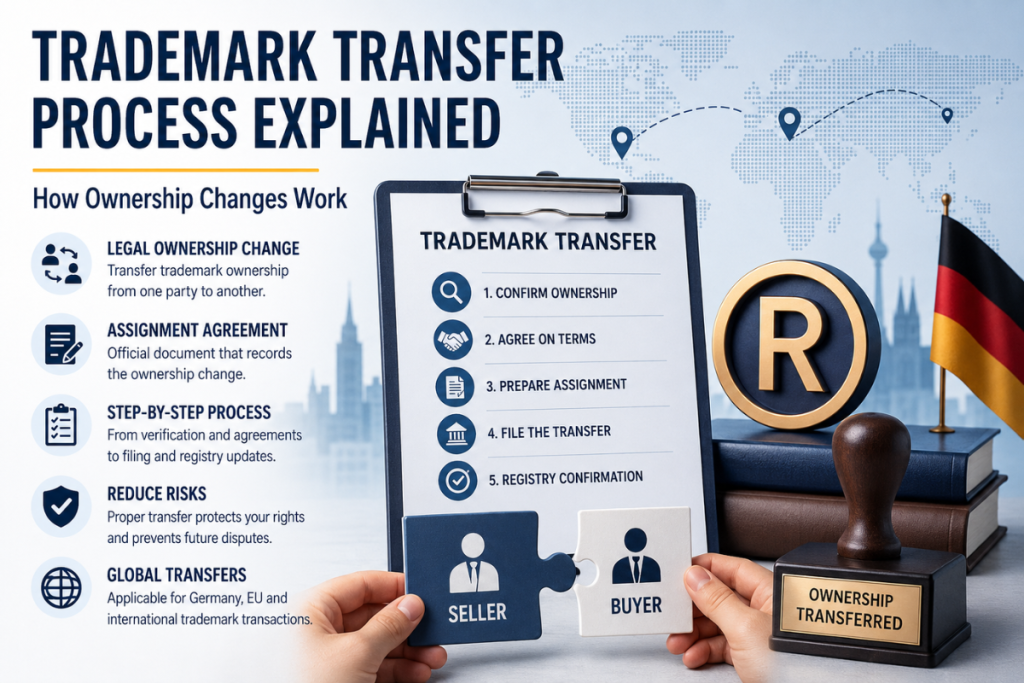
Buying or selling a trademark is only part of the process.
What many business owners do not realize is this:
A trademark transaction is not complete until ownership officially changes.
This is called the trademark transfer process.
Whether you are selling a registered trademark, buying an existing brand, or expanding into Germany and Europe, understanding how trademark ownership changes work helps reduce legal confusion and avoid costly mistakes.
In this guide, you will learn how trademark transfer works, what a trademark assignment means, the steps involved, common risks, and how businesses can transfer ownership more securely.
What Is a Trademark Transfer?
A trademark transfer is the legal process of changing ownership from one person or business to another.
In most cases, trademark transfer happens after:
- A trademark sale
- A business acquisition
- A merger
- A trademark assignment agreement
- Internal company restructuring
Once completed, the new owner becomes responsible for the trademark.
This typically includes:
- Ownership rights
- Commercial usage rights
- Brand control
- Legal protection
In many jurisdictions, ownership only officially changes after the transfer process is properly documented and filed.
What Is a Trademark Assignment?
A trademark assignment is the legal agreement used to transfer ownership.
Think of it as the official document that records the ownership change.
Trademark assignment agreements often include:
- Seller information
- Buyer information
- Trademark registration details
- Transfer terms
- Ownership rights included
- Geographic coverage
Without proper assignment documentation, ownership disputes may arise later.
This is why legal clarity matters.
Why Trademark Transfer Matters
Trademark ownership transfer is important because simply agreeing to a sale does not automatically change ownership.
Many buyers assume payment equals ownership.
In reality, trademark transfer often requires additional administrative steps.
A proper process helps:
- Protect buyer rights
- Protect seller rights
- Reduce legal disputes
- Clarify ownership records
- Support future trademark enforcement
This becomes especially important for:
- German trademarks
- EU trademarks
- International trademark transactions
- Cross-border acquisitions
Step-by-Step Trademark Transfer Process
Trademark ownership changes are easier to understand when broken into steps.
Step 1: Confirm Trademark Ownership
Before any transfer begins, ownership should be verified.
Questions to review include:
- Who owns the trademark?
- Is registration active?
- Are renewals up to date?
- Are there disputes?
This reduces legal risk later.
Step 2: Agree on Transfer Terms
Buyer and seller usually negotiate key commercial terms.
This may include:
- Purchase price
- Trademark scope
- Geographic rights
- Brand-related assets
Clear agreements help prevent misunderstandings.
Step 3: Prepare Trademark Assignment Documentation
A trademark assignment agreement is typically prepared.
This document often defines:
- Ownership transfer details
- Rights included
- Responsibilities
- Effective dates
Documentation quality matters because incomplete agreements can delay transfers.
Step 4: File the Trademark Transfer
After agreements are completed, the transfer process often moves to filing or administrative coordination.
Depending on jurisdiction, this may involve:
- Registry filing
- Ownership verification
- Transfer review
- Administrative updates
For Germany and Europe, transfer procedures may vary depending on trademark registration type.
Step 5: Registry Updates and Confirmation
Once approved, ownership records are updated.
The new owner becomes officially connected to the trademark.
At this stage, the buyer typically gains legal control.
How Long Does Trademark Transfer Take?
Timelines vary.
Several factors influence transfer speed.
These may include:
- Country requirements
- Documentation quality
- Registry workload
- Trademark complexity
- Cross-border coordination
For example:
A Germany trademark transfer may follow different timelines compared to an EU trademark transfer.
Because of this, realistic expectations matter.
Trademark Transfer in Germany
Germany remains one of Europe’s strongest business markets.
Many businesses entering Germany seek registered trademarks instead of waiting for registration timelines.
This includes companies from:
- India
- China
- Austria
- Switzerland
- International e-commerce sectors
In these situations, ownership transfer becomes an important step after purchase.
Proper trademark transfer helps businesses move toward market entry faster.
Common Mistakes During Trademark Transfer:
Many transfer problems are avoidable.
Here are common mistakes business owners make.
Mistake #1: Assuming Payment Equals Ownership
A transaction is not complete until ownership transfer is documented.
Mistake #2: Ignoring Trademark Classes
Buyers should confirm relevant business categories are included.
Mistake #3: Skipping Due Diligence
Ownership history and legal standing matter.
Mistake #4: Using Incomplete Documentation
Poor agreements may create disputes later.
Mistake #5: Ignoring International Requirements
Cross-border transactions often require extra coordination.
Can Foreign Companies Receive German Trademark Ownership?
Yes.
Foreign businesses can often receive ownership of German trademarks.
This is especially relevant for:
- Indian companies entering Germany
- Chinese businesses targeting Europe
- Amazon Germany sellers
- International expansion brands
After purchase, ownership may transfer through documented procedures.
This makes trademark acquisition a useful option for faster market entry.
What is the trademark transfer process?
Trademark transfer is the legal process of changing trademark ownership from one party to another.
What is a trademark assignment?
A trademark assignment is the legal agreement used to transfer trademark ownership.
Does payment automatically transfer ownership?
No. Ownership usually changes after proper transfer documentation and filing.
How long does trademark transfer take?
Timelines vary depending on jurisdiction and documentation.
Can foreign companies own German trademarks?
Yes. International businesses can often acquire German trademarks.
A trademark sale or purchase is only one part of the journey.
Ownership transfer is what makes the transaction official.
Understanding the trademark transfer process helps business owners reduce risk, improve clarity, and avoid costly mistakes.
Whether you are buying, selling, or transferring a trademark in Germany or internationally, having a structured transfer process matters.
Need help with trademark transfer or ownership changes?
Book a Consultation to explore trademark transfer support, valuation, and buyer or seller opportunities.