
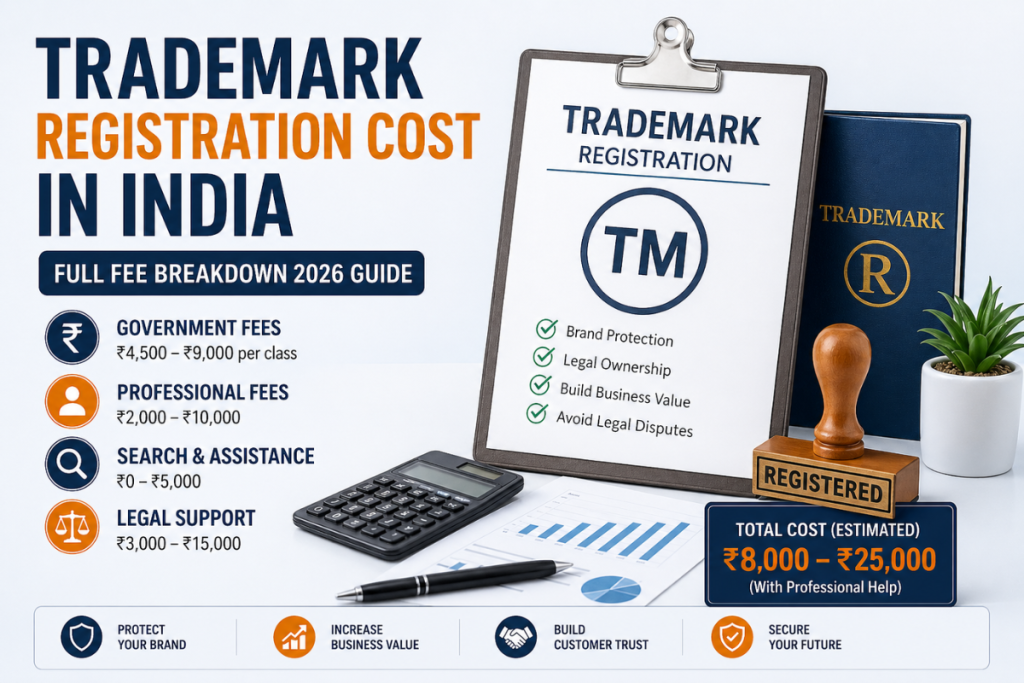
How much does trademark registration cost in India? For an e-filed trademark application, the official government fee is ₹4,500 per class per mark for individuals, startups and small enterprises, and ₹9,000 per class per mark for other applicants. Physical filing fees are ₹5,000 and ₹10,000 respectively.
These are government filing fees only. Professional assistance, trademark searches, responses to objections, opposition proceedings and other services can create additional costs.
This guide explains the trademark registration cost in India in 2026, including government fees, per-class charges, professional costs, renewal fees and possible additional expenses.
Trademark Registration Cost in India at a Glance:
The official government fee for a standard e-filed trademark application is:
| Applicant type | E-filing government fee | Physical filing fee |
|---|---|---|
| Individual | ₹4,500 per class | ₹5,000 per class |
| Startup | ₹4,500 per class | ₹5,000 per class |
| Small Enterprise | ₹4,500 per class | ₹5,000 per class |
| Other applicants | ₹9,000 per class | ₹10,000 per class |
The official fee is charged for each class and for each mark.
If an eligible startup files one trademark in two classes through e-filing, for example, the government filing fee would generally be ₹9,000.
What Is Trademark Registration in India?
Trademark registration gives legal protection to a mark used to distinguish one person’s or entity’s goods or services from those of others.
A trademark can cover elements such as a brand name, logo or other distinctive mark, depending on the application and applicable legal requirements.
Trademark applications in India are filed with the Trade Marks Registry under the Trade Marks Act, 1999. Applications are generally filed using Form TM-A.
If you want to understand the broader process and requirements, see our guide to trademark registration in India.
Registration does not mean that every possible use of a similar name is automatically prohibited. The scope of protection depends on the registered mark, the relevant goods or services and the applicable legal rules.
Why Does Trademark Registration Cost Vary?
Trademark registration cost is not the same for every applicant because several factors affect the total amount.
The main factors include:
- Applicant category
- Number of trademark classes
- Number of marks being filed
- Government filing method
- Whether a professional is hired
- Whether a trademark search is performed
- Whether the application receives an objection
- Whether a third party files an opposition
- Whether additional procedural requests are required
The most important point is that government fees are generally calculated per class and per mark.
What Is a Trademark Class?
India uses the Nice Classification system to classify goods and services.
- Classes 1–34: Goods
- Classes 35–45: Services
The correct class is important because trademark protection is connected to the goods or services specified in the application.
A business may therefore need more than one class depending on what it sells or provides.
For example, a company offering software services may need a different class strategy from a company selling physical consumer products.
This is why searches such as “trademark fees per class” and “trademark class list India” are important when estimating the total filing budget.
Government Fees for Trademark Registration in India
The government filing fee is the most predictable part of the registration cost.
For e-filing:
Individual, Startup or Small Enterprise:
₹4,500 per class per mark
Other Applicants:
₹9,000 per class per mark
These are the standard government e-filing rates for a trademark application.
Physical filing costs more:
- ₹5,000 for Individual / Startup / Small Enterprise applicants
- ₹10,000 for other applicants
The applicant must meet the relevant eligibility requirements for the reduced Individual/Startup/Small Enterprise fee category.
Trademark Registration Fees for Individuals:
If you are filing as an eligible individual, the official e-filing government fee is ₹4,500 per class per mark.
For one mark:
| Number of classes | Government e-filing fee |
|---|---|
| 1 class | ₹4,500 |
| 2 classes | ₹9,000 |
| 3 classes | ₹13,500 |
| 4 classes | ₹18,000 |
These amounts represent the government filing fee only.
Professional fees, if applicable, are separate.
Trademark Registration Fees for Startups and Small Enterprises:
Eligible startups and small enterprises can also use the reduced government fee category.
For e-filing, the official fee is ₹4,500 per class per mark.
Applicants should have the appropriate supporting documentation where required to claim startup or small-enterprise status.
If your business qualifies for one of these categories, confirming eligibility before filing can help you avoid paying the wrong fee.
Trademark Fees for Companies:
For applicants that do not qualify for the Individual, Startup or Small Enterprise category, the e-filing government fee is ₹9,000 per class per mark.
For example:
- 1 class = ₹9,000
- 2 classes = ₹18,000
- 3 classes = ₹27,000
These figures represent government filing fees and do not include professional service charges.
Trademark Filing Fees vs Total Registration Cost:
It is important to distinguish between the government filing fee and the total cost of registering a trademark.
The government fee is only one component.
Your total budget may include:
- Government filing fee
- Professional service fee
- Trademark search cost
- Response to examination objections, if required
- Opposition-related costs, if applicable
- Amendment or other procedural fees
- Renewal costs in the future
There is no single official price for professional assistance because professional charges depend on the provider and the work involved.
When comparing quotes, check exactly what is included.
Does Trademark Search Cost Money?
A trademark search can be performed before filing to identify potentially conflicting marks.
The cost depends on how the search is performed.
A basic search of publicly available trademark information may not require a separate professional search fee. However, a professional may charge for a structured search and analysis.
If you want professional assistance with checking an existing mark, you can learn more about our trademark search service.
A search does not guarantee that an application will be accepted, but it can help identify potential conflicts before filing.
Professional Trademark Registration Fees:
If you use a trademark professional, attorney or service provider, their fee is separate from the government filing fee.
Professional fees may cover different services, such as:
- Trademark availability search
- Class selection assistance
- Application preparation
- Filing
- Monitoring
- Examination objection response
- Opposition assistance
- Registration follow-up
Because providers offer different levels of service, there is no single standard professional fee that applies to every application.
When comparing professional quotes, check whether the quoted amount includes the government fee or whether it is charged separately.
Additional Costs You May Encounter:
A straightforward application may involve little more than the filing fee and professional assistance.
However, additional costs can arise if the application requires further action.
1. Examination Objection
If the Trade Marks Registry raises an objection, you may need to prepare and submit a response.
The professional cost depends on the complexity of the objection and the service provider.
2. Opposition
A third party may oppose an application.
Opposition proceedings can involve additional government and professional costs depending on the circumstances.
3. Amendments and Other Requests
Certain changes or procedural requests may also have separate government fees.
The applicable amount depends on the type of request and the relevant form.
This is why a basic filing estimate should not be presented as the guaranteed total cost of every trademark application.
Trademark Renewal Fees in India:
A registered trademark is valid for 10 years and can be renewed for additional 10-year periods.
The standard government e-filing renewal fee is ₹9,000 per class.
If renewal is filed late, additional surcharge or restoration-related fees may apply depending on the circumstances.
Therefore, the normal renewal fee should not be confused with the total amount that may become payable after a missed renewal deadline.
How Much Would One Trademark Cost?
Suppose an eligible individual wants to file one trademark in one class using e-filing.
The government filing fee would be:
₹4,500
If the applicant also hires a professional, the total amount paid to the professional plus the government fee will depend on the provider’s pricing.
If the same applicant needs two classes, the government filing fee becomes:
₹9,000
If three classes are required:
₹13,500
The calculation is therefore straightforward:
Government filing fee × number of classes
The exact applicant category and applicable government fee should always be confirmed before filing.
How to Reduce Trademark Registration Cost
You can control some parts of your trademark budget by planning the application carefully.
1. Choose the Correct Classes
Do not automatically select every class.
Choose classes that genuinely relate to the goods or services for which protection is required.
2. Search Before Filing
A search can help identify potential conflicts before you spend money on an application.
It cannot guarantee registration, but it can help you identify obvious conflicts and make a more informed filing decision.
3. Use E-Filing
For the standard trademark application, e-filing has a lower official fee than physical filing.
4. Avoid Unnecessary Applications
If the same mark is being considered for several classes, assess which classes are actually relevant to the business rather than filing indiscriminately.
5. Understand Professional Fees
If you hire a professional, ask whether the quoted amount includes:
- Government fee
- Search
- Filing
- Monitoring
- Objection response
- Other procedural work
This makes it easier to compare different service packages.
Common Mistakes That Can Increase Trademark Costs
Several mistakes can create additional work and expense.
Filing in the Wrong Class
Incorrect classification can reduce the usefulness of the registration and may require additional applications.
Skipping a Trademark Search
A search does not guarantee registration, but identifying potential conflicts before filing can help you make a more informed decision.
Assuming One Fee Covers Everything
The government filing fee is not the same as professional fees or costs arising from objections and oppositions.
Missing Renewal Deadlines
A trademark needs to be renewed to maintain registration. Additional fees can apply when renewal is delayed.
Assuming Registration Guarantees Acceptance
An application must satisfy the requirements of the Trade Marks Act and Rules. The Registry can raise objections or refuse applications on applicable grounds.
Is Registering a Logo More Expensive?
The government fee is generally determined by the applicant category, number of classes and number of marks, rather than simply by whether the mark is a word or logo.
Therefore, a logo application does not automatically have a separate higher government fee just because it is a logo.
For an eligible applicant using e-filing, the standard fee remains ₹4,500 per class per mark. For other applicants, it is ₹9,000 per class per mark.
The professional cost may differ depending on the work required.
Trademark Registration Cost vs Buying a Registered Trademark
Registering a new trademark and acquiring an existing registered trademark are different processes.
With a new application, you pay the applicable government filing fee and wait for the application to proceed through the examination and registration process.
Buying an existing trademark involves acquiring rights from an existing proprietor and completing the applicable transfer or assignment procedure.
If you are researching this alternative, you can learn more about how to buy a registered trademark.
Buying an existing trademark should not simply be described as a zero-wait or “instant” alternative. The transaction still requires proper due diligence, documentation and registration of the transfer.
Who Should Consider Trademark Registration?
Trademark registration may be relevant for:
- Startups
- Individual business owners
- Small businesses
- E-commerce brands
- Amazon sellers
- Manufacturers
- Service businesses
- Technology companies
- International businesses operating in India
Foreign applicants can also apply for trademark registration in India, subject to the applicable requirements.
Trademark Registration Cost in India: Quick Summary
| Cost item | Government fee |
|---|---|
| Individual / Startup / Small Enterprise e-filing | ₹4,500 per class per mark |
| Other applicants e-filing | ₹9,000 per class per mark |
| Individual / Startup / Small Enterprise physical filing | ₹5,000 per class per mark |
| Other applicants physical filing | ₹10,000 per class per mark |
| Normal e-filing renewal | ₹9,000 per class |
| Opposition notice e-filing | Additional fee applies |
These figures represent government fees. Professional fees and case-specific costs are separate.
How much does trademark registration cost in India?
For e-filing, the official government fee is ₹4,500 per class per mark for individuals, startups and small enterprises, and ₹9,000 per class per mark for other applicants.
What are the government fees for trademark registration in India?
The current e-filing government fee is ₹4,500 per class per mark for eligible individuals, startups and small enterprises, and ₹9,000 for other applicants.
How much are trademark registration fees for a company?
For applicants in the “other applicants” category, the e-filing government fee is ₹9,000 per class per mark.
How much are trademark fees for an individual?
An eligible individual pays ₹4,500 per class per mark for e-filing.
Is trademark registration charged per class?
Yes. The official application fee is charged for each class and each mark.
How much does trademark renewal cost in India?
The standard government e-filing renewal fee is ₹9,000 per class. Additional fees can apply in cases involving delayed renewal or restoration.
How long is a trademark registration valid in India?
A registered trademark is valid for 10 years and can be renewed for further 10-year periods.
Does registering a logo cost more than registering a name?
The standard government fee is based primarily on applicant category, number of classes and number of marks. A logo does not automatically carry a separate higher government filing fee.
Can foreign businesses register trademarks in India?
Yes. Foreign businesses can apply for trademark registration in India, subject to the applicable requirements and procedures.
The trademark registration cost in India depends mainly on the applicant category, number of classes and number of marks.
For standard e-filing, the government fee is currently:
- ₹4,500 per class per mark for eligible individuals, startups and small enterprises
- ₹9,000 per class per mark for other applicants
Professional assistance and additional proceedings can increase the overall cost. Renewal is also a future expense, with the standard e-filing renewal fee at ₹9,000 per class.
Before filing, check the applicable government fee, select the correct classes and consider whether a trademark search or professional assistance is appropriate for your situation.
Need Help With Trademark Registration in India?
If you need help checking a trademark, understanding the filing process or evaluating an existing registered trademark, Trademark Buy Sale can provide guidance based on your requirements.
Explore our trademark registration and India trademark resources or contact the team to discuss your requirements.