
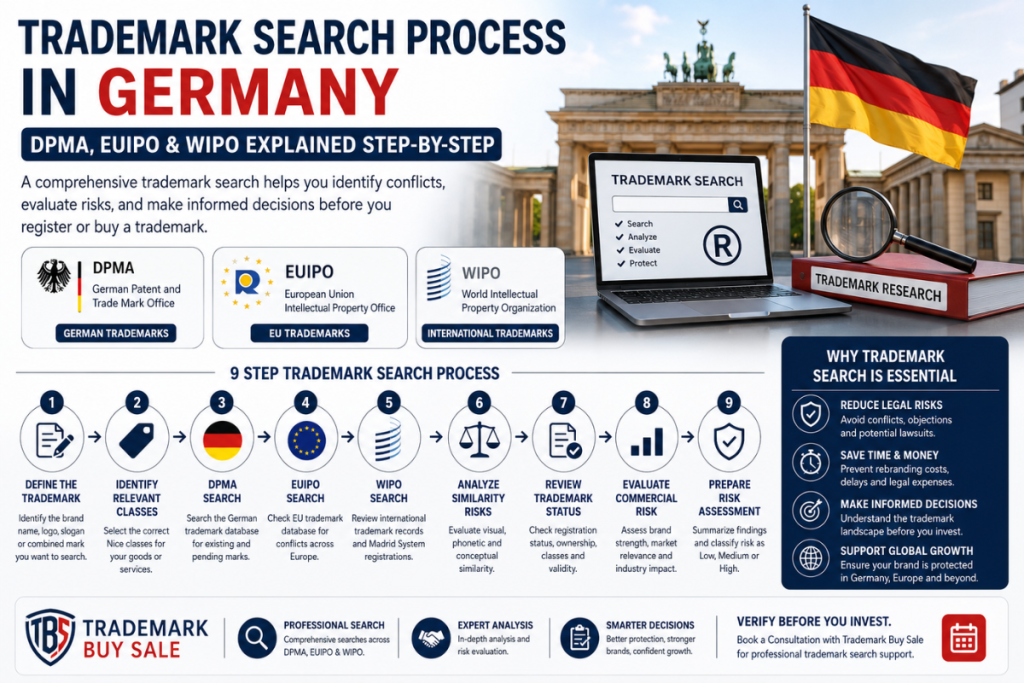
The trademark search process in Germany involves checking trademark databases maintained by the German Patent and Trade Mark Office (DPMA), the European Union Intellectual Property Office (EUIPO), and the World Intellectual Property Organization (WIPO). A comprehensive trademark search helps businesses identify conflicts, evaluate risks, and make informed decisions before registering or purchasing a trademark.
Why Trademark Search Matters Before Registration or Acquisition
Whether you are launching a new brand, buying an existing trademark, or expanding into Germany, conducting a trademark search is one of the most important steps in the process.
Many businesses invest heavily in branding, marketing, packaging, and website development before verifying whether their chosen trademark is legally available.
This can result in:
- Trademark disputes
- Registration refusals
- Rebranding costs
- Market-entry delays
- Lost marketing investments
- Legal expenses
A professional trademark search helps identify potential issues before they become expensive problems.
What Is a Trademark Search?
A trademark search is the process of reviewing trademark databases to determine whether a proposed trademark conflicts with existing registered or pending trademarks.
The objective is to identify:
- Identical trademarks
- Similar trademarks
- Class conflicts
- Industry overlap
- Potential infringement risks
A proper trademark search provides businesses with a clearer understanding of the legal landscape before proceeding with registration or acquisition.
Understanding the Three Main Trademark Databases
When searching trademarks in Germany and Europe, three major databases should be considered.
DPMA (German Patent and Trade Mark Office)
DPMA manages trademark registrations within Germany.
A DPMA search helps identify:
- Registered German trademarks
- Pending German applications
- Trademark owners
- Registration details
- Trademark classes
If your business plans to operate in Germany, a DPMA search is essential.
EUIPO (European Union Intellectual Property Office)
EUIPO manages European Union trademarks.
A single EU trademark can provide protection across EU member states.
Searching EUIPO helps identify:
- Existing EU trademarks
- Pending applications
- Similar trademarks across Europe
- Cross-border conflicts
Businesses entering multiple European countries should always include EUIPO in their trademark search process.
WIPO (World Intellectual Property Organization)
WIPO administers international trademark systems.
A WIPO search helps identify:
- International trademark registrations
- Madrid System filings
- Global trademark rights
- International expansion risks
For businesses planning international growth, WIPO searches provide valuable additional protection.
Step 1: Define the Trademark You Want to Search
Before accessing trademark databases, clearly identify the trademark you want to evaluate.
This may include:
- Brand name
- Product name
- Company name
- Logo
- Slogan
- Combined trademark
The more precise your search criteria, the more accurate the results.
Step 2: Identify Relevant Trademark Classes
Trademark rights are generally organized using the Nice Classification system.
Different classes cover different categories of goods and services.
Examples:
- Class 9 – Software and technology
- Class 25 – Clothing
- Class 35 – Business and marketing services
- Class 42 – Technology services
Searching the correct classes is critical because conflicts often arise within related industries.
Step 3: Conduct a DPMA Trademark Search
The next step is reviewing the German trademark database.
During a DPMA search, evaluate:
- Exact matches
- Similar names
- Registration status
- Trademark owner information
- Relevant classes
Many businesses mistakenly focus only on identical trademarks.
However, similar trademarks often create the greatest legal risk.
Step 4: Search the EUIPO Database
After reviewing Germany-specific registrations, the next step is examining EU trademark records.
This stage helps identify:
- EU-wide trademark rights
- Similar trademarks operating across Europe
- Potential opposition risks
Because EU trademarks provide broad geographic protection, this step is essential for companies planning European expansion.
Step 5: Search International Records Through WIPO
A WIPO search adds another layer of protection.
This review helps identify:
- International trademark registrations
- Cross-border risks
- Global branding conflicts
- Expansion limitations
Although not every business requires international protection immediately, understanding potential future conflicts is valuable.
Step 6: Analyze Similarity Risks
A trademark search is not simply a database lookup.
Professional trademark analysis evaluates three primary areas:
Visual Similarity
How similar trademarks appear when viewed.
Examples include:
- Similar logos
- Similar design elements
- Similar word structures
Phonetic Similarity
How trademarks sound when spoken.
For example:
- “TechNova”
- “TekNova”
Even different spellings may create legal concerns.
Conceptual Similarity
Whether trademarks convey similar meanings or concepts.
Courts and trademark offices often consider conceptual similarity when assessing conflicts.
Step 7: Review Trademark Status
Not every trademark found during a search creates the same level of risk.
Review:
- Registered trademarks
- Pending applications
- Expired registrations
- Cancelled trademarks
- Opposed applications
Understanding trademark status helps determine actual legal exposure.
Step 8: Evaluate Commercial Risk
Legal availability is only part of the equation.
Businesses should also assess:
- Brand strength
- Market relevance
- Expansion opportunities
- Industry competitiveness
- Commercial attractiveness
A trademark may be legally available but commercially weak.
Likewise, a commercially attractive trademark may require additional due diligence before acquisition.
Step 9: Prepare a Risk Assessment
A professional trademark search should conclude with a risk evaluation.
Many advisors categorize results as:
Low Risk
No significant conflicts identified.
Medium Risk
Some similar trademarks exist and require further review.
High Risk
Substantial conflict potential or legal concerns identified.
This assessment helps businesses make informed decisions before investing resources.
Trademark Search Before Trademark Registration
Many businesses view trademark search as a preliminary step before filing a trademark application.
Benefits include:
- Reduced rejection risk
- Better application strategy
- Lower legal exposure
- Greater confidence during registration
A trademark search does not guarantee registration approval, but it significantly improves decision-making.
Trademark Search Before Buying a Trademark
Trademark searches are equally important when acquiring an existing trademark.
Before purchasing a trademark, buyers should evaluate:
- Ownership records
- Existing conflicts
- Registration status
- Transfer eligibility
- Commercial value
This process forms part of broader trademark due diligence.
Common Trademark Search Mistakes:
1. Searching Only Exact Matches
Many conflicts arise from similar rather than identical trademarks.
2. Ignoring EU Trademarks
Businesses often focus solely on Germany while overlooking broader EU rights.
3. Not Reviewing Trademark Classes
Class conflicts are among the most common trademark issues.
4. Skipping WIPO Searches
International rights can create unexpected complications.
5. Relying on Automated Tools Alone
Automated searches provide useful information but often miss strategic and legal nuances.
Benefits of Professional Trademark Search Services:
A professional trademark search provides:
- More comprehensive analysis
- Better risk assessment
- Stronger acquisition decisions
- Improved registration planning
- Reduced legal uncertainty
For businesses entering Germany or Europe, professional searches can help prevent costly mistakes.
How Trademark Buy Sale Supports Trademark Searches
Trademark Buy Sale helps businesses evaluate trademarks before registration, acquisition, and transfer.
Services include:
- Trademark Search Service
- Trademark Acquisition Support
- Trademark Transfer Guidance
- Trademark Marketplace Access
- Market Entry Advisory
The goal is to help businesses identify opportunities while reducing legal and commercial risks.
What is a trademark search?
A trademark search is a review of trademark databases to identify existing trademarks and potential conflicts.
Why is trademark search important?
It helps reduce legal risks before registration or acquisition.
What is DPMA?
DPMA is the German Patent and Trade Mark Office responsible for German trademark registrations.
What is EUIPO?
EUIPO is the European Union Intellectual Property Office responsible for EU trademarks.
What is WIPO?
WIPO is the World Intellectual Property Organization, which manages international trademark systems.
Should I search all three databases?
In many cases, yes. Searching DPMA, EUIPO, and WIPO provides broader protection.
Can a trademark search guarantee approval?
No. However, it helps identify risks before filing or purchasing.
How long does a trademark search take?
Simple searches may take a few hours, while detailed professional reviews can take several days.
Is trademark search necessary before buying a trademark?
Yes. It is an important part of trademark due diligence.
Can foreign companies search German trademarks?
Yes. Trademark databases are accessible to businesses worldwide.
A trademark search is one of the most important steps in protecting a brand before registration, acquisition, or expansion into Germany and Europe.
By reviewing DPMA, EUIPO, and WIPO databases, businesses gain valuable insight into potential conflicts, legal risks, and commercial opportunities.
Whether you are registering a new trademark, buying an existing one, or entering the European market, a structured trademark search can help you make more informed decisions and avoid costly mistakes.
Ready to Verify a Trademark Before You Invest?
Before registering or purchasing a trademark, make sure you understand the legal and commercial risks.
Book a Consultation with Trademark Buy Sale to receive professional trademark search support and build a stronger foundation for successful market entry in Germany and Europe.