
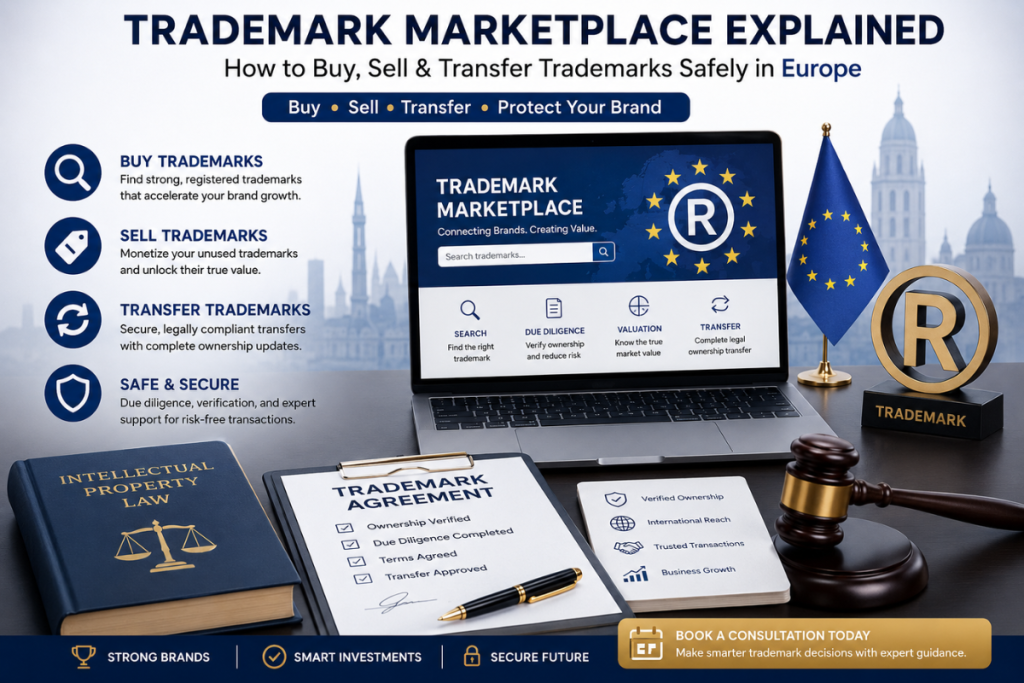
A trademark marketplace is a platform where businesses and trademark owners can buy, sell, and transfer registered trademarks. It helps connect buyers with available trademark assets while supporting due diligence, valuation, ownership verification, and secure trademark transfers. For companies entering Europe, buying an existing trademark can often be faster than creating and registering a new brand from scratch.
What Is a Trademark Marketplace?
A trademark marketplace is similar to a real estate marketplace—but instead of buying and selling property, businesses buy and sell trademark rights.
Registered trademarks are valuable business assets. They can be transferred, licensed, acquired, or sold to another party through a legally recognized process.
A trademark marketplace helps:
- Trademark owners sell unused trademarks
- Businesses find available trademarks
- Investors acquire brand assets
- International companies enter new markets faster
- Buyers and sellers connect more efficiently
As trademark acquisition becomes more common, marketplaces are playing an increasingly important role in modern brand strategy.
Why Businesses Buy Existing Trademarks
Many companies assume the only way to secure a brand is through trademark registration.
However, buying an existing trademark can provide several advantages.
Faster Market Entry
Registering a new trademark often takes months.
An existing trademark may already have legal protection, helping businesses accelerate their expansion plans.
Reduced Branding Delays
Finding an available trademark is becoming increasingly difficult in competitive industries.
Purchasing an existing trademark can eliminate the need to start from scratch.
Strategic Brand Acquisition
Some trademarks already possess market recognition, commercial value, or expansion potential.
Acquiring these assets can strengthen a company’s market position.
International Expansion Opportunities
Businesses entering Germany or Europe often use trademark acquisition to simplify their market-entry strategy.
Why Trademark Owners Sell Trademarks
Not every registered trademark is actively used.
Many trademark owners decide to sell because:
- The business changed direction
- A project was discontinued
- The trademark is no longer needed
- The owner wants to monetize intellectual property assets
- The trademark has investment value
Instead of allowing a trademark to remain dormant, owners may generate value through a sale.
Understanding Trademark Ownership Transfer
A trademark transfer occurs when ownership rights move from one party to another.
The process generally involves:
- Purchase agreement
- Ownership verification
- Transfer documentation
- Trademark assignment
- Registration updates
Once completed, the buyer becomes the legal owner of the trademark.
Trademark transfers are recognized across Germany, the European Union, and most international trademark systems.
How a Trademark Marketplace Works
A trademark marketplace typically follows a structured process.
Step 1: Trademark Listing
The trademark owner lists a trademark for sale.
Key information may include:
- Trademark name
- Registration status
- Classes
- Jurisdiction
- Asking price
- Industry relevance
Step 2: Buyer Review
Potential buyers evaluate:
- Trademark strength
- Industry fit
- Market potential
- Geographic coverage
Step 3: Trademark Search
A trademark search helps identify:
- Similar trademarks
- Legal risks
- Registration status
- Potential conflicts
This step is essential before any acquisition.
Step 4: Due Diligence
Buyers investigate:
- Ownership records
- Transfer eligibility
- Existing disputes
- Commercial value
Step 5: Negotiation
Buyer and seller negotiate terms.
Step 6: Transfer Completion
Ownership is legally transferred to the buyer.
Buy vs Register a Trademark: Which Is Better?
Businesses frequently compare buying a trademark with registering a new one.
| Factor | Buying a Trademark | Registering a Trademark |
| Speed | Faster | Slower |
| Existing Protection | Often yes | No |
| Availability Challenges | Lower | Higher |
| Initial Cost | Usually higher | Usually lower |
| Market Entry | Faster | Longer process |
| Due Diligence Required | High | Moderate |
The right option depends on business objectives, budget, and timelines.
Why Trademark Search Is Critical Before Buying
One of the biggest mistakes trademark buyers make is skipping the search process.
A registered trademark is not automatically a risk-free investment.
A professional trademark search can reveal:
- Similar trademarks
- Legal conflicts
- Class overlap
- Geographic restrictions
- Opposition history
This information helps buyers make informed decisions before purchasing.
Trademark Due Diligence: The Hidden Key to Safe Acquisitions
Trademark due diligence goes beyond a simple database search.
It evaluates:
- Trademark ownership
- Registration validity
- Transferability
- Litigation history
- Market relevance
- Commercial strength
For serious buyers, due diligence is one of the most important stages of the acquisition process.
Buying Trademarks in Germany and Europe
Germany is one of Europe’s most attractive markets for trademark acquisition.
Buyers often target:
- German trademarks
- EU trademarks
- Industry-specific trademarks
- Amazon-ready brands
- Expansion-focused trademarks
A well-chosen trademark can support faster growth across multiple European markets.
Can Foreign Companies Buy European Trademarks?
Yes.
European trademarks can generally be owned by businesses from:
- India
- China
- United States
- United Kingdom
- Middle East
- Australia
- Other international jurisdictions
This makes trademark acquisition an attractive strategy for businesses entering Europe.
Common Mistakes Buyers Make:
1. Buying Without a Trademark Search
Failure to identify conflicts can create future legal problems.
2. Ignoring Trademark Classes
Trademark rights are linked to specific goods and services.
3. Not Verifying Ownership
Ownership verification is essential before any transaction.
4. Focusing Only on Price
The cheapest trademark may not provide the strongest commercial value.
5. Skipping Due Diligence
Every acquisition should include a thorough review process.
Common Mistakes Sellers Make:
1. Overpricing the Trademark
Unrealistic pricing can discourage serious buyers.
2. Not Understanding Trademark Value
Trademark valuation is often overlooked.
3. Poor Documentation
Missing ownership records can delay transactions.
4. Weak Marketplace Presentation
Poor listings reduce buyer interest.
How Trademark Valuation Supports Better Transactions:
Trademark valuation helps determine a realistic market value.
Factors often include:
- Registration status
- Industry demand
- Geographic coverage
- Brand strength
- Commercial potential
- Revenue history (if applicable)
A valuation can help both buyers and sellers negotiate more effectively.
Benefits of Using a Specialized Trademark Marketplace:
A specialized trademark marketplace offers:
- Access to available trademarks
- Structured acquisition processes
- Greater transparency
- Reduced transaction risk
- Professional guidance
- International opportunities
Compared to private transactions, marketplaces often provide a more efficient experience.
Why Businesses Use Trademark Buy Sale
Trademark Buy Sale focuses on helping businesses buy, sell, value, and transfer trademarks safely.
Services include:
- Trademark Search Service
- Trademark Acquisition Support
- Trademark Transfer Guidance
- Trademark Valuation Support
- Trademark Marketplace Access
- International Market Entry Assistance
This integrated approach helps reduce uncertainty and support successful transactions.
What is a trademark marketplace?
A trademark marketplace is a platform where registered trademarks can be bought, sold, and transferred.
Is it legal to sell a trademark?
Yes. Trademarks are transferable intellectual property assets.
Can I buy a registered trademark in Europe?
Yes. European trademarks can generally be acquired through a legal transfer process.
Why should I conduct a trademark search before buying?
Trademark searches help identify conflicts and reduce legal risk.
What is trademark due diligence?
Trademark due diligence evaluates ownership, validity, and commercial risks before acquisition.
Can foreign companies own European trademarks?
Yes. International businesses can own trademarks in Europe.
How does trademark transfer work?
Ownership rights are legally assigned from one party to another through documented procedures.
Is buying a trademark faster than registering one?
In many situations, yes. Buying an existing trademark can accelerate market entry.
What affects trademark value?
Factors include legal protection, industry demand, geographic coverage, and commercial potential.
Can I sell an unused trademark?
Yes. Many businesses successfully monetize unused trademark assets through marketplace sales.
Trademark marketplaces are transforming the way businesses acquire and monetize intellectual property assets.
Whether you want to buy a trademark, sell an unused brand, or transfer ownership safely, a structured marketplace approach can simplify the process while reducing legal and commercial risks.
For businesses entering Germany and Europe, trademark acquisition can provide a strategic advantage by accelerating market entry and reducing branding challenges.
However, successful transactions require proper trademark searches, due diligence, valuation, and transfer planning.
By approaching trademark acquisitions strategically, businesses can make better investment decisions and build stronger brands for long-term growth.
Ready to Buy, Sell, or Transfer a Trademark?
Before making a trademark transaction, ensure you understand the legal, commercial, and strategic implications.
Book a Consultation with Trademark Buy Sale to explore trademark opportunities, evaluate acquisition targets, and complete transfers with greater confidence.