
Why Every Trademark Buyer Needs a Search First
You found a trademark you want to buy. The brand name is strong. The domain looks clean. The seller seems legitimate.
But here is the question most buyers skip — is it actually safe to own?
Buying a trademark without a professional search is one of the costliest mistakes in intellectual property. You may inherit hidden conflicts, face rejection from EUIPO or DPMA, or receive an infringement claim from a brand you never knew existed.
A Trademark Search Service exists specifically to prevent this.
In this complete guide, you will learn exactly what a trademark search service is, how it works in Germany, the EU, and global markets, who needs it, and what happens after a clean search result. Whether you are a buyer, investor, startup, or international brand expanding into Europe — this guide is your starting point.
What Is a Trademark Search Service?
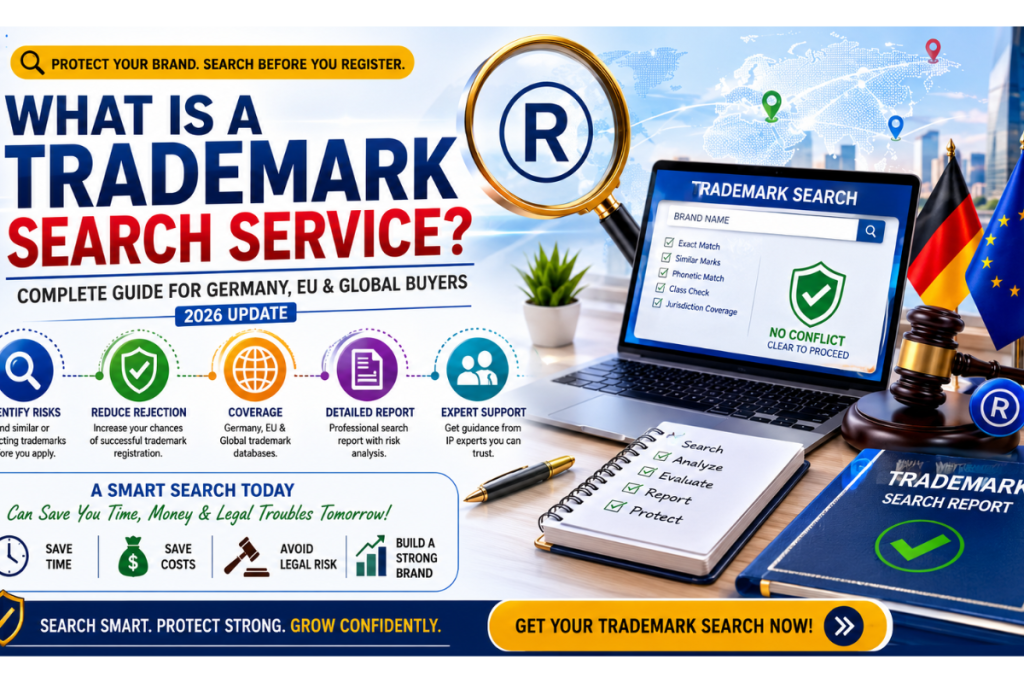
A Trademark Search Service is a structured intellectual property verification process that checks whether a brand name, logo, or mark is already registered, legally protected, or in conflict with existing trademarks in one or more jurisdictions.
It is not a registration service. It does not create a new trademark. It is an analysis and verification process designed to answer one critical question before you invest:
“Is this trademark legally safe to acquire and use?”
A professional trademark search covers:
- Database screening across official trademark registries (EUIPO, DPMA, WIPO)
- Conflict and similarity analysis — phonetic, visual, and conceptual
- Nice Classification matching to identify class-specific risks
- Risk scoring — a clear Low / Medium / High verdict you can act on
Think of it as due diligence for intellectual property. Just as you would verify financial records before acquiring a business, you verify trademark status before acquiring a brand.
Why Trademark Search Is Critical Before Buying in 2026
The trademark landscape in Germany and the EU has become significantly more complex. With the rise of cross-border e-commerce, Amazon marketplace growth, and international brand acquisitions, the number of registered trademarks in EUIPO and DPMA databases has grown sharply.
Here is what can go wrong without a trademark search:
1. Trademark Infringement Claims
If you purchase and begin using a trademark that conflicts with an already-registered mark, the rights holder can file a legal claim against you — even if you bought the trademark in good faith. Legal disputes are expensive and damaging.
2. EUIPO or DPMA Rejection
If you attempt to transfer or re-register a trademark with hidden conflicts, the application may be rejected outright. You lose time, fees, and market entry momentum.
3. Amazon and Marketplace Bans
Amazon Germany and other EU marketplaces have strict Brand Registry policies. A trademark with conflicts can result in account suspension or listing removal — a devastating outcome for sellers who built their business on that brand.
4. Forced Rebranding After Launch
Perhaps the most damaging scenario: you invest in packaging, advertising, website development, and product launch — only to receive a cease-and-desist letter. Rebranding at this stage costs significantly more than a trademark search would have.
5. International Expansion Failures
If you plan to expand a German or EU brand into global markets — or bring an Indian, Chinese, UK, or US brand into Europe — undetected conflicts can block your entry at every border crossing.
A trademark search service eliminates these risks before they materialize.
How a Professional Trademark Search Service Works
A reliable trademark search follows a structured multi-step process. Here is how it works in practice:
Step 1: Submit the Trademark Information
You provide the brand name, logo, or mark you wish to evaluate, along with the industry sector and target markets (Germany, EU-wide, or international).
Step 2: Database Screening
The search covers the three primary trademark databases:
- EUIPO — European Union Intellectual Property Office (covers all 27 EU member states)
- DPMA — Deutsches Patent- und Markenamt (Germany’s national trademark authority)
- WIPO — World Intellectual Property Organization (international trademark database)
Each database is searched for identical and similar marks across relevant trademark classes.
Step 3: Conflict and Similarity Analysis
This is the most critical phase. The analysis looks beyond exact name matches to identify:
- Phonetic similarities — names that sound alike when spoken
- Visual similarities — logos or word marks that look confusingly similar
- Conceptual similarities — marks with the same meaning in different languages
- Industry overlap — competing marks within the same product or service category
Step 4: Nice Classification Matching
Trademarks are registered under specific classes defined by the Nice Classification system (an international standard with 45 classes covering goods and services). A trademark safe in Class 25 (clothing) may conflict in Class 18 (leather goods). Class-level analysis prevents overlooked conflicts.
Step 5: Risk Scoring and Report Delivery
The final output is a comprehensive risk report with a clear recommendation:
| Risk Level | Meaning | Recommended Action |
| Low | No significant conflicts found | Safe to proceed with acquisition |
| Medium | Minor similarities or class overlaps | Proceed with legal advisory review |
| High | Direct conflicts detected | Do not acquire without resolution |
Report delivery typically takes 24 to 72 hours.
Trademark Search vs. Trademark Registration: What Is the Difference?
Many buyers confuse these two services. They are fundamentally different processes with different goals.
| Factor | Trademark Search | Trademark Registration |
| Purpose | Check if a trademark is available or safe | Create a new trademark and establish rights |
| Risk Level | Low — analysis only, no legal exposure | Medium to High — rejection is possible |
| Time Required | 24–72 hours | Several months (3–18 months depending on jurisdiction) |
| Cost Efficiency | High — low cost, high protection value | Moderate — official fees plus professional costs |
| Best For | Buyers, investors, acquirers | New brand creators registering original marks |
If you are buying a trademark rather than creating one from scratch, the search comes first — always. Registration is what follows if you are building a new brand or securing an acquired one under your own ownership.
The Risk Analysis Process: What Gets Evaluated
Every trademark submitted for search is evaluated across six dimensions:
- Identical Name Conflicts Direct exact matches in any active trademark database. The highest-risk scenario — if an identical name is registered in the same class and jurisdiction, acquisition carries serious legal exposure.
- Phonetic Similarity Risks Names that are pronounced similarly can constitute trademark infringement under EU trademark law. For example, “Zara” and “Zahara” may be considered confusingly similar in certain contexts.
- Visual and Logo Similarity Logo marks are evaluated for visual resemblance to registered figurative marks. Color combinations, stylistic elements, and graphic layouts are all considered.
- Conceptual Similarity A trademark can conflict with another even in a different language if the concepts are equivalent. “Sun” and “Sol” may conflict in a multilingual EU context.
- Industry and Market Overlap Two identical names in different industries may coexist peacefully. The same names in the same industry cannot. Industry context determines whether a similarity is a real conflict.
- Trademark Class Conflicts The Nice Classification system assigns goods and services to 45 distinct classes. A thorough search maps the trademark against all relevant classes to detect cross-class risks.
Who Needs a Trademark Search Service?
This service is specifically valuable for the following groups:
Trademark Buyers and Investors
If you are purchasing a registered trademark as an asset — whether for immediate use, resale, or portfolio building — a search is non-negotiable. Acquisition without verification is speculation, not investment.
Amazon Sellers Entering Germany and the EU
Amazon’s Brand Registry requires trademark ownership. But owning a conflicted trademark creates more problems than it solves. Sellers need a clean trademark to operate safely on Amazon Germany and EU marketplaces.
Startups Acquiring Brand Assets
Many startups accelerate brand-building by acquiring existing registered trademarks rather than creating from scratch. A trademark search ensures the acquired asset is actually an asset, not a liability.
International Companies Expanding to Europe
Companies from India, China, the United States, and the United Kingdom frequently expand into German and EU markets. A trademark that is conflict-free in your home country may still conflict with an existing EU or DPMA registration. Cross-border search is essential.
Businesses Buying Ready-Made Trademarks
Ready-made or “shelf” trademarks are increasingly popular for fast market entry. Even pre-registered trademarks require a current conflict check before transfer, as the trademark landscape changes continuously.
Germany and EU Trademark Systems: What Buyers Must Understand
Germany and the EU operate separate but overlapping trademark systems. Understanding both is critical for any buyer entering the European market.
Germany — DPMA (Deutsches Patent- und Markenamt)
The DPMA is Germany’s national trademark authority. A trademark registered at DPMA is protected within Germany’s borders only. It does not automatically provide EU-wide protection.
EU — EUIPO (European Union Intellectual Property Office)
A trademark registered at EUIPO — known as an EU Trade Mark (EUTM) — provides protection across all 27 EU member states in a single registration. It is the preferred route for businesses seeking broad European coverage.
Why Both Matter
An EU trademark does not eliminate German trademark conflicts. Pre-existing DPMA national registrations can block or challenge an EUTM in Germany. A comprehensive search must cover both systems to guarantee safe cross-border brand usage and market-entry readiness.
International Trademark Search: India, China, UK, and US Buyers
Europe is one of the most active destinations for international trademark acquisition. Buyers from the following markets frequently seek trademark assets in Germany and the EU:
India → Germany & EU Expansion Indian companies and entrepreneurs expanding into German and EU markets must verify that their home-country trademark does not conflict with existing DPMA or EUIPO registrations. The reverse also applies — Indian buyers acquiring EU trademarks need full European database coverage.
China → EU Brand Acquisition Chinese brands expanding into European markets face particularly complex trademark landscapes due to the volume of existing registrations. A thorough search is critical before any acquisition or brand launch in Germany or the EU.
UK & US → European Market Entry Post-Brexit, UK trademark registrations no longer automatically provide EU protection. US and UK brands entering Europe must verify trademark status independently under EU and German law.
In all cases, the trademark search covers EUIPO, DPMA, and WIPO — ensuring no conflict is missed across jurisdictions.
What Happens After a Successful Trademark Search?
A clean search result — Low Risk — opens the path to confident trademark acquisition. Here is what typically follows:
Trademark Purchase
You proceed with purchasing the registered trademark from the current owner or marketplace.
Transfer Assistance
The trademark must be formally transferred through an official assignment process recorded with EUIPO, DPMA, or the relevant authority. Professional transfer assistance ensures the process is legally complete and properly documented.
Acquisition Deal Negotiation
For higher-value trademark assets, structured negotiation support helps you secure favorable terms while protecting your interests as a buyer.
Ownership Confirmation
Once the transfer is recorded, you hold the legal rights to the trademark and can begin using, licensing, or building upon it — in full compliance with EU and German IP law.
Trademark Due Diligence: The Full Picture
A trademark search is one component of broader trademark due diligence. For buyers making significant acquisitions, due diligence also includes:
- Ownership verification — confirming the seller actually holds the rights they are selling
- Encumbrance check — identifying any licenses, pledges, or legal proceedings attached to the trademark
- Renewal status — confirming the trademark is active and not lapsed
- Usage evidence — in some cases, verifying that the trademark has been genuinely used (non-use cancellation is a risk in EU trademark law)
- NDA protection — ensuring the evaluation process remains confidential
A professional trademark search service handles the conflict analysis layer. For full due diligence, buyers should combine search results with ownership and status verification before any transaction is completed.
Common Questions About Trademark Search Service
Is trademark search a legal service? A professional trademark search service provides analysis, risk scoring, and marketplace advisory. It is not a law firm service and does not constitute legal advice. For complex conflict situations, engaging a trademark attorney alongside your search report is recommended.
Can foreigners buy trademarks in Germany and the EU? Yes. Trademarks are transferable intellectual property assets. There is no nationality restriction on trademark ownership in Germany or the EU. Both EUIPO and DPMA allow international buyers to own and transfer trademark rights.
Is trademark search required before buying? It is not legally mandated, but it is professionally essential. Buying a trademark without a search exposes you to legal conflicts, financial loss, and marketplace risk that could have been prevented for a fraction of the acquisition cost.
How long does a trademark search take? A professional search typically delivers results within 24 to 72 hours, depending on the complexity of the mark and the number of jurisdictions covered.
What if a conflict is found? A conflict finding does not necessarily mean the acquisition is impossible. Medium-risk results may be resolvable through class limitation, coexistence agreements, or alternative trademark options. Your search report should include actionable alternatives, not just a rejection.
Can I use a trademark immediately after purchase? You can begin using the trademark once the legal transfer is formally completed and recorded with the relevant authority. Using a trademark before the transfer is recorded carries ownership risk.
Why Work With a Specialized Trademark Search Service?
Generic legal searches and DIY database checks have two major limitations: they miss similarity analysis (phonetic, visual, conceptual), and they do not account for marketplace-specific risks like Amazon Germany compliance.
A specialized trademark search service designed for German, EU, and global markets brings:
- Multi-database coverage — EUIPO, DPMA, and WIPO in a single process
- Similarity analysis — not just exact-match searches
- Marketplace intelligence — Amazon Germany and EU marketplace readiness checks
- Cross-border expertise — for buyers expanding from India, China, UK, and US into Europe
- Acquisition support — from search result to completed transfer
- Confidential handling — NDA-protected evaluation and transaction process
The goal is not just a search result. It is a confident acquisition decision backed by structured analysis and expert advisory.
Search Before You Buy
The trademark market in Germany and the EU offers significant opportunities for buyers, investors, and international companies. Registered trademarks are valuable assets — but only when acquired safely.
A trademark search service is the first and most important step in any trademark acquisition. It converts uncertainty into clarity, and legal risk into informed decision-making.
Before you invest in a brand, verify it.
Ready to verify your trademark?
Start with a professional trademark search covering Germany (DPMA), the EU (EUIPO), and international databases (WIPO) — and get a clear risk report within 24–72 hours.
👉 Book a Consultation | 👉 Find Your Trademark | 💬 WhatsApp Expert Support
This article is for informational purposes only and does not constitute legal advice. For complex trademark matters, consult a qualified intellectual property attorney.