
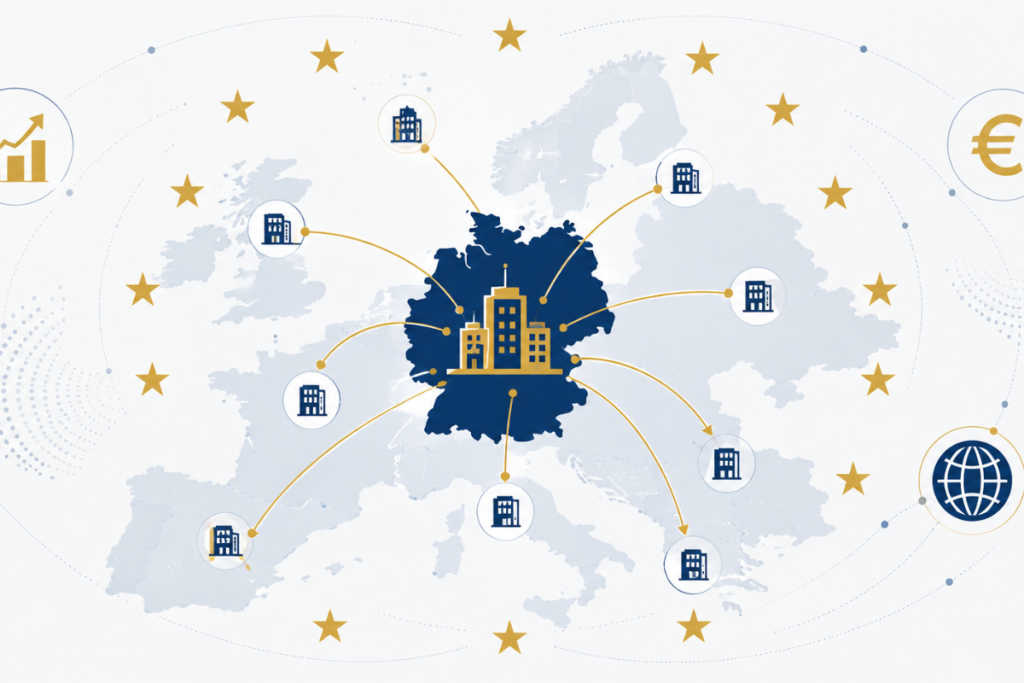
The Answer Is Germany — Here Is Exactly Why
Every year, thousands of international companies make the same decision.
When the time comes to establish a European headquarters — a legal entity, a strategic base, a commercial hub from which to serve the entire European market — they choose Germany.
Not France, despite its 68 million consumers and world-leading luxury market. Not the Netherlands, despite its English-friendly environment and Rotterdam logistics gateway. Not Switzerland, despite its low tax rates and premium brand positioning. Not Ireland, despite its 12.5% corporate tax rate and English-speaking workforce.
Germany.
The pattern is not coincidental. It reflects a specific combination of factors that no other European country replicates at the same level — market scale, geographic centrality, logistics infrastructure, legal stability, IP protection, talent access, and the commercial credibility that a German business address confers on international brands operating across the EU.
This guide explains exactly why Germany is the preferred European headquarters location for international companies in 2026 — and what you need to do, in the right sequence, to establish yours correctly.
What Does “European Headquarters” Mean for International Companies?
Before examining why Germany is the preferred choice, it is worth being precise about what a European headquarters actually means for an international company — because the term is used loosely and the implications of the decision are significant.
A European headquarters is not simply a sales office or a representative address. It is a fully formed legal entity — typically a GmbH or equivalent private limited company — that serves as the primary operating base for a company’s European activities. It is the entity that:
- Holds the company’s EU trademark rights
- Employs European staff under local employment law
- Maintains the company’s primary banking relationships in Europe
- Files EU VAT returns and manages cross-border tax obligations
- Signs commercial contracts with European suppliers, distributors, and partners
- Operates the company’s EU e-commerce and marketplace presence
- Determines the company’s tax residency within the EU
The headquarters location determines trademark jurisdiction, tax treatment, employment law applicability, banking infrastructure, and the strategic positioning of the entire European operation. Choosing the wrong country for your European headquarters is not simply an administrative inconvenience — it is a strategic decision that affects every aspect of your European business for years.
Germany by the Numbers — Why the Data Points Here
Before examining the qualitative factors, the quantitative case for Germany as European headquarters location is compelling on its own.
| Metric | Germany | Significance |
| GDP (2026 est.) | ~€4.1 trillion | Largest economy in the EU |
| Population | 84 million | Largest consumer market in the EU |
| EU single market access | 27 member states | Full access from one entity |
| Amazon.de market size | No.1 in EU | Highest Amazon revenue in Europe |
| Logistics performance | No.1 in EU | World Bank Logistics Performance Index |
| Foreign direct investment | Top 5 globally | Consistent FDI destination |
| EUIPO trademark filings | Highest in EU | Most active IP market in Europe |
| Export value | No.3 globally | Strongest export economy in EU |
| Fortune Global 500 HQs | 27 companies | Most of any EU country |
| Frankfurt financial center | No.1 post-Brexit EU | ECB, Deutsche Bundesbank, major banks |
These are not marketing statistics — they are the operational reality that international companies encounter when they evaluate where to concentrate their European commercial activities. Germany is simply where the most commercial activity, the most sophisticated business ecosystem, and the most significant market opportunity are concentrated within the EU.
10 Reasons International Companies Choose Germany as European HQ
1. Largest Consumer Market in the EU
Eighty-four million consumers. The highest per-capita e-commerce spending in Europe. The deepest B2B market on the continent. Germany’s domestic market scale is the foundation of every other argument for German headquarters status.
For consumer goods companies, establishing a German headquarters means direct access to the EU’s largest domestic consumer base without the complexity of cross-border distribution from a smaller market. For B2B companies, Germany’s industrial ecosystem — automotive, manufacturing, chemical, pharmaceutical, engineering — represents the most sophisticated and highest-spending business purchasing environment in Europe. For e-commerce companies, Amazon.de generates more seller revenue than any other European marketplace — and a German headquarters with a registered trademark provides the legal foundation for full marketplace participation.
No other European country offers this combination of consumer scale, B2B depth, and e-commerce dominance at the same level.
2. Central Geographic Position in Europe
Germany sits at the geographic center of Europe — bordered by nine countries and positioned equidistant from the EU’s eastern and western extremities. This geographic centrality is not a coincidence of history; it is one of the primary operational reasons why international companies choose Germany as their European hub.
From a German distribution center, a company can reach the majority of EU consumers within one to two days by road freight. From Hamburg, goods entering Europe from Asia can be distributed across the continent efficiently. From Frankfurt, air cargo can reach any European city within hours. From Duisburg — home to the world’s largest inland port — rail freight from China arrives directly into the heart of the EU’s most productive industrial region.
For companies managing European supply chains, this centrality translates directly into lower logistics costs, faster delivery times, and simpler inventory management compared to operating from a peripheral EU location.
3. Full EU Single Market Access From One Location
Germany is a full EU member state — which means a German-registered company operates within the EU single market with all the commercial advantages that membership provides.
A single German GmbH can sell goods and services across all 27 EU member states with no customs duties, no tariff barriers, and harmonized regulatory treatment. A single EUIPO trademark registered from a German entity covers all 27 member states simultaneously. The EU VAT One Stop Shop (OSS) system allows a German entity to manage VAT obligations across multiple EU countries through a single German filing.
This single-entity, single-market access is what makes Germany strategically superior to non-EU European alternatives — Switzerland and the UK — as a European headquarters location. A Swiss holding company or a UK-based entity does not carry the same EU market access rights, and the additional compliance complexity of cross-border EU operations from outside the bloc adds cost and friction that a German entity eliminates.
4. World-Class Logistics and Infrastructure
Germany’s logistics infrastructure is Europe’s most comprehensive — and for international companies moving physical goods across the continent, it is one of the most commercially significant advantages of a German headquarters.
The Port of Hamburg is Europe’s second-largest container port — handling enormous volumes of goods from Asia, the Americas, and beyond. Frankfurt Airport is the EU’s largest air cargo hub — essential for time-sensitive and high-value goods moving by air. The Autobahn road network provides efficient road freight connectivity to all neighboring countries. Deutsche Bahn’s rail network connects German industrial and logistics centers to the broader European rail freight system.
For companies participating in China’s Belt and Road Initiative rail freight services, Duisburg is the primary European terminus — making Germany not just geographically central but operationally central to the most significant global trade infrastructure investment of the past decade.
No other EU country combines deep-water port access, major air cargo hub, extensive road network, and central EU geographic position in the same package.
5. Strong Legal System and Intellectual Property Protection
Germany’s legal system is one of the most reliable and predictable in the world for commercial purposes. Contracts are enforced. Courts function efficiently. Intellectual property rights — trademarks, patents, trade secrets — are actively protected and vigorously enforced.
For international companies establishing a European headquarters, legal predictability is not a soft benefit — it is a fundamental operational requirement. The ability to enforce commercial contracts with suppliers and distributors, protect trademark rights against infringers, and resolve disputes through a well-functioning judicial system directly affects the reliability of business operations across the entire European market.
Germany’s trademark enforcement environment is particularly strong. DPMA and EUIPO trademark rights held by German-registered companies are enforceable across Germany and the EU with the full backing of German and European IP law — including customs seizure of infringing goods at German ports, injunctions against infringing sellers on German marketplaces, and damage claims through German commercial courts.
6. Amazon Germany — Europe’s Largest E-Commerce Platform
For international companies with any e-commerce component — and increasingly, that is most companies — Germany’s position as home to the EU’s largest Amazon marketplace is a decisive factor in European headquarters location decisions.
Amazon.de generates the highest seller revenue of any Amazon marketplace in Europe. German consumers are among the most active online shoppers in the EU, with high per-capita spending across virtually every product category. The German market’s combination of scale, purchasing power, and digital adoption makes it the essential first market for any Amazon seller entering Europe.
A German-registered company with a registered EUIPO or DPMA trademark can enroll in Amazon Brand Registry — gaining full brand protection on Amazon.de, blocking unauthorized sellers, accessing A+ Content and Sponsored Brand advertising, and building a fully protected brand presence on Europe’s most important e-commerce platform.
For e-commerce companies specifically, a German headquarters is not just strategically advantageous — it is operationally essential for maximum marketplace participation and brand protection.
7. Highly Skilled Workforce
Germany’s workforce combines engineering excellence, manufacturing precision, and an increasingly strong technology talent pool that makes it one of Europe’s most attractive locations for building a skilled European team.
Germany’s dual vocational training system — combining workplace apprenticeship with academic education — produces some of Europe’s most practically skilled technical workers across manufacturing, engineering, logistics, and skilled trades. University graduates from Germany’s extensive higher education system are among Europe’s most sought-after for technology, finance, and professional services roles.
Berlin has developed into one of Europe’s most significant technology startup talent ecosystems — attracting software engineers, product managers, data scientists, and startup professionals from across the EU and internationally. Munich’s combination of elite universities (TU Munich consistently ranks among Europe’s top engineering schools) and established technology companies (Siemens, BMW, SAP) creates a premium engineering talent market.
For international companies building European teams alongside their headquarters, Germany’s talent depth across technical, engineering, technology, and professional domains provides sustainable hiring capability that smaller EU markets cannot match.
8. Established Foreign Business Community
Germany has the largest and most established foreign business community of any EU country — with particularly strong communities from the markets that most commonly establish European headquarters: India, China, the United States, Japan, and South Korea.
For Indian companies expanding to Europe, Germany hosts the largest Indian business diaspora in the EU — concentrated in cities including Frankfurt, Munich, and Berlin. The support infrastructure — Indian chambers of commerce, professional networks, legal and accounting advisors experienced in India-Germany business structures — is more developed in Germany than anywhere else in the EU.
For Chinese companies, Hamburg and Düsseldorf host major Chinese business communities built over decades of trade relationships. For US multinationals, Frankfurt and Munich are the traditional centers of American corporate presence in Europe. For Japanese and Korean companies, Düsseldorf is the established European hub with a support ecosystem that has served the Asian business community for generations.
This established foreign business infrastructure significantly reduces the practical friction of establishing a European headquarters in Germany — the advisors, translators, cultural bridges, and professional networks that new entrants need already exist at scale.
9. Access to EU Banking and Finance
Frankfurt is the EU’s primary financial center — hosting the European Central Bank, the Deutsche Bundesbank, and the European operations of virtually every major global financial institution. Post-Brexit, Frankfurt has attracted significant financial services relocations from London — expanding its position as the EU’s leading banking and finance hub.
For international companies establishing a European headquarters, Frankfurt’s financial infrastructure provides access to EU capital markets, trade finance, export credit facilities, and the banking relationships that support serious European commercial operations. The concentration of major banks in Frankfurt — including Deutsche Bank, Commerzbank, and the European operations of major US, Asian, and Middle Eastern financial institutions — means German-registered companies have access to the full range of corporate banking services that support European market growth.
Beyond Frankfurt, Germany’s broader banking ecosystem — including regional banks, savings banks (Sparkassen), and an increasingly developed fintech sector — provides business banking options across the country for companies of all sizes.
10. Brand Credibility — The Germany Effect
The final reason is less quantifiable than the previous nine — but arguably as commercially significant. Germany carries a global brand reputation for quality, reliability, and engineering excellence that no other European country matches at the same level.
“Made in Germany” is one of the most recognized quality signals in global commerce — a brand credential that extends from automotive to pharmaceuticals to consumer goods and professional services. A German business address on company correspondence, a German IBAN on invoices, and a German-registered entity on contracts all carry credibility signals in global B2B relationships that a Maltese or Bulgarian equivalent simply cannot replicate.
For international companies for whom European market credibility and premium brand positioning are commercial objectives — not just operational necessities — Germany’s brand reputation is a genuine business asset that a German headquarters delivers alongside the operational benefits.
Germany vs Other European Headquarters Locations
| Factor | Germany | Netherlands | UK (post-Brexit) | Switzerland | Ireland |
| EU membership | ✅ Yes | ✅ Yes | ❌ No | ❌ No | ✅ Yes |
| Market size | ✅ Largest EU | Mid-sized | Large (non-EU) | Small (non-EU) | Small |
| EUIPO trademark | ✅ Full coverage | ✅ Full coverage | ❌ Excluded | ❌ Excluded | ✅ Full coverage |
| Corporate tax rate | 28–33% | 19–25.8% | 25% | 12–20% | 12.5% |
| Business language | German | ✅ English | ✅ English | German/French | ✅ English |
| Logistics hub | ✅ Hamburg/FRA | ✅ Rotterdam | Heathrow (non-EU) | Limited EU | Limited |
| Amazon marketplace | ✅ Largest EU | Growing | Large (non-EU) | None | None |
| Financial center | ✅ Frankfurt | Amsterdam | London (non-EU) | Zurich/Geneva | Dublin |
| Talent pool | ✅ Largest EU | Strong | Large (non-EU) | Strong | Limited |
| Foreign business community | ✅ Largest EU | Strong | Large (non-EU) | Strong | Moderate |
| Best suited for | Scale, B2B, e-commerce | Holding, logistics | UK market access | Tax efficiency | Tax efficiency |
The two most significant limitations of non-German EU headquarters options are worth addressing directly.
Ireland at 12.5% corporate tax is frequently cited as a more attractive headquarters location than Germany. For pure tax efficiency — particularly for technology IP-holding companies — Ireland’s rate is genuinely lower. However, Ireland’s domestic market of 5 million consumers provides essentially no commercial scale. A German headquarters sacrifices some tax efficiency in exchange for direct access to 84 million consumers, the EU’s strongest logistics network, and the most commercially significant domestic market in Europe.
The Netherlands is the strongest alternative to Germany for European headquarters consideration. Lower formation cost, English-friendly business environment, Rotterdam logistics access, and a more favorable corporate tax rate make the Netherlands a genuine competitor for certain business types. However, Germany’s market is four times larger, Amazon.de dwarfs Amazon.nl, and Germany’s B2B ecosystem depth is unmatched. For companies choosing between Germany and the Netherlands based on operational commercial factors rather than purely on formation ease, Germany is typically the stronger choice.
Which Industries Choose Germany as European HQ?
Manufacturing and Industrial Companies
Germany is the natural home for manufacturing and industrial European headquarters — primarily because of the density and sophistication of Germany’s industrial supply chain ecosystem. The German Mittelstand — the network of mid-sized manufacturing and engineering companies — represents the most extensive industrial supplier base in Europe.
For international manufacturers entering Europe, Germany provides direct access to component suppliers, specialist subcontractors, logistics providers, and technical expertise that would take years to build relationships with from a non-manufacturing European headquarters location.
Technology and Software Companies
Berlin has established itself as one of Europe’s premier technology startup ecosystems — home to a dense concentration of funded startups, technology talent, venture capital, and the international professional community that supports technology company growth. Munich serves as Germany’s enterprise technology hub — home to SAP, major technology divisions of BMW and Siemens, and a deep pool of engineering and software development talent.
Frankfurt is emerging as a European fintech center — benefiting from its financial infrastructure and the presence of regulatory bodies that fintech companies need proximity to.
E-Commerce and Amazon Sellers
For Amazon sellers and e-commerce brands, Germany is not just the preferred European headquarters — it is often the only commercially rational choice. Amazon.de’s revenue dominance, the Brand Registry trademark requirements that a German or EUIPO trademark satisfies, and the FBA logistics infrastructure across Germany make German headquarters establishment the operational foundation of a serious European e-commerce strategy.
Financial Services Companies
Post-Brexit, Frankfurt has become the primary EU destination for financial services companies that previously operated their European activities from London. The ECB, the Deutsche Bundesbank, and the concentration of major European bank headquarters in Frankfurt make Germany the operational center of EU financial services regulation and activity.
For financial services companies needing EU regulatory passporting — the ability to offer regulated financial products across all EU member states from a single entity — a German-licensed entity operating from Frankfurt provides the most credible EU financial services headquarters outside the UK.
Pharmaceutical and Life Sciences
Germany’s pharmaceutical and life sciences ecosystem — anchored by companies including Bayer, BASF, Merck, and Boehringer Ingelheim — makes it the natural European headquarters for international pharmaceutical and biotech companies. Germany’s research infrastructure, regulatory relationships with the EMA (European Medicines Agency, based in Amsterdam but with strong German operational connections), and deep academic-industry partnerships across German universities support pharmaceutical company operations at scale.
Indian and Chinese Companies
For Indian companies expanding to Europe, Germany’s established Indian business community, strong India-Germany trade relationships, and the presence of experienced India-Germany business advisory infrastructure make Germany the default first European headquarters consideration. The combination of market scale and community support is unmatched in any other EU country.
For Chinese companies, Germany is the primary European market for e-commerce expansion (through Amazon.de) and the primary European B2B market for industrial and manufacturing companies. Trademark squatting risk for Chinese brands entering the EU makes EUIPO trademark acquisition or registration — from a German entity — an urgent early priority.
Legal Structure for Your German European Headquarters
The GmbH (Gesellschaft mit beschränkter Haftung) is the standard legal structure for European headquarters in Germany — chosen by the vast majority of international companies establishing significant German operations.
The GmbH provides:
- Limited liability protection for shareholders and directors
- High credibility with German banking institutions, B2B partners, and suppliers
- Flexible governance structure adaptable to complex international shareholding arrangements
- Full eligibility for EUIPO trademark registration and Amazon Brand Registry enrollment
- Professional standing appropriate for a company presenting itself as a European headquarters
The UG (Unternehmergesellschaft) is available as a lower-capital entry option — suitable for companies testing the German market before committing to full GmbH formation, or for those with genuinely constrained initial capital. For international companies designating Germany as their European headquarters with serious commercial intentions, GmbH formation is typically the appropriate structure.
Both structures allow 100% foreign ownership — no German co-founder, local shareholder, or resident director is required. The managing director (Geschäftsführer) can be a foreign national based entirely outside Germany.
Trademark Protection for Your European Headquarters
A European headquarters without trademark protection is a commercial entity without legal brand defense. For international companies establishing their European base in Germany, trademark protection is the most important intellectual property decision they will make — and it must happen before commercial operations begin.
A German-based European headquarters needs, at minimum, an EUIPO EU Trade Mark covering all 27 EU member states — including Germany, Austria, France, Italy, Spain, and the other markets the headquarters will serve. This single registration provides the legal foundation for brand protection across the entire EU from one application and one registration fee.
For companies targeting the DACH market beyond Germany, a separate Swiss IGE/IPI trademark completes the regional coverage that EUIPO alone cannot provide.
The trademark search that precedes any registration or acquisition investment must cover DPMA, EUIPO, and WIPO databases — with phonetic, visual, and conceptual similarity analysis confirming the brand is conflict-free across all relevant jurisdictions before the European headquarters strategy is built on it.
For companies with urgent timelines — particularly Amazon sellers needing immediate Brand Registry access — acquiring an existing registered EUIPO trademark provides immediate protection from the moment the transfer is recorded, without the 4–6 month wait for new registration examination.
Setting Up Your European Headquarters in Germany — Step by Step
Step 1: Trademark Search and Protection (Day 1)
Before any other action, conduct a professional trademark search covering DPMA, EUIPO, and WIPO databases. Confirm your brand name and logo are conflict-free. Initiate trademark acquisition or registration immediately — this is the legal foundation of your entire European headquarters strategy.
Step 2: Choose Your German Headquarters City
| City | Best Industry Fit | Key Advantage |
| Berlin | Tech, startups, creative, digital | Largest EU startup ecosystem, deep international talent pool |
| Munich | Engineering, automotive, luxury, enterprise tech | Premium positioning, strong corporate infrastructure |
| Frankfurt | Finance, logistics, international trade | ECB, financial hub, Frankfurt Airport cargo access |
| Hamburg | Logistics, trade, e-commerce, maritime | Port of Hamburg, northern EU gateway, strong Asian business community |
| Düsseldorf | Japanese, Korean, Asian business | Most established Asian business community in Germany |
| Stuttgart | Automotive, manufacturing, precision engineering | Bosch, Daimler, Porsche ecosystem access |
Step 3: Choose Your Legal Structure
GmbH for most European headquarters. UG for early-stage market entry before full commitment. The structure decision affects formation timeline, capital requirements, banking options, and B2B credibility from day one.
Step 4: Secure a German Business Address
A registered German business address is legally required for GmbH formation and must be in place before notarization. For companies not yet ready for physical German office space, a professional virtual business address service provides a valid registered address immediately at €50–€200 per month.
Step 5: Complete Company Formation
GmbH formation requires document preparation, notarization, share capital deposit, and Commercial Register registration. The realistic timeline for non-EU founders is 6–10 weeks. Starting the bank account opening process in parallel with document preparation compresses this timeline.
Step 6: Open German Business Bank Account
A German business bank account is required for the share capital deposit that precedes Commercial Register registration. For non-EU founders, fintech banking through Qonto or similar platforms provides the fastest route to a German IBAN — typically within 1–3 weeks via remote VideoIdent verification.
Step 7: Complete VAT and Tax Registration
Register with the local German tax authority (Finanzamt) for Steuernummer and USt-IdNr immediately after Commercial Register confirmation. The German VAT number is required for commercial operations, invoicing EU business customers, and Amazon seller account compliance.
Step 8: Activate Trademark Transfer and Amazon Brand Registry
If a trademark was acquired, ensure the transfer is officially recorded at EUIPO or DPMA. Once ownership is confirmed, enroll in Amazon Brand Registry — typically completing in 1–5 business days after trademark confirmation.
Step 9: Build Your European Team and Operations
With legal entity, banking, trademark protection, and marketplace presence established, activate the full European headquarters function — hiring local staff, establishing supplier relationships, signing commercial contracts under the GmbH entity, and launching EU-wide commercial operations.
Cost of Establishing a European Headquarters in Germany (2026)
| Cost Category | Low Estimate | High Estimate | Notes |
| GmbH formation (notary, register, advisory) | €1,800 | €3,800 | One-time formation cost |
| Share capital (GmbH) | €12,500 | €25,000 | Working capital — not a fee |
| Registered German address (annual) | €600 | €3,600 | Virtual to co-working space |
| Trademark search (DPMA + EUIPO + WIPO) | €200 | €800 | Professional search with analysis |
| EUIPO trademark registration (1–2 classes) | €850 | €1,700 | Or acquisition: €1,000–€100,000+ |
| Document translation and apostille | €200 | €800 | Non-EU founders — country dependent |
| Professional advisory fees | €800 | €2,000 | Formation support |
| Business bank account setup | €0 | €300 | Fintech to traditional |
| VAT registration | €200 | €500 | If not included in advisory |
| Annual tax advisor (ongoing) | €1,200 | €5,000 | Essential compliance cost |
| Total first-year (excluding share capital) | €5,850 | €18,500 | First-year investment estimate |
For most international companies establishing a genuine European headquarters — with trademark protection, professional formation, and ongoing compliance — the realistic first-year investment falls between €18,000 and €43,000 including share capital. This is the total cost of a properly established, legally protected European headquarters in the EU’s most commercially significant market.
European HQ in Germany — What Indian, Chinese, US, and UK Companies Need to Know:
1. Indian Companies
Germany hosts the largest Indian business diaspora in the EU — making it the natural choice for Indian companies establishing their first European headquarters. The India-Germany trade corridor is well-developed across manufacturing, IT services, pharmaceuticals, and engineering — with established bilateral trade agreements, Indian chambers of commerce in major German cities, and advisory professionals experienced in navigating both systems.
For Indian companies, the EUIPO trademark route is particularly important — Indian CNIPA-equivalent (IPAB) trademarks provide no EU protection, and the risk of brand name registration by competitors or opportunists in Germany before the Indian company arrives is a documented pattern. Trademark search and EUIPO registration or acquisition should be the first action in any Indian company’s German headquarters planning.
2. Chinese Companies
Germany is the primary European destination for Chinese e-commerce expansion — driven by Amazon.de’s scale and the established Chinese business communities in Hamburg and Düsseldorf. For Chinese manufacturers expanding into European B2B markets, Germany’s industrial ecosystem provides both the largest customer base and the most sophisticated supplier network.
Trademark squatting — the registration of Chinese brand names by third parties in the EU before the original Chinese brand owner arrives — is a particularly acute risk for Chinese companies. Chinese trademarks registered with CNIPA provide no EU protection. EUIPO trademark protection must be secured immediately upon deciding to enter the German market.
3. US Companies
Post-Brexit, many US multinationals that previously managed European operations from UK entities have established German headquarters as their primary EU operating base — replacing the UK entity’s EU market access with a German GmbH that carries full EU single market rights.
Frankfurt is the traditional center of US corporate presence in Germany — home to Goldman Sachs, JP Morgan, Citigroup, and dozens of other US financial and professional services companies’ European operations. For US companies in non-financial industries, Berlin and Munich offer strong talent ecosystems and established American business communities.
4. UK Companies
Brexit fundamentally changed the calculus for UK-based businesses serving EU customers. A UK company operating in Europe now faces customs duties, regulatory barriers, and the loss of EU single market access that it previously enjoyed. A German GmbH established as a European subsidiary restores that EU market access — providing a fully EU-compliant entity from which UK companies can serve EU customers, hold EU trademark rights, and operate within EU regulatory frameworks.
The EUIPO trademark issue is particularly significant for UK companies: EU trademarks registered before Brexit were automatically converted into equivalent UK registrations, but going forward, UK companies need separate EUIPO registrations for EU coverage — often most efficiently obtained through a German entity.
European Headquarters in Germany
Do I need to live in Germany to set up a European headquarters there?
No. German law allows 100% foreign ownership and management of a GmbH from abroad. The managing director (Geschäftsführer) can be a foreign national based entirely outside Germany. Professional advisory support handles the German-language formation process on your behalf.
Is Germany the best EU country for tax efficiency?
Not for pure tax minimization — Ireland at 12.5% and the Netherlands at 19–25.8% offer lower corporate tax rates. Germany’s combined rate of 28–33% is mid-to-high within the EU. However, for companies prioritizing market access, commercial scale, and operational infrastructure over tax minimization, Germany provides a return on its higher tax environment through dramatically larger market opportunity.
Can a German GmbH serve as the holding company for EU subsidiaries?
Yes — though the Netherlands is typically more tax-efficient as a holding structure due to its participation exemption on dividend income from qualifying subsidiaries. For operational headquarters — companies actively selling in Germany and the EU — a German GmbH is the preferred structure. For pure holding arrangements, Netherlands or Luxembourg structures may offer tax advantages worth analyzing.
How important is the trademark for a European headquarters?
Critical — and it must come before commercial operations begin. A European headquarters without registered trademark protection is a commercial entity without legal brand defense across its entire operating territory. EUIPO trademark registration or acquisition from the German entity is the foundational IP decision for any serious European headquarters.
Which German city is best for a tech company European headquarters?
Berlin is the primary choice for startups and technology companies — Europe’s most vibrant startup ecosystem with deep international technology talent. Munich is stronger for enterprise technology, engineering, and hardware companies due to its proximity to BMW, Siemens, and TU Munich. Frankfurt suits fintech and B2B software companies requiring proximity to the financial services sector.
How long does it take to establish a European headquarters in Germany?
From trademark search on Day 1 to fully operational GmbH with VAT registration and Amazon Brand Registry: 8–14 weeks for most non-EU founders. The critical path runs through banking — choosing a fintech bank for speed compresses the timeline to the 8–10 week range. The detailed week-by-week formation timeline covers every stage of this process.
Does a German headquarters give me automatic access to sell across all EU countries?
Yes — a German-registered GmbH can sell goods and services across all 27 EU member states under EU single market rules, with no additional per-country entity requirements for most product and service categories. EU VAT compliance across multiple member states can be managed through Germany’s EU VAT OSS registration.
Is a German business address enough, or do I need a physical office?
A virtual business address service provides a legally valid German registered address for GmbH formation, VAT registration, and Commercial Register purposes. A physical office is not legally required and many international companies manage their German headquarters remotely with a virtual address, local professional advisors, and occasional in-person presence for key business activities.
Germany Is Not the Easiest European Headquarters Choice — It Is the Right One
The honest truth about Germany as a European headquarters location is this: it is not the easiest choice. Formation takes longer than the Netherlands. Corporate tax is higher than Ireland. The language barrier requires professional support that English-speaking EU countries do not. Banking for non-EU founders requires more effort than most other EU markets.
But ease of setup is not the right criterion for a European headquarters decision. Return on investment, market access, commercial scale, operational infrastructure, and long-term strategic positioning are the right criteria — and on every one of those dimensions, Germany is the strongest choice available within the EU.
The largest consumer market. The best logistics infrastructure. The most powerful B2B ecosystem. The EU’s dominant e-commerce platform. The most established foreign business community. The strongest brand credibility. Full EUIPO trademark coverage across 27 markets from one entity. All in the EU’s most legally stable, commercially predictable operating environment.
International companies choose Germany as their European headquarters because it works — commercially, operationally, and strategically — in ways that no other single EU country can match.
Your European headquarters decision starts with a trademark. Protect your brand before your first euro of European investment goes anywhere else.
Ready to establish your European headquarters in Germany?
Get expert support combining trademark protection and company formation — so your German headquarters is legally protected and commercially operational from day one.
👉 Book a Consultation | 👉 Explore Company Formation Services | 💬 WhatsApp Expert Support