
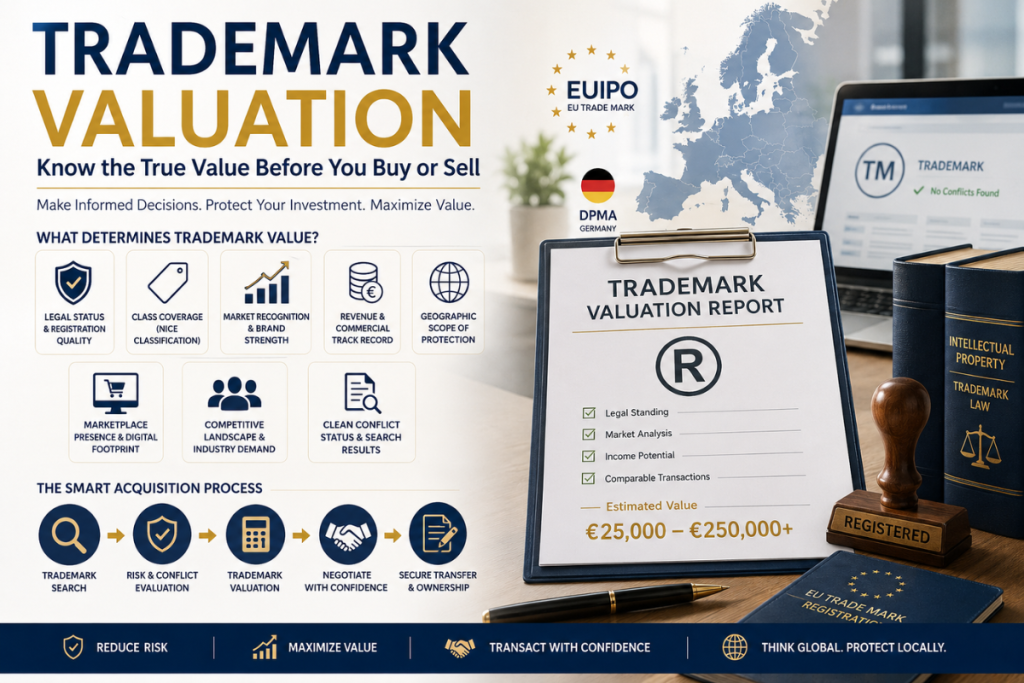
What Is a Trademark Actually Worth?
A trademark is more than a name on a certificate.
It is a business asset — one that carries commercial value, legal standing, and market power. But unlike real estate or equipment, a trademark has no visible price tag. Its value is not stamped on the registration document. It must be determined through a structured professional process.
That process is called trademark valuation.
Whether you are buying a registered trademark, selling a brand asset, entering a licensing agreement, or preparing for cross-border expansion into Germany or the EU — valuation is the step that separates informed decisions from costly guesses.
This guide explains exactly how trademark valuation works, what factors drive value up or down, how it connects to the acquisition process, and why it matters to buyers, sellers, and investors operating in Germany, the EU, and global markets in 2026.
What Is Trademark Valuation?
Trademark valuation is the process of determining the economic worth of a registered trademark as an intellectual property asset. It produces a defensible, structured estimate of what a trademark is worth in the context of a sale, acquisition, licensing deal, or business transaction.
Trademark valuation answers questions like:
- How much should I pay for this registered trademark?
- Is this brand asset priced fairly by the seller?
- What is my trademark worth if I decide to sell it?
- Can I use this trademark as collateral or in a licensing deal?
- How does this trademark’s value compare to others in the same industry?
Valuation is not guesswork. It is a methodical analysis of legal, commercial, financial, and market factors that together determine what a trademark is genuinely worth to a buyer or seller at a specific point in time.
Why Trademark Valuation Matters Before a Transaction
Skipping valuation before a trademark transaction creates risk on both sides of the deal.
For buyers, overpaying for a trademark — or paying full price for one with hidden legal conflicts, narrow class coverage, or weak market recognition — erodes return on investment before the brand is even used.
For sellers, underpricing a trademark means leaving significant value on the table. A brand with strong market presence, broad class coverage, and clean legal status is worth considerably more than its registration fee.
For both parties, transacting without valuation means the agreed price is driven by negotiation instinct rather than evidence — which rarely produces fair outcomes for either side.
In Germany and the EU specifically, where trademark law is structured and IP assets are recognized as balance sheet items, valuation is increasingly expected as part of any serious trademark acquisition process.
The Three Core Methods of Trademark Valuation
Trademark valuation professionals use three primary methodologies. In practice, the most reliable valuations combine elements of all three.
1. The Cost-Based Approach
This method calculates what it would cost to recreate the trademark from scratch — including registration fees, legal costs, branding investment, and the time required to build equivalent market recognition.
What it measures: Replacement cost of the trademark asset
Best used for: Early-stage trademarks with limited market history, or when comparable market data is unavailable
Limitation: It does not capture the commercial value the trademark has already generated. A well-established brand may be worth far more than what it cost to build.
Example: A trademark registered in Germany (DPMA) with basic branding development might have a replacement cost of €5,000–€15,000. But if the brand has developed market recognition and customer loyalty over five years, its actual market value could be multiples of that figure.
2. The Market-Based Approach
This method determines value by comparing the trademark to similar trademarks that have recently been sold or licensed in comparable markets and industries.
What it measures: Fair market value based on comparable transactions
Best used for: Trademarks in active marketplaces with sufficient transaction data, including ready-made trademark markets and industry-specific IP exchanges
Limitation: Comparable data can be difficult to find, particularly for niche industries or less common trademark classes.
Example: If registered trademarks in a specific industry and Nice Classification class have recently transacted at €8,000–€25,000 in the EU market, a comparable trademark in good legal standing falls within that range — adjusted up or down based on specific factors.
3. The Income-Based Approach
This is the most commercially rigorous method. It calculates trademark value based on the future economic income the trademark is expected to generate — through product sales, licensing royalties, or brand premium pricing.
What it measures: Present value of future economic benefit attributable to the trademark
Best used for: Established trademarks with revenue history, licensing agreements, or clear commercial application
Limitation: Requires reliable financial projections, which can be difficult for early-stage brands or trademarks being sold without operating businesses attached.
Example: A trademark licensed to three distributors generating €50,000 annually in royalties, projected over a 10-year period with an appropriate discount rate, can be valued at several hundred thousand euros based on income alone.
Key Factors That Determine Trademark Value
Beyond methodology, trademark valuation is shaped by a set of specific factors that assessors evaluate for every mark. Understanding these factors helps both buyers and sellers approach negotiations with realistic expectations.
1. Legal Status and Registration Quality
A trademark registered with EUIPO (EU-wide protection) is more valuable than one registered only at DPMA (Germany only), which is in turn more valuable than an unregistered mark. Active, renewed, and clean registrations carry more value than those with lapses, disputes, or pending challenges.
Key questions:
- Is the trademark currently active and in good standing?
- Has it been renewed on schedule?
- Are there any opposition proceedings or cancellation actions filed against it?
2. Trademark Class Coverage
The Nice Classification system divides goods and services into 45 classes. A trademark registered across multiple relevant classes — particularly in classes aligned with high-value or high-growth industries — commands higher value than a single-class registration.
Broad class coverage means broader exclusivity rights. More exclusivity means more commercial utility, and therefore higher value.
3. Age and History of the Trademark
Older trademarks with a continuous registration history carry more legal weight. In EU trademark law, long-standing use can strengthen rights and reduce vulnerability to cancellation challenges based on non-use.
A trademark registered and actively used for 10 years is significantly more defensible — and more valuable — than one registered 18 months ago.
4. Market Recognition and Brand Strength
Does the public associate this trademark with a specific product, service, or quality standard? Brand recognition — sometimes called “brand equity” — is one of the most significant drivers of trademark value.
A trademark that consumers actively recognize and associate with positive experiences carries commercial premium that pure legal analysis cannot capture. This is measured through brand awareness data, search volume, marketplace presence, and customer engagement indicators.
5. Revenue and Commercial Track Record
Has the trademark been used commercially? Are there sales records, e-commerce performance data, licensing agreements, or marketplace metrics attached to it?
A trademark with a verifiable commercial track record — even a modest one — is more valuable than a registered mark sitting dormant. The income-based valuation method depends heavily on this data.
6. Marketplace Presence and Digital Footprint
In 2026, a trademark’s digital presence is a material component of its value. Indicators include:
- Active listings on Amazon Germany or EU marketplaces
- Amazon Brand Registry enrollment
- Online customer reviews and ratings
- Social media presence under the trademark
- Domain name alignment
Sellers who can demonstrate active marketplace performance command premium valuations.
7. Competitive Landscape and Industry Demand
A trademark in a high-demand, fast-growing industry sector is more valuable than an equivalent mark in a declining or saturated category. Valuation must account for where the industry is heading, not just where it has been.
8. Geographic Scope of Protection
EUIPO-registered trademarks (EU Trade Marks) cover 27 member states. WIPO international registrations can extend protection across dozens of additional countries. The wider the geographic protection, the greater the commercial utility — and the higher the value.
For buyers planning cross-border expansion from India, China, the US, or the UK into European markets, EU-wide trademark coverage is particularly valuable.
9. Clean Conflict Status
A trademark with no existing conflicts, no opposition history, and no pending challenges is worth more than one with a complex legal background. This is where trademark search and trademark valuation intersect — a clean search result directly supports a higher valuation.
How Trademark Search and Trademark Valuation Connect
Trademark search and trademark valuation are two distinct services — but they are deeply connected in the acquisition process.
Here is how they relate:
Trademark Search answers: Is this trademark legally safe to acquire?
Trademark Valuation answers: How much is this trademark worth?
You need both before making an informed acquisition decision.
A trademark that passes a clean search but is overvalued is a financial risk. A trademark priced fairly but concealing legal conflicts is a legal risk. Only by combining both processes can a buyer assess whether a trademark is worth acquiring at the proposed price.
The standard acquisition sequence is:
- Identify a trademark of interest
- Conduct trademark search (EUIPO, DPMA, WIPO)
- Evaluate conflict and risk status
- Commission or review trademark valuation
- Negotiate acquisition price based on evidence
- Complete transfer through formal assignment process
Skipping either step leaves a significant gap in your due diligence.
Trademark Valuation in the Germany and EU Context
Germany and the EU have well-developed frameworks for treating trademarks as financial assets. Under International Financial Reporting Standards (IFRS), which apply to companies operating within the EU, intangible assets — including trademarks — must be recognized and valued on corporate balance sheets under certain conditions.
This means trademark valuation in the EU is not just a deal-making exercise. It has formal accounting and financial reporting implications for businesses of a certain size.
For buyers and sellers operating in the German and EU markets specifically:
DPMA registrations — National German trademarks. Value is bounded by German market scope but relevant for businesses focused on the German market specifically.
EUIPO registrations (EUTM) — EU Trade Marks. Higher value due to 27-country coverage. Most attractive to investors and international buyers seeking broad European protection.
WIPO international registrations — Madrid System marks extending protection into Germany, the EU, and other designated territories. Value depends on which territories are covered and the commercial potential of each.
A comprehensive valuation covers the full registration scope and attributes appropriate value to each territorial layer.
What Sellers Should Know Before Listing a Trademark
If you are preparing to sell a registered trademark — whether in Germany, across the EU, or on an international marketplace — valuation preparation is essential to achieving a fair price and a smooth transaction.
Before listing, sellers should:
Confirm legal standing. Verify the trademark is active, renewed, and free from any opposition or cancellation proceedings. Buyers will check this regardless; resolving issues in advance protects your valuation.
Document commercial use. Gather any evidence of how the trademark has been used — product listings, sales records, Amazon marketplace data, licensing agreements. Documented use supports higher valuations.
Assess class coverage. Understand which Nice Classification classes your trademark covers and consider whether additional classes could be registered before sale to increase value.
Obtain a professional valuation. A seller who presents a professionally supported valuation — rather than an arbitrary asking price — attracts more serious buyers and reduces negotiation friction.
Prepare for due diligence. Sophisticated buyers will conduct their own trademark search and valuation review. Being prepared for this process demonstrates professionalism and accelerates the transaction.
What Buyers Should Know Before Making an Offer
Buyers approaching a trademark acquisition in 2026 — particularly in Germany and the EU — should enter negotiations with a structured understanding of value, not just a budget.
Before making an offer, buyers should:
Complete a trademark search first. Valuation means nothing if the trademark has hidden conflicts. Search always comes before valuation in the acquisition sequence.
Request documentation from the seller. Ask for the registration certificate, renewal history, class coverage details, and any commercial use evidence. This information directly informs your valuation assessment.
Use valuation to anchor negotiation. A professionally supported valuation gives you a defensible basis for your offer. It protects you from overpaying and provides leverage in price discussions.
Factor in transfer costs. The trademark purchase price is not the total acquisition cost. Official assignment recording fees, legal costs, and advisory fees must be factored into your total investment calculation.
Consider future use and expansion. Value a trademark not just for what it is today, but for what it enables commercially. A trademark with EU-wide coverage that supports your Amazon Germany strategy or European expansion plan is worth more to your specific business than its standalone market value might suggest.
Common Misconceptions About Trademark Valuation
“The registration fee equals the value.” Registration fees are administrative costs — not valuations. A trademark registered for €850 at EUIPO may be worth €50,000 or €500,000 depending on its commercial attributes. Registration fee and market value are entirely unrelated.
“Older always means more valuable.” Age is a positive factor, but only if the trademark has been actively used. A 15-year-old trademark with no commercial history may have lower value than a 3-year-old trademark with strong marketplace performance.
“A trademark registered in more classes is always worth more.” Broader class coverage is generally positive, but only when the classes are commercially relevant. A trademark covering 20 unrelated classes may add less value than one covering 3 highly relevant classes with strong commercial alignment.
“I can value a trademark by searching similar names online.” Online name searches do not constitute trademark valuation. Valuation requires a structured analysis of legal status, commercial performance, market comparables, and income potential — none of which is visible from a simple name search.
Trademark Valuation for International Buyers Entering Europe
For companies and investors from India, China, the United States, and the United Kingdom expanding into European markets, trademark valuation carries additional complexity.
Exchange rate fluctuations, market entry costs, regulatory differences, and varying levels of brand recognition across EU member states all affect how a trademark’s value translates across borders.
Key considerations for international buyers:
- EU trademark value is driven by European market data, not home-country market performance
- A well-known brand in China or India may carry no recognition premium in Germany or the EU — valuation must be market-specific
- Amazon Germany marketplace performance is a meaningful value indicator for e-commerce focused acquisitions
- Cross-border licensing structures affect income-based valuations significantly
Working with an advisory service that understands both the German and EU trademark landscape and the cross-border acquisition context is essential for international buyers making informed decisions.
About Trademark Valuation
What is the average value of a registered trademark in Germany or the EU? There is no fixed average. Trademark values range from a few thousand euros for a newly registered, commercially inactive mark to millions for a well-known brand with strong revenue history. Value is entirely specific to the individual trademark and its attributes.
Do I need a trademark valuation for every acquisition? For small, straightforward acquisitions, a full formal valuation may not be necessary. However, understanding the value framework — and how the asking price relates to it — is always worthwhile. For significant acquisitions, professional valuation is essential.
Can a trademark valuation be challenged? Yes. Valuations are professional opinions based on available data and methodology. Different valuators may reach different conclusions. This is why transparency of methodology and data is important in any valuation report.
Is trademark valuation the same as brand valuation? Not exactly. Trademark valuation focuses specifically on the intellectual property asset — the registered mark. Brand valuation is broader and may include customer goodwill, reputation, and other intangible assets beyond the trademark registration itself.
How long does a trademark valuation take? A professional trademark valuation typically takes 3 to 7 business days, depending on the complexity of the mark, availability of commercial data, and the number of jurisdictions involved.
Can I use a trademark valuation for financing or collateral purposes? Yes. In Germany and the EU, registered trademarks are recognized as financial assets and can in some cases be used as collateral for business financing. A formal valuation is typically required for this purpose.
Value First, Then Transact
Trademark valuation is not an optional step in the acquisition process. It is the evidence layer that separates a structured, defensible transaction from an expensive mistake.
For buyers, valuation prevents overpayment and ensures the price reflects real commercial and legal value. For sellers, it supports fair pricing and attracts serious buyers. For both parties, it creates a shared, evidence-based foundation for negotiation.
In Germany and the EU — markets with mature trademark law, active IP trading, and increasing international buyer participation — professional valuation is increasingly the standard, not the exception.
Before you buy, know what you are paying for. Before you sell, know what you are offering.
Ready to evaluate a trademark’s true value?
Combine professional trademark search with acquisition advisory to make your next trademark transaction with full legal and commercial confidence.
👉 Book a Consultation | 👉 Find Your Trademark | 💬 WhatsApp Expert Support
This article is for informational and educational purposes only and does not constitute legal or financial advice. For complex trademark valuation matters, consult a qualified intellectual property professional.