Two Economic Giants — One Right Choice for Your Business
When foreign companies narrow their European expansion to two countries, the comparison that comes up most often is not Germany vs Netherlands or France vs Spain.
It is Germany vs France.
Together, Germany and France account for nearly half of the European Union’s total economic output. Both are founding EU members. Both are in the top 10 global economies. Both have powerful consumer markets, established business infrastructure, strong legal systems, and significant communities of foreign investors who have already made this exact choice.
But they are not interchangeable — and the wrong choice for your specific industry, business model, and expansion goals can cost you years of unnecessary friction, misaligned market positioning, and missed revenue.
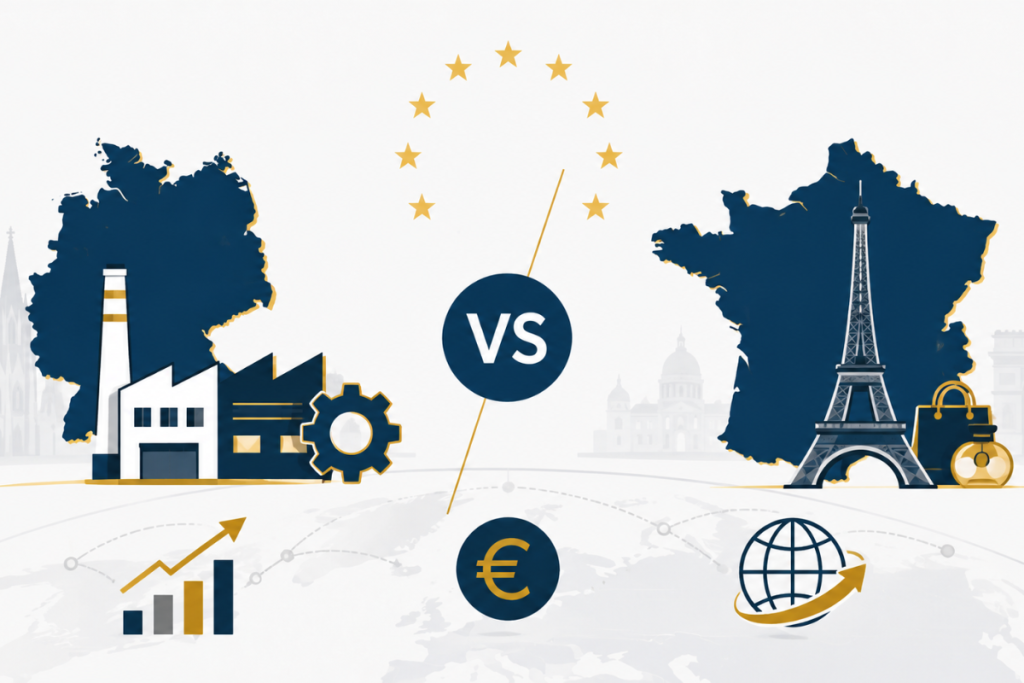
Germany is Europe’s manufacturing and B2B powerhouse — the largest economy, the dominant e-commerce market, and the strongest industrial ecosystem on the continent. France is Europe’s second-largest economy and the world’s leading destination for luxury goods, fashion, food, and consumer brand building — with its own powerful e-commerce market growing rapidly.
This guide gives you the complete, honest comparison of Germany vs France for international business expansion in 2026 — covering market size, company formation, corporate tax, language and culture, e-commerce, trademark, banking, employment, and the specific scenarios where each country is clearly the stronger choice.
Why Germany and France Are the Two Most Compared EU Markets
The Germany vs France comparison dominates foreign investor research for a straightforward reason: these two countries represent the EU’s two largest economies, and together they define the center of gravity of European commerce.
Germany’s GDP of approximately €4.1 trillion makes it the EU’s largest economy and Europe’s undisputed industrial and manufacturing leader. France’s GDP of approximately €2.8 trillion makes it the EU’s second-largest economy and the world’s most visited tourist destination — with a consumer market built on strong national brand identity and premium product categories.
Beyond their individual scale, Germany and France together represent a combined consumer market of 152 million people — more than any other two-country combination in the EU. A brand successfully established in both markets has access to the majority of the EU’s highest-value consumer spending.
Both countries attract foreign investment at scale. Both offer full EU single market access. And both present genuine challenges for international companies — different in nature but equally real in their impact on expansion timelines, costs, and operational complexity.
Germany vs France — Quick Comparison at a Glance
| Factor | Germany | France |
| GDP (2026 est.) | ~€4.1 trillion | ~€2.8 trillion |
| Population | 84 million | 68 million |
| EU market access | ✅ Full | ✅ Full |
| Primary company structure | GmbH / UG | SAS / SARL |
| Minimum capital | €25,000 (GmbH) / €1 (UG) | €1 (SAS / SARL) |
| Corporate tax rate | ~29–33% combined | ~25% |
| Language of business | German | French |
| Primary logistics hub | Hamburg, Frankfurt, Duisburg | Paris, Lyon, Marseille, Le Havre |
| E-commerce market size | Largest in EU | Second largest in EU |
| Amazon marketplace | Amazon.de (No.1 EU) | Amazon.fr (No.2 EU) |
| Trademark authority | DPMA + EUIPO | INPI + EUIPO |
| Formation timeline | 4–8 weeks (GmbH) | 1–4 weeks (SAS) |
| Formation cost (excl. capital) | €3,850–€8,600 | €1,000–€3,500 |
| English business environment | Moderate | Low–Moderate |
| Employer social charges | ~20% | ~45% of gross salary |
| Best for | B2B, manufacturing, e-commerce scale | Luxury, fashion, food, consumer brands |
Market Size and Consumer Opportunity
Germany — Largest EU Economy and Consumer Market
Germany’s 84 million consumers represent the single largest domestic consumer market in the EU — with per-capita purchasing power consistently among the highest in Europe. German consumers spend significantly on quality goods across electronics, home furnishings, clothing, automotive, and food — and they are among the most active e-commerce shoppers on the continent.
For B2B companies, Germany’s industrial and manufacturing ecosystem is unmatched in Europe. The automotive sector — centered on BMW, Mercedes-Benz, Volkswagen, and their vast supplier networks — generates enormous B2B spending. The chemical, pharmaceutical, engineering, and technology sectors add further depth to what is simply the most powerful business-to-business market in the EU.
For e-commerce sellers, Amazon.de consistently generates the highest revenue per seller of any European Amazon marketplace. The combination of market scale, high consumer spending, and strong digital adoption makes Germany the default first-choice EU market for virtually every e-commerce brand entering Europe from outside the bloc.
France — Second Largest EU Economy
France’s 68 million consumers are the EU’s second-largest consumer market — and they are defined by strong national brand loyalty, premium product preferences, and category-specific spending patterns that differ meaningfully from German consumer behavior.
French consumers are Europe’s most important market for luxury goods, fashion, beauty, wine and spirits, gourmet food, and cultural products. Paris retains its global position as the capital of luxury and fashion — making France the essential market for brands in these categories regardless of their German market ambitions.
Amazon.fr is the EU’s second-largest Amazon marketplace — growing rapidly and increasingly competitive, but still significantly smaller than Amazon.de in total consumer spending. For Amazon sellers, France represents a strong secondary market rather than a primary entry point.
Which Market Fits Your Industry?
| Industry | Germany Strength | France Strength |
| Manufacturing and engineering | ✅ Dominant | Moderate |
| Automotive | ✅ Global center | Limited |
| Electronics and technology | ✅ Strong | Moderate |
| Luxury goods | Moderate | ✅ Global center |
| Fashion and clothing | ✅ Volume | ✅ Premium positioning |
| Beauty and cosmetics | Moderate | ✅ World-leading |
| Food and beverage | ✅ Large market | ✅ Premium and gourmet |
| Wine and spirits | Moderate | ✅ Dominant globally |
| Mass-market retail | ✅ Strongest in EU | ✅ Strong |
| B2B services | ✅ Deepest market | Moderate |
| E-commerce (Amazon) | ✅ No.1 EU | ✅ No.2 EU |
Company Formation — Germany vs France
German GmbH vs French SAS
The French SAS (Société par Actions Simplifiée) is France’s most commonly used private company structure for foreign investors — offering flexible governance, minimal capital requirements, and a formation process that is generally faster and less expensive than a German GmbH.
| Factor | GmbH (Germany) | UG (Germany) | SAS (France) | SARL (France) |
| Minimum capital | €25,000 | From €1 | €1 | €1 |
| Liability | Limited | Limited | Limited | Limited |
| Formation timeline | 4–8 weeks | 2–4 weeks | 1–4 weeks | 1–4 weeks |
| Formation cost (excl. capital) | €3,850–€8,600 | €2,050–€6,200 | €1,000–€3,500 | €1,000–€3,000 |
| Notarization required | ✅ Yes — mandatory | ✅ Yes — mandatory | Only for some contributions | Only for some |
| Language of formation | German | German | French | French |
| 100% foreign ownership | ✅ Yes | ✅ Yes | ✅ Yes | ✅ Yes |
| Governance flexibility | Moderate | Moderate | ✅ High | Moderate |
| Credibility with local partners | Very High | Moderate | High | Moderate |
The French SAS offers significant advantages in formation speed and cost — and its flexible governance structure makes it a popular choice for startups and foreign investors who want to customize shareholding and management arrangements.
However, French company formation still requires French-language documentation throughout. While France does not have the same mandatory notarization requirement as Germany for most SAS formations, the administrative process — involving registration with the Greffe du Tribunal de Commerce (Commercial Court Registry) — still requires professional guidance for non-French-speaking founders.
For non-EU founders, both Germany and France present language barriers in the formation process. France is not meaningfully more accessible than Germany on this dimension — despite the lower cost and faster timeline.
Which Is Faster and Cheaper to Form?
France wins on formation speed and cost. A French SAS can be operational in 1–4 weeks at a cost of €1,000–€3,500 — significantly faster and cheaper than a German GmbH at 4–8 weeks and €3,850–€8,600.
However, the lower formation cost must be weighed against the market opportunity each structure unlocks. The German market is approximately 50% larger than the French market in GDP terms — and significantly larger for e-commerce and B2B operations. The additional formation investment for a German GmbH is a proportionally smaller cost relative to the larger market it provides access to.
Corporate Tax — Germany vs France
German Tax Structure
Germany’s corporate tax environment combines two layers — corporate income tax and trade tax — that together produce one of the higher effective corporate tax rates in the EU.
Körperschaftsteuer: Approximately 15% flat rate on taxable profits, plus a 5.5% solidarity surcharge — producing an effective corporate income tax rate of approximately 15.825%.
Gewerbesteuer (Trade Tax): A mandatory municipal-level tax varying from 7% to 17% depending on the location of the company’s registered address. Unlike corporate income tax, the trade tax is not deductible — it represents a genuine additional tax burden on top of the corporate rate.
Combined effective rate: 28–33% for most German locations — making Germany one of the higher-tax environments for operating companies within the EU.
French Tax Structure
France applies a single-tier corporate tax rate that is significantly lower than Germany’s combined rate — and it comes with one of the most generous R&D tax credit systems in the world.
Corporate Income Tax: A flat rate of approximately 25% on all taxable profits. France eliminated its tiered rate structure and simplified to a single rate — making the headline rate the effective rate without an additional layer of municipal tax.
No municipal trade tax equivalent: France does not apply a Germany-style local trade tax. The 25% corporate rate is the effective rate for most commercial operations.
Crédit d’Impôt Recherche (CIR): France’s research and development tax credit is among the most generous in the EU — providing a 30% tax credit on qualifying R&D expenditure up to €100 million, and 5% above that. For technology companies, pharmaceutical firms, or any business with significant R&D investment, the CIR provides material tax advantages that can reduce France’s effective corporate tax burden substantially below the headline rate.
Employer social charges: France’s most significant financial burden for employment-intensive businesses. French employer social charges add approximately 45% of gross salary to the employment cost of each worker — substantially higher than Germany’s equivalent burden of approximately 20%. For companies planning significant French hiring, this dramatically increases the real cost of the French workforce relative to Germany.
Tax Comparison at a Glance
| Tax Factor | Germany | France |
| Corporate income tax | ~15.825% | ~25% |
| Municipal trade tax | 7–17% additional | None |
| Combined effective rate | 28–33% | ~25% |
| R&D tax incentive | Available but limited | ✅ CIR — very generous (30%) |
| Employer social charges | ~20% of gross salary | ~45% of gross salary |
| VAT standard rate | 19% | 20% |
| Best for | Operating companies | R&D-intensive companies; lower operating tax |
For operating companies without significant R&D investment, France’s ~25% effective corporate rate is lower than Germany’s 28–33% combined rate. For companies with substantial R&D budgets, France’s CIR credit can push the effective French tax burden significantly lower — making France materially more tax-efficient for qualifying businesses.
For employment-intensive operations, Germany’s lower employer social charges make German hiring meaningfully cheaper per employee than French hiring — partly offsetting France’s lower corporate tax rate advantage.
Language and Business Culture
Germany — German Business Culture
German business culture is defined by directness, formal structure, precision, and a strong emphasis on product quality and technical competence. Business relationships in Germany are typically formal — titles matter, punctuality is essential, and detailed documentation and preparation are expected in any serious commercial engagement.
All official German company formation documents, Commercial Register filings, Finanzamt correspondence, legal contracts, and court proceedings are in German. Business meetings with German manufacturing, industrial, and traditional sector companies are frequently conducted in German — English is not assumed even at senior levels outside of international or technology companies.
For foreign companies operating in Germany, this creates a genuine dependency on German-language capability — either through German-speaking staff, local advisors, or translation services. Managing this dependency is entirely possible but represents a real ongoing operational cost.
French Business Culture
French business culture is equally formal — but with a distinctive emphasis on intellectual engagement, relationship-building, and a strong national cultural identity that extends into commercial preferences. French business partners and consumers generally prefer to communicate in French — and the expectation that international companies will engage in French is stronger in France than the equivalent German expectation in Germany.
The French business hierarchy is typically more centralized than the German equivalent — decision-making authority is concentrated at senior levels, and building the right relationships at the right organizational level is often more important than the technical merits of a proposal alone.
French consumers have strong preferences for French-language marketing, French-language customer service, and brands that demonstrate genuine engagement with French culture rather than simply translating their home-market positioning. Companies that enter France with a copy-paste international marketing approach typically underperform relative to those that invest in France-specific brand positioning.
Language Barrier Impact on Foreign Companies
Both countries require genuine local language capability for sustained commercial operations. Neither is truly English-friendly in the way that the Netherlands or Scandinavia are — though English is increasingly used in international business contexts in Paris and in German technology hubs like Berlin.
For non-EU founders comparing the two markets on language accessibility alone, neither offers a significant advantage. Both require professional local-language advisory support for formation, tax compliance, legal matters, and B2B relationship management. The language investment required in France and Germany is comparable — though the consequences of language missteps may be more commercially visible in France, where linguistic engagement with local culture is a more active consumer preference.
E-Commerce and Amazon Marketplace
Amazon Germany (Amazon.de)
Amazon.de is the largest Amazon marketplace in Europe — and no comparison between Germany and France for e-commerce purposes is complete without acknowledging the scale difference between the two marketplaces.
German consumers spend more per capita on Amazon than any other EU nation. Categories including electronics, home goods, clothing, sports equipment, tools, and consumer products generate enormous revenue through Amazon.de — making it the single most important EU e-commerce platform for the vast majority of non-EU sellers entering European markets.
Amazon Germany Brand Registry requires a registered trademark at DPMA (German national) or EUIPO (EU-wide). For sellers prioritizing Brand Registry protection, EUIPO registration provides the most cost-effective route — covering both Amazon.de and Amazon.fr with a single trademark.
Amazon France (Amazon.fr)
Amazon.fr is the EU’s second-largest Amazon marketplace — and it is growing rapidly as French consumers’ e-commerce adoption continues to increase. The marketplace is substantially smaller than Amazon.de in total consumer spending, but it represents a meaningful secondary revenue opportunity for sellers already established on Amazon.de.
French consumer protection laws — particularly around returns and consumer rights — impose specific compliance requirements on sellers operating on Amazon.fr that differ from German requirements. Understanding these requirements before entering the French marketplace prevents compliance surprises after launch.
Which Amazon Market Should You Target First?
For virtually every Amazon seller entering Europe for the first time — Germany is the correct first market. The revenue opportunity on Amazon.de is dramatically larger than Amazon.fr, and establishing Brand Registry protection in the EU’s largest marketplace should take priority over secondary markets.
Amazon.fr is the natural second marketplace for sellers already performing on Amazon.de — accessible through Pan-European FBA inventory distribution with minimal additional operational complexity.
The trademark strategy for both markets is identical: a single EUIPO trademark covers both Amazon.de and Amazon.fr Brand Registry requirements simultaneously.
Trademark System — Germany vs France
Germany — DPMA + EUIPO
Germany’s trademark system operates through DPMA (Deutsches Patent- und Markenamt) for national German protection and EUIPO for EU-wide coverage. A DPMA trademark protects your brand within Germany; an EUIPO EU Trade Mark covers all 27 EU member states including both Germany and France.
France — INPI + EUIPO
France’s national trademark authority is INPI — Institut National de la Propriété Industrielle. A trademark registered with INPI provides protection within France only. For EU-wide coverage including both France and Germany, EUIPO registration is required.
EUIPO — The Single Solution for Both Markets
The most important trademark insight for companies comparing Germany and France: a single EUIPO EU Trade Mark covers both countries simultaneously — along with all other 25 EU member states — under one application and one fee.
For foreign companies entering both the German and French markets, EUIPO registration eliminates the need for separate DPMA and INPI national registrations. One trademark search covering DPMA, INPI, EUIPO, and WIPO databases confirms whether your brand is conflict-free across both target markets before a single euro is invested in company formation.
This is the most cost-effective trademark strategy for any company with multi-market EU ambitions — and it should be step one in any Germany or France expansion plan.
For companies with urgent timelines — particularly Amazon sellers needing immediate Brand Registry access — acquiring an existing registered EUIPO trademark provides immediate protection in both Germany and France simultaneously, without the 4–6 month wait for new registration examination.
Banking and Financial Services
German Business Banking
German business banking is comprehensive but challenging for non-EU founders. Traditional German banks — Deutsche Bank, Commerzbank, Sparkasse — apply rigorous KYC processes for non-EU directors, frequently require in-person attendance, and take 4–8 weeks to open accounts.
Fintech alternatives — particularly Qonto — provide faster, remote-friendly German business banking with VideoIdent verification for non-EU directors. Most non-EU founders starting a German company use Qonto or a similar fintech for their initial operational banking, with a traditional bank relationship developed as the German business establishes a local track record.
French Business Banking
French business banking presents broadly similar challenges to German banking for non-EU founders — with some differences in specific bank requirements and process.
Major French banks — BNP Paribas, Société Générale, Crédit Agricole, LCL — offer business banking services for foreign-owned French companies. Account opening requirements for non-EU directors vary by bank but generally involve similar documentation to German banks — identity verification, company formation documents, proof of address, and beneficial ownership declarations.
Qonto — originally a French fintech — provides particularly strong business banking services for French SAS and SARL companies, with remote account opening and a French IBAN. For foreign founders forming a French SAS, Qonto’s French market expertise makes it a natural banking choice.
Comparison — Which Is More Accessible?
Both countries present similar banking accessibility challenges for non-EU founders. Neither is dramatically easier than the other for foreign company banking — though France’s fintech banking ecosystem, led by Qonto, provides a relatively smooth path to a French business account for foreign-owned entities.
Employment and Labor Laws
Germany Employment Law
Germany offers strong employee protections within a structured, predictable legal framework. Key characteristics:
Working hours: Standard 48-hour maximum working week; collective agreements often set lower limits.
Dismissal protection: German employment law provides significant dismissal protection for employees after a probationary period. Unfair dismissal claims must be filed within 3 weeks. Redundancy requires genuine business justification.
Works councils (Betriebsrat): Companies with 5 or more permanent employees are eligible to establish works councils. Companies with 20 or more employees must consult works councils on specific operational decisions.
Employer social charges: Approximately 20% of gross salary — covering pension, health, unemployment, and long-term care insurance contributions. Competitive within the EU.
Average salary (manufacturing sector): €40,000–€60,000 annually — reflecting Germany’s strong wage level.
French Employment Law
France’s employment framework is among the most protective for employees in the EU — and among the most complex for employers to navigate.
35-hour working week: France’s famous 35-hour legal work week applies to most employees, with overtime subject to specific rules and compensation requirements. Managing working time compliance is a significant administrative burden for French employers.
Dismissal complexity: French employment law makes dismissal — particularly for performance reasons — a complex, documentation-intensive process with significant risk of legal challenge. Redundancy procedures are strictly regulated and can take months to complete.
Union presence: French unions are active at both sector and company level. Collective bargaining agreements (conventions collectives) covering specific industries define minimum employment terms that frequently exceed the statutory minimums.
Employer social charges: Approximately 45% of gross salary — one of the highest employer social charge burdens in the EU. For every €100 of gross salary paid to a French employee, the employer pays approximately €45 in social contributions on top.
Employment cost comparison:
| Employment Factor | Germany | France |
| Employer social charges | ~20% of gross salary | ~45% of gross salary |
| Effective cost of €50,000 salary | ~€60,000 total | ~€72,500 total |
| Dismissal complexity | Moderate | High |
| Working time regulation | Flexible | Strict (35-hour week) |
| Union environment | Structured | Active and influential |
For employment-intensive businesses — retail, manufacturing, customer service, logistics — France’s employer social charges significantly increase the cost per employee relative to Germany. This is one of the most important financial factors for companies planning to hire local staff in either market.
Industry-Specific Recommendations:
Manufacturing and Engineering → Germany
Germany is the undisputed European leader in manufacturing, engineering, and industrial production. The German Mittelstand — the ecosystem of mid-sized manufacturing and engineering companies — represents the most sophisticated industrial supplier and customer base in Europe. Foreign manufacturers entering Europe looking for supply chain partnerships, distribution relationships, or direct B2B customers will find Germany’s industrial ecosystem unmatched.
Luxury, Fashion, and Beauty → France
France is the global center of luxury goods, high fashion, and premium beauty — a position it has held for centuries and shows no signs of relinquishing. For brands in these categories, France is not just the largest market — it is the market where brand positioning is established, where industry perception is shaped, and where global credibility in luxury and premium product categories is earned. A luxury brand that succeeds in France carries a market endorsement that no other EU country provides.
E-Commerce and Amazon → Germany First
For Amazon sellers and e-commerce brands, Germany is the primary European market without meaningful competition from France at the same revenue scale. Amazon.de’s consumer spending significantly exceeds Amazon.fr’s, and German consumers’ digital adoption and per-capita online spending make Germany the correct first e-commerce market for virtually every non-EU seller entering Europe.
Automotive → Germany, Unambiguously
The global automotive industry’s European center of gravity is Germany — full stop. Any company in the automotive supply chain, automotive technology, electric vehicle ecosystem, or automotive services targeting European customers must have a German presence. There is no meaningful alternative.
Food, Wine, and Gourmet Products → France
France’s food and wine culture is both a commercial opportunity and a brand positioning asset. The French AOC and AOP designation systems create premium positioning for food and beverage products that extends into German and global export markets. Companies in food, wine, spirits, and gourmet products entering Europe will find France’s market credentials irreplaceable for premium brand building.
Technology and SaaS → Germany for Scale
For technology companies and SaaS businesses, Germany offers the largest addressable market in the EU — the most technology-literate business community and the strongest enterprise software spending. Berlin has developed into one of Europe’s most significant technology startup ecosystems. For SaaS companies targeting EU enterprise customers, Germany’s market scale makes it the primary entry point.
Which Country Is Right for Your Business Type?
| Business Type | Germany | France | Recommendation |
| Amazon FBA seller | ✅ No.1 EU | ✅ No.2 EU | Germany first — revenue scale decisive |
| B2B manufacturer | ✅ Best in EU | Moderate | Germany |
| Luxury brand | Moderate | ✅ Global center | France — positioning is irreplaceable |
| Fashion brand | ✅ Volume market | ✅ Premium positioning | France for brand; Germany for volume |
| Technology / SaaS | ✅ Largest market | Moderate | Germany |
| Beauty and cosmetics | Moderate | ✅ World-leading | France |
| Food and beverage | ✅ Large market | ✅ Premium gourmet | France for premium; Germany for volume |
| Automotive | ✅ Global center | Limited | Germany — no competition |
| Mass-market retail | ✅ Largest | ✅ Strong | Germany for scale |
| Indian company entering EU | ✅ Large market | Moderate | Germany first |
| Chinese company entering EU | ✅ E-commerce | ✅ Luxury | Germany for Amazon; France for luxury |
| US/UK company entering EU | ✅ B2B scale | ✅ Consumer premium | Depends on product category |
| Cosmetics / skincare | Moderate | ✅ Strong perception | France — Paris positioning advantage |
| Wine and spirits | Moderate | ✅ Global authority | France |
Can You Expand to Both Germany and France?
For companies building serious European market presence, expanding to both Germany and France is not just possible — for many business categories it is the optimal long-term strategy. Together, Germany and France provide 152 million consumers and access to the EU’s two most commercially important economies.
Sequential Expansion
Most foreign companies entering Europe start with one market and expand to the second once the operational model is proven and generating sufficient revenue to fund the second market setup.
Revenue-first sequence: Germany first for e-commerce, B2B, and technology companies — then France once Amazon.de and German B2B relationships are generating revenue. Germany’s larger market typically generates the revenue needed to fund the French expansion.
Positioning-first sequence: France first for luxury, fashion, beauty, and premium food brands — establishing the Paris market credibility that enhances the brand’s German and broader EU positioning. Then Germany for volume once brand positioning is established.
EUIPO Trademark — The Simplest Dual-Market Solution
Regardless of your expansion sequence, a single EUIPO trademark registration covers both Germany and France simultaneously — from the moment of registration or transfer completion.
For companies planning both markets, EUIPO is the only trademark strategy that makes sense. Separate DPMA (Germany) and INPI (France) national registrations add cost and complexity for no additional protection that an EUIPO registration does not already provide.
Germany vs France vs Netherlands — Three-Way Quick Comparison
For companies evaluating all three of Europe’s most popular foreign investment destinations, here is a condensed comparison across the key decision factors.
| Factor | Germany | France | Netherlands |
| Market size | Largest EU | 2nd EU | 5th EU |
| Formation speed | 4–8 weeks | 1–4 weeks | 1–2 weeks |
| Formation cost | €3,850–€8,600 | €1,000–€3,500 | €1,500–€4,000 |
| Effective corporate tax | 28–33% | ~25% | 19–25.8% |
| Employer social charges | ~20% | ~45% | ~18% |
| Language barrier | High | High | Low |
| E-commerce (Amazon) | No.1 EU | No.2 EU | No.4 EU |
| Holding company | Limited | Limited | ✅ Best (participation exemption) |
| Best for | B2B, manufacturing, scale | Luxury, premium brands | Logistics, holding, speed |
For a full analysis of Germany vs Netherlands specifically — including the Dutch BV vs German GmbH comparison, the Dutch participation exemption, and Rotterdam vs Hamburg logistics — the dedicated Germany vs Netherlands guide covers every dimension of that specific comparison in detail.
Germany vs France for Business Expansion
Which country has a lower corporate tax rate — Germany or France?
France’s effective corporate tax rate of approximately 25% is lower than Germany’s combined rate of 28–33% (corporate income tax plus trade tax). For R&D-intensive companies, France’s CIR tax credit can reduce the effective rate further. Germany’s advantage is that it has no equivalent to France’s 45% employer social charge burden — making German employment significantly cheaper per worker.
Which country is easier to form a company in as a foreigner?
France is generally faster and cheaper to form a company in — a French SAS can be operational in 1–4 weeks at €1,000–€3,500. However, both countries require French and German language documentation respectively — neither is accessible to non-local-language speakers without professional advisory support.
Do I need separate trademarks for Germany and France?
No. A single EUIPO EU Trade Mark covers both Germany and France — along with all other 25 EU member states — under one registration. This is the most cost-effective trademark strategy for any company targeting both markets.
Which country is better for Amazon sellers?
Germany is definitively better for Amazon sellers targeting maximum European revenue. Amazon.de generates substantially higher consumer spending than Amazon.fr. Most successful European Amazon sellers enter Germany first and expand to France through Pan-European FBA as a secondary market.
Which country is better for luxury brands?
France is the correct first market for luxury brands without question. The French market’s role in luxury brand credibility — centered on Paris — is irreplaceable. No other EU market confers the same brand positioning advantage for luxury, fashion, and premium product categories.
Are German employees more expensive than French employees?
In gross salary terms, German and French salaries are broadly comparable for many roles. However, France’s employer social charges of approximately 45% of gross salary make the total employment cost per French worker significantly higher than the equivalent German worker — where employer social charges are approximately 20%.
Which country has better logistics infrastructure?
Germany has superior logistics infrastructure for EU-wide distribution — with Hamburg as Europe’s second-largest container port, the central EU road and rail network, and Amazon FBA fulfillment centers across the country. France’s logistics infrastructure is strong for southern European and North African distribution but less central for EU-wide coverage than Germany’s network.
Can I target both Germany and France with one trademark?
Yes — a single EUIPO trademark registration covers both countries simultaneously. A professional trademark search covering DPMA (Germany), INPI (France), EUIPO, and WIPO databases confirms your brand is conflict-free in both markets before you invest in either company formation or trademark registration.
Germany for Scale, France for Positioning — Both for Complete EU Presence
The Germany vs France decision comes down to one fundamental question: what does your business need from its first — or next — European market?
If you need revenue scale, B2B market depth, e-commerce dominance, and the largest consumer market in Europe — Germany is your market. The GmbH formation process is more complex and expensive than France’s SAS equivalent, but the market it unlocks is 50% larger and generates higher per-capita consumer spending.
If you need luxury positioning, premium consumer brand credibility, category leadership in fashion, beauty, food, or wine — or France’s generous R&D tax credit for technology-intensive businesses — France is your market. The SAS forms faster and cheaper, and Paris confers brand authority that no German city can replicate for premium consumer categories.
And if you are building a serious, long-term European business that needs both revenue scale and brand positioning — the answer is both markets, connected by a single EUIPO trademark that protects your brand across Germany, France, and all 27 EU member states simultaneously.
Whatever your choice, both markets require one foundation before any other investment: a confirmed trademark that is legally safe to build on in the EU. That confirmation starts with a professional trademark search. And it starts on Day 1.
Ready to expand your business into Germany, France, or both EU markets?
Get expert support combining trademark protection and company formation — so your European expansion starts on legally secure and commercially confident ground.
👉 Book a Consultation | 👉 Explore Company Formation Services | 💬 WhatsApp Expert Support