Two Strong Choices — Only One Is Right for Your Business
You have decided to expand into Europe. You have done your initial research. Two countries keep appearing at the top of every list — Germany and the Netherlands.
Both are founding members of the EU. Both offer full access to the EU single market. Both have strong rule of law, established business infrastructure, and significant foreign investment communities. On the surface, they look like equally valid choices.
They are not equally valid for every business. The right choice depends entirely on your industry, your operational model, your target customers, your timeline, your capital, and your long-term European strategy.
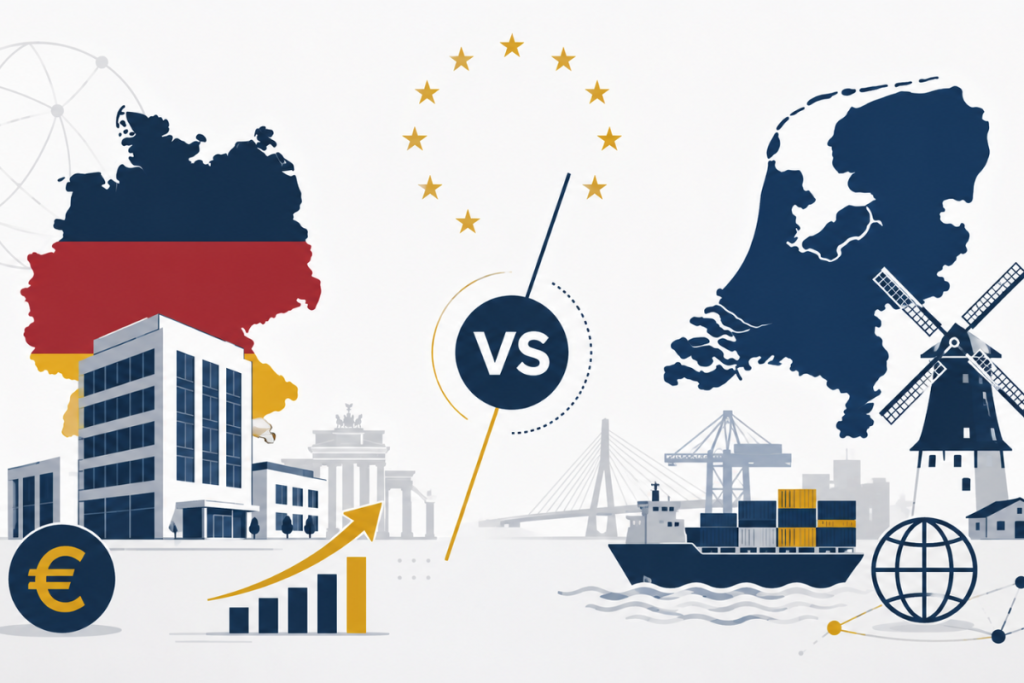
Germany is Europe’s largest economy — the biggest consumer market, the most powerful B2B ecosystem, and the dominant e-commerce destination on the continent. The Netherlands is Europe’s most internationally accessible business environment — English-friendly, tax-efficient for holding structures, and home to the world’s largest port and one of its busiest airports.
This guide gives you the complete, honest comparison of Germany vs Netherlands for business expansion in 2026 — covering market size, company formation, tax, trademark, banking, logistics, e-commerce, and the specific scenarios where each country is the stronger choice.
By the end, you will know which country fits your business — or whether both belong in your European expansion plan.
Why Foreign Companies Compare Germany and the Netherlands
Germany and the Netherlands are the two most commonly compared EU destinations for foreign business expansion — and for good reason. They share several critical advantages that make them stand out from other EU member states:
- Full EU single market access — goods, services, and capital move freely across all 27 member states
- Political and economic stability — both are among the most stable economies globally
- Strong rule of law — contracts are enforced, IP rights are respected, courts function reliably
- Established foreign investor communities — both countries have extensive infrastructure for supporting international businesses
- World-class logistics infrastructure — Rotterdam and Hamburg between them handle a significant proportion of all European trade
Where they diverge is in the specifics — market scale, language, tax structure, formation complexity, e-commerce opportunity, and the type of business operations they best support.
Germany vs Netherlands — Quick Comparison at a Glance
| Factor | Germany | Netherlands |
| GDP (2026 est.) | ~€4.1 trillion | ~€1.1 trillion |
| Population | 84 million | 18 million |
| EU market access | ✅ Full | ✅ Full |
| Primary company structure | GmbH / UG | BV (Besloten Vennootschap) |
| Minimum capital (standard) | €25,000 (GmbH) / €1 (UG) | €0.01 (BV) |
| Corporate tax rate | ~29–33% (combined) | ~19–25.8% |
| Language of business | German (English in corporate/international contexts) | English widely used at all levels |
| Primary logistics hub | Hamburg, Frankfurt, Duisburg | Rotterdam, Amsterdam, Schiphol |
| E-commerce market | Largest in EU (Amazon.de) | Top 5 in EU (Amazon.nl growing) |
| Trademark authority | DPMA (national) + EUIPO (EU) | BOIP (Benelux) + EUIPO (EU) |
| Formation timeline | 4–8 weeks (GmbH) / 2–4 weeks (UG) | 1–2 weeks (BV) |
| Formation cost (excl. capital) | €3,850–€8,600 | €1,500–€4,000 |
| English business environment | Moderate | Very High |
| Best for | Market scale, B2B, e-commerce revenue | Speed of setup, holding structures, logistics gateway |
Market Size and Consumer Opportunity
Germany — Europe’s Largest Consumer Market
Germany’s consumer market is simply the largest in the EU — and it is not close. With 84 million consumers and one of the highest per-capita purchasing powers in Europe, Germany provides a commercial opportunity that no other single EU market can match.
For B2C businesses, Germany represents the largest addressable domestic market in the EU. For B2B companies, Germany’s industrial, manufacturing, automotive, chemical, and technology sectors form the most powerful business-to-business ecosystem in Europe. For e-commerce sellers, Amazon.de is consistently the highest-revenue Amazon marketplace outside of the United States.
The German consumer is discerning — quality, reliability, and clear value propositions matter significantly in German purchasing decisions. Companies that succeed in the German market have typically invested in understanding local preferences rather than simply translating their home-market approach into German.
Netherlands — Smaller but High-Value Market
The Netherlands has 18 million consumers — a fraction of Germany’s scale — but they are among the highest-spending consumers in the EU per capita. The Dutch digital adoption rate is among the highest in Europe, making the Netherlands an attractive first market for digital products, SaaS businesses, and e-commerce brands testing EU-specific messaging before scaling to larger markets.
Amazon.nl launched in 2020 and has grown steadily since — but it remains significantly smaller than Amazon.de in both seller count and consumer spending. For Amazon sellers specifically, the Netherlands is a secondary market, not a primary revenue opportunity.
Which Market Is Right for Your Business Size?
For companies prioritizing revenue scale and B2B market depth, Germany is the stronger choice. The market is larger, the B2B spending is deeper, and the e-commerce opportunity — particularly on Amazon.de — is significantly greater.
For companies prioritizing speed of market entry, English-language operations, and a less complex initial setup, the Netherlands offers a more accessible starting point — with Germany as a natural subsequent expansion once the operational model is proven.
Logistics and Distribution Infrastructure
Germany’s Logistics Advantage
Germany’s logistics infrastructure is the backbone of European distribution for a large proportion of goods moving across the continent.
The Port of Hamburg — Europe’s second-largest container port — handles enormous volumes of goods from Asia and the Americas entering the European market. The rail and road network radiating from Germany connects to every EU member state efficiently. Duisburg, Germany’s industrial heartland, hosts the world’s largest inland port and is the primary European terminus for China’s Belt and Road rail freight routes.
For Amazon sellers, Germany hosts multiple large Amazon FBA fulfillment centers — enabling fast Prime delivery across Germany and, through Pan-European FBA, across the broader EU. Companies storing inventory in German Amazon warehouses benefit from some of the most efficient fulfillment infrastructure in the EU.
Netherlands’ Logistics Advantage
The Port of Rotterdam is Europe’s largest container port — and one of the world’s largest — handling a vast share of all goods entering and leaving northern Europe. For companies importing from Asia, the Americas, or other global markets, Rotterdam provides the most efficient deep-water port gateway into Europe.
Schiphol Airport is one of Europe’s most important air cargo hubs — making the Netherlands particularly advantageous for high-value, time-sensitive goods moving by air. Amsterdam’s tech and digital infrastructure also supports the Netherlands’ growing position as a European data center hub.
For distribution across northern and western Europe — UK, Scandinavia, Belgium, France — the Netherlands’ geographic position provides efficient outbound logistics that rivals Germany’s central EU position.
Which Is Better for Your Supply Chain?
For companies distributing primarily within the EU’s central and eastern markets — and particularly for Amazon FBA operations — Germany’s central position and Hamburg port access is the stronger logistics base.
For companies importing goods from Asia by sea and distributing primarily across northern and western Europe — or those with significant UK trade relationships — the Netherlands’ Rotterdam gateway is often the more efficient entry point.
Company Formation — Germany vs Netherlands
German GmbH vs Dutch BV
The comparison between Germany’s GmbH and the Netherlands’ BV (Besloten Vennootschap) is one of the most frequently cited factors in the Germany vs Netherlands decision.
| Factor | GmbH (Germany) | UG (Germany) | BV (Netherlands) |
| Minimum capital | €25,000 | From €1 | €0.01 |
| Capital at formation | €12,500 | Full amount | Full amount |
| Liability | Limited | Limited | Limited |
| Formation timeline | 4–8 weeks | 2–4 weeks | 1–2 weeks |
| Formation cost (excl. capital) | €3,850–€8,600 | €2,050–€6,200 | €1,500–€4,000 |
| Notarization required | ✅ Yes — mandatory | ✅ Yes — mandatory | ✅ Yes — mandatory |
| Language of formation | German | German | Dutch (English accepted in many cases) |
| 100% foreign ownership | ✅ Yes | ✅ Yes | ✅ Yes |
| Credibility with local partners | Very High | Moderate | High |
The Dutch BV forms faster and at lower cost than a German GmbH. The Netherlands notarization process accepts English-language documentation in many cases — a significant practical advantage for non-Dutch-speaking foreign founders compared to Germany’s exclusively German-language notarization requirements.
However, the GmbH carries stronger credibility in German B2B markets — and the German market it unlocks is four times larger than the Dutch market. The formation cost premium for a GmbH is a meaningful investment in a much larger commercial opportunity.
Which Is Faster and Cheaper to Set Up?
Netherlands wins on formation speed and cost. A Dutch BV can be operational in 1–2 weeks with formation costs of €1,500–€4,000. A German GmbH takes 4–8 weeks and costs €3,850–€8,600 excluding share capital.
For companies where speed of legal entity setup is the primary concern — particularly startups or companies needing a European entity quickly for a specific commercial opportunity — the Netherlands offers a faster path to operational status.
Corporate Tax — Germany vs Netherlands
Germany Corporate Tax Structure
German corporate taxation combines two layers that together produce one of the higher effective corporate tax rates in the EU.
Körperschaftsteuer (Corporate Income Tax): Approximately 15% on taxable profits, plus a 5.5% solidarity surcharge — producing an effective corporate income tax rate of approximately 15.825%.
Gewerbesteuer (Trade Tax): A municipal-level tax that varies by location, typically ranging from 7% to 17% of taxable income. Trade tax applies to virtually all commercial entities in Germany and is not deductible against corporate income tax.
Combined effective rate: Most German locations produce a combined corporate tax burden of 28–33% — making Germany one of the higher-tax environments for operating companies within the EU.
Netherlands Corporate Tax Structure
The Netherlands applies a tiered corporate tax rate that is more favorable than Germany’s combined rate, particularly for growing businesses.
Corporate Income Tax:
- 19% on the first €200,000 of taxable profits
- 25.8% on profits above €200,000
No trade tax equivalent: The Netherlands does not apply a Germany-style municipal trade tax — meaning the headline corporate tax rate is the effective rate, without an additional layer.
Dutch participation exemption: The Netherlands’ most distinctive tax advantage for holding structures. Dividends and capital gains received from qualifying subsidiaries are exempt from Dutch corporate tax — making the Netherlands the preferred jurisdiction for multinational holding companies managing EU subsidiary income.
Tax Comparison at a Glance
| Tax Factor | Germany | Netherlands |
| Corporate income tax | ~15.825% | 19% (first €200K) / 25.8% (above) |
| Municipal trade tax | 7–17% (additional) | None |
| Combined effective rate | 28–33% | 19–25.8% |
| Holding company advantage | Limited | ✅ Strong (participation exemption) |
| R&D tax incentive | Available | ✅ Innovation box (9% on qualifying IP income) |
| Best for | Operating companies | Holding structures, IP management |
For operating companies — businesses actively selling products or services — both tax environments are comparable at scale, though the Netherlands’ lower effective rate provides a modest advantage. For holding companies and IP management structures, the Netherlands’ participation exemption and innovation box provide material advantages over Germany.
Language and Business Culture
Germany — German-Language Business Environment
German is the official language of business in Germany — and unlike Scandinavian countries or the Netherlands, German business culture does not default to English in most commercial contexts.
All official company formation documents are in German. Commercial Register filings, Finanzamt correspondence, legal contracts, and court proceedings are in German. B2B business meetings — particularly with German manufacturing, industrial, and traditional sector companies — are frequently conducted in German.
For non-German-speaking foreign founders, this creates a practical dependency on German-language advisory support, translation services, and in some cases local German-speaking staff. This is a manageable challenge — but it is a real one that adds operational friction and cost that is absent in the Netherlands.
In international and technology company environments in major German cities — Berlin, Munich, Frankfurt, Hamburg — English is used more freely. But the baseline assumption for business operations in Germany is German, not English.
Netherlands — English-Friendly Business Environment
The Netherlands consistently ranks among the top countries globally for English language proficiency — and this extends from casual conversation into formal business contexts.
Business contracts, shareholder agreements, board meetings, and commercial correspondence in the Netherlands routinely take place in English. Dutch BV formation documents can be prepared in English in many cases. Banking, accounting, and legal advisory services are widely available in English. Hiring international English-speaking staff in Amsterdam, Rotterdam, or other major Dutch cities is straightforward.
For non-EU founders who do not speak German, Dutch, or any EU language, the Netherlands offers significantly lower day-to-day operational friction than Germany. The language advantage is particularly valuable for companies managing their European entity remotely from India, China, the US, or the UK — where English-language operations eliminate a layer of translation dependency.
Impact on Day-to-Day Operations
For companies with a German-speaking founder or local German advisory support, Germany’s language environment is entirely manageable. For companies managing their European entity remotely without German language capability, the Netherlands’ English-friendly environment reduces friction across banking, legal, accounting, and partner communication.
E-Commerce and Amazon Marketplace
Amazon Germany (Amazon.de)
Amazon.de is the largest Amazon marketplace in Europe — and among the most important e-commerce platforms globally. For sellers expanding from Asian, Indian, or US markets into Europe, Amazon Germany represents the single largest digital commerce revenue opportunity on the continent.
Amazon Germany Brand Registry enrollment requires a registered trademark at DPMA (German national) or EUIPO (EU-wide). The marketplace’s scale — combined with Germany’s strong consumer purchasing power — makes it the primary target for virtually every Amazon seller considering European expansion.
The competition on Amazon.de is intense — but so is the revenue potential. Categories including electronics, clothing, home goods, sports equipment, and consumer products generate enormous sales volumes through Amazon.de that no other EU marketplace approaches.
Amazon Netherlands (Amazon.nl)
Amazon.nl launched in 2020 and has grown steadily as Dutch consumers increasingly use the platform for everyday purchases. The marketplace is significantly smaller than Amazon.de — both in seller count and total consumer spending — but it offers lower competition and easier ranking for categories that are saturated on Amazon.de.
For sellers already established on Amazon.de, expanding to Amazon.nl through Pan-European FBA is a straightforward way to capture additional European revenue with minimal incremental effort.
Which Amazon Market Should You Target First?
For any Amazon seller entering Europe for the first time — Germany is the correct first market. The revenue opportunity is dramatically larger, the consumer base is four times the size, and Brand Registry protection on Amazon.de is more critical given the higher competition and counterfeit risk.
Amazon.nl is a valuable secondary market for sellers already established in Germany — not a starting point for European Amazon expansion.
Trademark System — Germany vs Netherlands
Germany Trademark System (DPMA + EUIPO)
Germany operates a national trademark system through DPMA (Deutsches Patent- und Markenamt) for German-only protection, alongside EU-wide coverage through EUIPO registration. A DPMA trademark protects your brand within Germany; an EUIPO trademark protects across all 27 EU member states including Germany.
For foreign companies entering Germany, EUIPO registration is the most cost-effective route — one application, one fee, protection across all 27 EU member states including both Germany and the Netherlands.
Netherlands Trademark System (BOIP + EUIPO)
The Netherlands does not have its own national trademark office. Dutch trademark registration is handled by BOIP — the Benelux Office for Intellectual Property — which covers the Netherlands, Belgium, and Luxembourg under a unified Benelux trademark system.
BOIP registration provides protection across the Benelux region (Netherlands, Belgium, Luxembourg) — a smaller territory than a full EUIPO EU Trade Mark but more targeted for Benelux-focused operations.
EUIPO — The Common Ground
The critical point for companies comparing Germany and the Netherlands: a single EUIPO trademark registration provides full protection in both countries simultaneously — along with the other 25 EU member states.
For foreign companies choosing between Germany and the Netherlands — or planning to expand to both — EUIPO registration is the single most cost-effective trademark solution. One application covers both markets entirely, making the trademark decision independent of the company formation location decision.
A professional trademark search covering DPMA, BOIP, EUIPO, and WIPO databases before any trademark investment ensures your brand is conflict-free across both target markets.
Banking and Financial Services
German Business Banking
German business banking is comprehensive and well-established — but it is more challenging for non-EU founders than Dutch banking. Traditional German banks apply extensive KYC requirements for non-EU directors, frequently require in-person attendance, and take 4–8 weeks to open accounts for foreign company entities.
Fintech alternatives — particularly Qonto — provide a faster, remote-friendly path to a German business account with a German IBAN, typically within 1–3 weeks via VideoIdent verification.
Dutch Business Banking
Dutch business banking is generally more accessible for international clients than German banking. Major Dutch banks — ING, Rabobank, ABN AMRO — have well-developed international client infrastructure, and English-language banking is standard rather than exceptional.
Fintech banking options including Bunq provide additional flexibility for foreign-owned Dutch entities. The combination of English-language banking, more flexible KYC processes for international clients, and faster account opening makes Dutch banking a meaningfully easier experience for most non-EU founders compared to Germany.
Which Banking Environment Is More Accessible for Foreign Founders?
The Netherlands offers a more accessible banking environment for non-EU founders — particularly those without German language capability or an existing German banking relationship. For founders who have already navigated German banking or have professional support in place, the difference is manageable. For founders starting from scratch, Dutch banking friction is meaningfully lower.
Holding Company and Tax Structures
Netherlands as a Holding Company Base
The Netherlands is one of Europe’s most established holding company jurisdictions — and the Dutch participation exemption is the primary reason why.
Under the participation exemption, dividends and capital gains received by a Dutch company from qualifying subsidiary shareholdings are fully exempt from Dutch corporate tax. For multinational groups with subsidiaries across multiple EU member states — or with operating companies in Germany — a Dutch holding company can receive subsidiary profits tax-free at the holding level.
The Dutch innovation box further reduces the effective tax rate on income derived from qualifying intellectual property to approximately 9% — making the Netherlands particularly attractive for companies with valuable IP assets, including registered trademarks, patents, and software.
Germany for Operational Companies
Germany is better suited to direct operational companies — businesses actively selling products or services to German and EU customers — than to holding or IP management structures. Germany’s trade tax and relatively high combined corporate rate make it less competitive than the Netherlands for passive holding activity.
Using Both — Germany Operations + Netherlands Holding
A structure that foreign investors increasingly use for serious EU market expansion is combining both jurisdictions: a Dutch holding company (BV) owning a German operating subsidiary (GmbH or UG). This structure captures the Netherlands’ tax efficiency at the holding level while accessing the German market’s commercial scale at the operating level.
This is a more complex and more costly structure to establish and maintain — but for companies planning substantial EU operations with significant profit levels, the tax efficiency and structural flexibility can justify the additional setup and compliance cost.
Which Country Is Right for Your Business Type?
| Business Type | Germany | Netherlands | Recommendation |
| Amazon FBA seller | ✅ Dominant | Growing | Germany first — revenue scale is incomparable |
| B2B manufacturer | ✅ Best in EU | Moderate | Germany — deepest B2B market in Europe |
| E-commerce brand (direct) | ✅ Strong | ✅ Accessible | Germany for scale; Netherlands for faster setup |
| Logistics and distribution | ✅ Central EU hub | ✅ Port gateway | Netherlands for sea imports; Germany for EU distribution |
| Tech startup | Moderate | ✅ Strong | Netherlands — English-friendly, lower setup cost, tech ecosystem |
| Holding company | Limited advantage | ✅ Best in EU | Netherlands — participation exemption advantage |
| IP management company | Limited | ✅ Strong | Netherlands — innovation box at 9% on qualifying IP income |
| Indian company entering EU | ✅ Large market | ✅ Easy setup | Germany for revenue; Netherlands for easier first entry |
| Chinese company entering EU | ✅ E-commerce | ✅ Port gateway | Germany for Amazon; Netherlands for logistics and holding |
| US/UK company entering EU | ✅ Market scale | ✅ Ease of entry | Netherlands for speed; Germany for long-term revenue |
| Franchise and licensing | ✅ Strong | Moderate | Germany — largest franchise market in EU |
| SaaS and digital services | ✅ Large user base | ✅ English market | Netherlands for operations; Germany for scale |
Can You Expand to Both Germany and the Netherlands?
For companies with serious European ambitions, expanding to both Germany and the Netherlands is not only possible — it is often the optimal long-term strategy.
Sequential Expansion
The most common approach for foreign companies with limited initial capital is sequential expansion — entering one market first, establishing operations, generating revenue, and then expanding to the second market once the operational model is proven.
The typical sequence depends on priorities:
- Revenue-first strategy: Enter Germany first for market scale, then add Netherlands operations once profitable
- Ease-of-entry strategy: Enter Netherlands first for faster setup and lower cost, then expand to Germany once the European entity is established
Simultaneous Expansion
Companies with sufficient capital and management bandwidth can establish entities in both countries simultaneously — capturing both markets from day one. This requires coordinating two company formation processes, two banking setups, and two sets of ongoing compliance obligations — but it eliminates the sequential delay.
EUIPO Trademark — The Simplest Dual-Market Solution
Regardless of your expansion sequence, a single EUIPO trademark registration provides brand protection in both Germany and the Netherlands simultaneously — from the moment of registration. There is no need for separate DPMA (Germany) and BOIP (Netherlands) registrations if EUIPO coverage is in place.
For companies planning to operate in both markets, EUIPO trademark acquisition or registration is the most cost-effective brand protection strategy — covering both target markets with a single investment.
Germany vs Netherlands for Business Expansion
Which country has lower corporate taxes — Germany or Netherlands?
The Netherlands has a lower effective corporate tax rate for most operating companies — 19–25.8% compared to Germany’s combined rate of 28–33% (corporate income tax plus trade tax). For holding companies, the Netherlands’ participation exemption creates additional tax advantages not available in Germany.
Which country is easier to form a company in as a foreigner?
The Netherlands is generally easier and faster for foreign founders — particularly non-EU founders without German language capability. A Dutch BV forms in 1–2 weeks, accepts English documentation in many cases, and has a more internationally accessible banking environment. A German GmbH takes 4–8 weeks and requires German-language documentation throughout.
Do I need separate trademarks for Germany and the Netherlands?
No. A single EUIPO trademark (EU Trade Mark) covers both Germany and the Netherlands — along with all other 27 EU member states — under one registration. For companies targeting both markets, EUIPO is the most cost-effective trademark solution.
Which country is better for Amazon sellers?
Germany is definitively better for Amazon sellers as a primary market. Amazon.de is the largest Amazon marketplace in Europe with dramatically higher consumer spending than Amazon.nl. Most successful European Amazon sellers treat Germany as their primary EU marketplace and the Netherlands as a secondary market accessed through Pan-European FBA.
Can I use a Dutch BV to operate in Germany?
Yes — a Dutch BV can trade in Germany as a foreign company operating in the EU single market. However, for sustained German operations — including hiring employees, maintaining a physical presence, or entering significant German commercial contracts — forming a German GmbH or UG subsidiary is typically the more appropriate structure.
Which country has better logistics for Asian imports?
Both offer excellent port access — Rotterdam (Netherlands) is Europe’s largest container port while Hamburg (Germany) is Europe’s second largest. Rotterdam has a slight advantage for deep-sea container volumes from Asia; Hamburg has stronger rail connections into central and eastern Europe. The best choice depends on your specific distribution destinations within Europe.
Is English sufficient to run a business in Germany?
In major German cities and in international/technology business environments, English is widely used. For formal legal, tax, and government interactions — including company formation, VAT registration, and Commercial Register filings — German is required. Non-German-speaking founders typically need professional advisory support for German-language compliance matters.
Which country should I choose if I want to expand across all of Europe?
Both are strong bases for EU-wide expansion — but they serve different strategic roles. Germany provides the largest single-country market and central EU distribution infrastructure. The Netherlands provides tax-efficient holding structures and the best port gateway for goods entering northern Europe. Companies with serious pan-European ambitions often use both — a Dutch holding company with German operating subsidiaries.
Germany for Scale, Netherlands for Ease — Or Both for Maximum Impact
The Germany vs Netherlands comparison does not have a universal answer. It has the right answer for your specific business — and that answer depends on what you are actually trying to achieve in Europe.
If you are an Amazon seller, a B2B manufacturer, or any company prioritizing access to Europe’s largest consumer and business market — Germany is your market. The revenue opportunity, the e-commerce scale, and the B2B ecosystem in Germany justify the higher formation cost, longer setup timeline, and language complexity.
If you are a tech startup, a holding company, an IP-management business, or any company prioritizing speed of entry, English-language operations, and tax-efficient structures — the Netherlands is your market. The lower formation cost, faster timeline, and participation exemption create a genuinely superior environment for these use cases.
And if you are building a serious, long-term European business with meaningful profit levels — the answer is both. A Dutch holding company owning a German operating subsidiary, covered by a single EUIPO trademark, gives you the best of both jurisdictions — tax efficiency at the top and commercial scale at the operating level.
Whatever your choice, both markets require one thing before any other step: a confirmed trademark that is legally safe to build on in the EU. That verification starts with a professional trademark search — and it starts on Day 1.
Ready to expand your business into Germany, the Netherlands, or both?
Get expert support combining trademark protection and company formation across EU markets — so your European expansion starts on solid legal and commercial ground.
👉 Book a Consultation | 👉 Explore Company Formation Services | 💬 WhatsApp Expert Support