
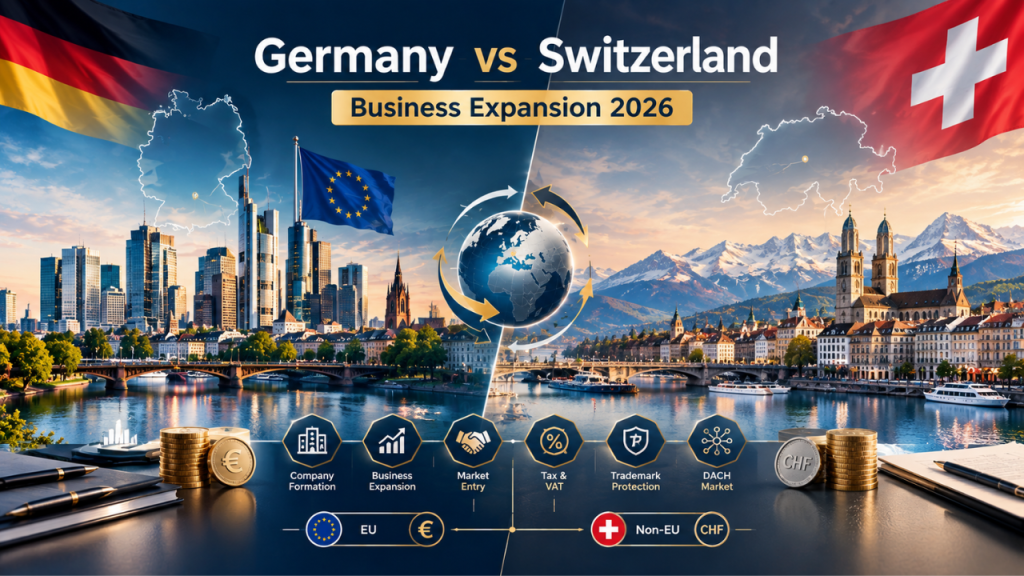
- Explain why foreign companies compare Germany and Switzerland when planning European or DACH expansion.
- Explain that both markets are geographically close and German-speaking, but they have different legal, tax, currency and market environments.
- Mention that Germany is an EU member while Switzerland is not an EU member.
- Explain that the appropriate market depends on the company’s customers, business model, budget and expansion objectives.
- Give a concise direct answer without declaring one country universally better.
Germany vs Switzerland: Quick Comparison
Create a concise comparison table covering:
- EU membership
- Currency
- Language
- Market size
- Main company structure
- Share capital
- Foreign ownership
- VAT
- Trademark protection
- Business address
- Market-entry options
- DACH position
Keep this table factual and easy to extract for featured snippets and AI search.
What Is the Main Difference Between Germany and Switzerland?
Compare the major structural differences:
- EU vs non-EU
- Euro vs Swiss franc
- Market size
- Legal system
- Company formation
- Tax and VAT environment
- Cross-border trade
- Trademark territory
- Regulatory requirements
Germany vs Switzerland Market Size:
Germany’s Market
Cover:
- Domestic market
- Customer base
- B2B ecosystem
- Industrial economy
- E-commerce opportunities
- EU market position
Switzerland’s Market
Cover:
- Domestic market
- Purchasing power
- German-speaking Swiss market
- International business environment
- Relationship with Germany and wider Europe
Why Market Size Matters for Foreign Companies
Explain how market size can affect:
- Customer acquisition
- Distribution
- Revenue potential
- Scaling
- Market-entry costs
Germany vs Switzerland for Foreign Companies:
Explain:
- Foreign ownership
- Company establishment
- Local presence
- Business address
- Management/director requirements
- Documentation
- Banking
- Tax registration
- Business activity requirements
Avoid suggesting that every foreign company has identical requirements.
Germany vs Switzerland Company Formation:
Company Structures in Germany
Cover:
- GmbH
- UG
- Other relevant structures
Company Structures in Switzerland
Cover:
- Swiss GmbH / Sàrl
- Swiss AG / SA
- Other structures where relevant
Germany GmbH vs Swiss GmbH
Compare:
- Minimum share capital
- Liability
- Ownership
- Management
- Registration
- Registered office
- Formation requirements
- Ongoing obligations
Use current official figures and requirements when writing the final article.
Germany vs Switzerland Company Formation Costs:
Create a comparison table covering:
| Cost Category | Germany | Switzerland |
|---|---|---|
| Share capital | ||
| Registration | ||
| Notary | ||
| Business address | ||
| Accounting | ||
| Tax compliance | ||
| Professional support | ||
| Ongoing administration |
Explain that share capital should not be confused with the total cost of establishing and operating a company.
Germany company formation cost breakdown
Germany vs Switzerland Business Address Requirements
Explain:
- Registered office
- Business address
- Local presence
- Mail handling
- Company registration
- Difference between registered address and operating office
For Switzerland, explain that requirements can differ according to company structure and canton.
Germany vs Switzerland Taxes and VAT:
Compare:
- Corporate taxation
- VAT
- Tax registration
- Accounting
- Filing
- Cross-border transactions
- Import/export considerations
- Canton-specific considerations in Switzerland
German VAT Considerations
Explain when foreign businesses may need German VAT registration.
Swiss VAT Considerations
Explain that Swiss VAT is separate from the EU VAT system and that registration depends on applicable Swiss rules.
Avoid presenting one universal registration rule for every foreign business.
Germany vs Switzerland: EU vs Non-EU Considerations
This should be one of the article’s most important sections.
Explain:
Germany as an EU Market
- EU membership
- EU single market context
- Cross-border EU trade
- EU regulatory framework
Switzerland as a Non-EU Market
- Switzerland is outside the EU
- Separate Swiss legal and regulatory framework
- Customs considerations
- Swiss VAT
- Currency considerations
Why This Difference Matters
Explain how EU/non-EU status can affect:
- Importing
- Exporting
- VAT
- Customs
- Product compliance
- Contracts
- Market-entry planning
Germany vs Switzerland Market Entry Strategy:
Market Entry Options in Germany
Cover:
- Cross-border selling
- Distributor
- Branch
- Subsidiary
- Licensing
- Franchising
Market Entry Options in Switzerland
Cover:
- Cross-border selling
- Distributor
- Local company
- Local partners
- Branch
- Licensing
- Franchising
Choosing an Entry Model
Explain that the appropriate model depends on:
- Business activity
- Target customers
- Revenue expectations
- Local presence
- Regulatory requirements
- Investment level
Germany vs Switzerland for E-commerce Businesses:
Cover:
- Amazon sellers
- Shopify businesses
- E-commerce brands
- VAT
- Customs
- Fulfilment
- Shipping
- Returns
- Marketplace expansion
- German-language localization
- Trademark protection
Important: Do not claim that every e-commerce seller needs German or Swiss VAT registration without considering the actual transaction and fulfilment model.
Germany vs Switzerland for B2B Companies:
Cover:
- Industrial customers
- Distributors
- Procurement
- Local partners
- German-language communication
- Sales cycles
- Local presence
- B2B market research
Germany vs Switzerland Trademark and Brand Protection:
Trademark Protection in Germany
Explain:
- German national trademark
- EU trademark
- Territorial protection
- German market considerations
Trademark Protection in Switzerland
Explain:
- Swiss national trademark protection
- Swiss territorial rights
- Difference between Swiss and EU trademark protection
Important:
Do not state or imply that an EU trademark automatically provides trademark protection in Switzerland.
Should You Search for a Trademark Before Entering Either Market?
Explain why businesses should consider trademark searching before investing heavily in:
- Website
- Packaging
- Advertising
- Amazon listings
- Distribution
- Brand development
Registering a New Trademark vs Buying an Existing Trademark
Compare:
- New application
- Existing registered trademark
- Due diligence
- Ownership verification
- Transfer
- Territorial scope
- Trademark classes
Germany vs Switzerland for Startups
Compare:
- Startup capital
- Operating costs
- Target market
- Customer acquisition
- Hiring
- Business structure
- Scalability
- International positioning
- DACH expansion
Avoid making unsupported claims about which country is universally more startup-friendly.
Germany vs Switzerland for International Companies
Discuss considerations for:
- US companies
- Asian companies
- UK companies
- Middle Eastern companies
- Existing EU companies
Cover:
- Market research
- Legal structure
- Local presence
- Tax/VAT
- Customs
- Trademark
- Localization
- Distribution
Can a German Company Expand Into Switzerland?
Explain:
- Cross-border selling
- Distributor arrangements
- Local subsidiary
- Branch
- Swiss company formation
- Swiss tax/VAT considerations
- Customs
- Trademark protection
Explain that a German company does not automatically need to establish a Swiss company for every form of commercial activity; requirements depend on how the business operates in Switzerland.
Germany vs Switzerland for DACH Expansion
Explain the three DACH markets:
- Germany
- Austria
- Switzerland
Compare:
- Language
- Legal systems
- EU membership
- Currency
- VAT
- Trademark territory
- Company formation
- Market-entry models
Explain why DACH should not be treated as one identical legal or tax market.
Germany vs Switzerland: Which Market Fits Your Business Model?
Do not give a universal winner.
When Germany May Be Relevant
Examples:
- Germany itself is the target market
- Larger domestic customer base matters
- EU market access is important
- German B2B ecosystem is relevant
- Company wants a Germany-first strategy
When Switzerland May Be Relevant
Examples:
- Swiss customers are the target
- Swiss market characteristics fit the business
- Swiss presence is commercially important
- Business is prepared for Swiss regulatory/tax requirements
When Both Markets May Make Sense
Examples:
- DACH expansion
- German-speaking customer base
- Multi-country distribution
- Existing Germany operations plus Swiss expansion
Germany vs Switzerland Business Expansion Checklist
Create an actionable checklist:
- Define target customers
- Research both markets
- Compare market size and demand
- Choose entry model
- Compare company structures
- Estimate formation costs
- Estimate ongoing costs
- Review business address requirements
- Review VAT/tax obligations
- Review customs requirements
- Search trademark rights
- Check territorial trademark protection
- Review localization
- Prepare website and marketing
- Build launch plan
- Review ongoing compliance
Germany vs Switzerland: Complete Comparison Table
Create a final comprehensive table:
| Factor | Germany | Switzerland |
|---|---|---|
| EU membership | ||
| Currency | ||
| Market size | ||
| Main languages | ||
| Main company structures | ||
| Foreign ownership | ||
| Share capital | ||
| Formation requirements | ||
| Business address | ||
| VAT | ||
| Corporate taxation | ||
| Customs considerations | ||
| Trademark protection | ||
| DACH role | ||
| Market-entry options | ||
| Key considerations |
Frequently Asked Questions
Is Germany or Switzerland better for business?
Give a criteria-based answer rather than a universal winner.
Summarize:
- Germany and Switzerland are geographically close but legally and commercially distinct markets.
- Germany is an EU member and uses the euro.
- Switzerland is outside the EU and uses the Swiss franc.
- Company formation, VAT, customs, taxation and trademark protection need to be evaluated separately.
- The appropriate expansion strategy depends on the company’s target customers, business model, budget and operational requirements.
- Companies planning DACH expansion should evaluate Germany, Austria and Switzerland as related but legally distinct markets.
Related Resources:
- Germany Market Entry Strategy → https://trademarkbuysale.com/germany-market-entry-strategy/
- DACH Market Entry Guide → https://trademarkbuysale.com/dach-market-entry-guide/
- Company Registration in Germany → https://trademarkbuysale.com/company-registration-germany/
- Germany Company Formation Cost Breakdown → https://trademarkbuysale.com/germany-company-formation-cost-breakdown/
- German VAT Registration → https://trademarkbuysale.com/german-vat-registration/
- Trademark Search Service → https://trademarkbuysale.com/trademark-search-service/
- Buy a Registered Trademark → https://trademarkbuysale.com/buy-trademark-service/