
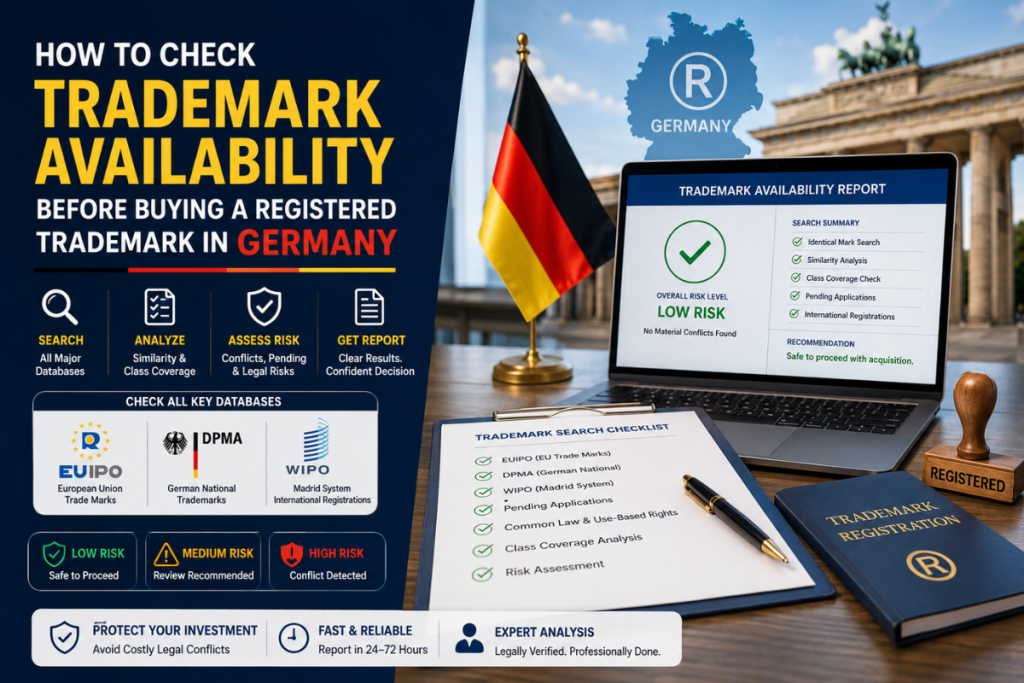
You Found a Trademark You Want to Buy. Now what?
You have identified a brand. The name is strong. The market opportunity is clear. You are ready to move forward.
But before you transfer a single euro — before you sign anything, negotiate anything, or commit to anything — you need to answer one question with complete certainty:
Is this trademark actually available and safe to buy?
Not “probably clean.” Not “looks fine on the surface.” Legally confirmed, professionally verified, conflict-free.
This is what trademark availability checking is for — and in Germany, where trademark law is structured, enforced, and legally binding, skipping this step has ended more brand launches than any competitor ever could.
This guide walks you through exactly how to check trademark availability before buying a registered trademark in Germany in 2026 — what to check, where to check it, what the results mean, and what to do when you find a conflict.
What Does “Trademark Availability” Actually Mean?
Trademark availability is not a single yes-or-no answer. It is a layered legal assessment that covers multiple dimensions of risk.
A trademark is considered available when:
- No identical mark exists in the same class and jurisdiction
- No confusingly similar mark exists that could create legal conflict
- The mark is not already registered by the intended seller — or by someone else entirely
- No pending applications could mature into a conflicting registration
- The trademark’s class coverage aligns with your intended business use
A trademark is considered unavailable or high-risk when:
- An identical name is registered in the same Nice Classification class
- A phonetically or visually similar mark exists in an overlapping industry
- A pending application for a similar mark is under examination
- The trademark has expired, lapsed, or is subject to cancellation proceedings
- Ownership is disputed or unclear
Availability is not black and white — it exists on a spectrum of legal risk. The goal of a trademark availability check is to map exactly where on that spectrum a specific trademark sits before you commit to buying it.
Why Checking Availability Is Different From a Basic Database Search
Here is the mistake most buyers make.
They go to the EUIPO or DPMA website, type in the trademark name, see no exact match, and assume the trademark is available.
It is not that simple — and that assumption has cost buyers significant money.
Here is what a basic database search misses:
Phonetic Similarity
Two names that sound alike when spoken can constitute trademark infringement under EU law — even if the spelling is completely different. “Zaro” and “Zara.” “Prolux” and “Prolog.” “Baven” and “Bayen.” A database search for exact text does not catch these.
Visual Similarity in Logos
A figurative mark or combined mark may conflict with an existing registered logo even when the text differs. Visual similarity analysis requires expert comparison — not a text search.
Conceptual Similarity
Trademarks can conflict when they share the same meaning across different languages. “Sun” in English and “Sol” in Spanish may be considered conceptually equivalent under EU trademark examination. A basic search will not flag this.
Related Class Risks
A name may be clear in Class 25 (clothing) but heavily conflicted in Class 35 (retail services) — which you also need for your business. A single-class search produces a dangerously incomplete picture.
Pending Applications
A trademark application filed but not yet registered does not show up as a registered mark — but it can mature into a conflict after you complete your purchase. A professional search includes pending applications, not just confirmed registrations.
National vs. EU Coverage Gaps
A search of EUIPO alone misses German national trademarks at DPMA. A search of DPMA alone misses EU-wide rights that can be enforced in Germany. Both databases must be checked.
This is why a professional trademark availability check is categorically different from a quick self-service database lookup — and why the results they produce are so different.
The 5 Databases You Must Check Before Buying a Trademark in Germany
A complete trademark availability check in Germany covers five distinct sources of trademark rights.
1. EUIPO — European Union Intellectual Property Office
What it covers: All registered EU Trade Marks (EUTM) — covering all 27 EU member states including Germany
Why it matters: An EUIPO-registered trademark is enforceable throughout Germany, even if the owner is based in another EU country. An EUTM conflict can block your use of a purchased trademark across the entire German market.
Where to search: eSearch Plus — EUIPO’s official trademark database
What to look for: Active registrations, pending applications, and recently lapsed marks (which may still be within the grace period for renewal)
2. DPMA — Deutsches Patent- und Markenamt
What it covers: All registered German national trademarks
Why it matters: German national trademarks predate the EU system and may not appear in EUIPO searches. A registered DPMA mark in a directly competing class is a serious conflict even for buyers acquiring EUIPO trademarks — because national rights can co-exist and sometimes challenge EU marks.
Where to search: DPMAregister — DPMA’s official public database
What to look for: Active German national registrations in your relevant Nice Classification classes
3. WIPO — World Intellectual Property Organization
What it covers: International trademark registrations filed through the Madrid System that designate Germany or the EU
Why it matters: A trademark owner in the US, China, India, or any other Madrid System member country can file an international registration that extends protection into Germany and the EU. These marks do not originate from EUIPO or DPMA but are fully enforceable in German territory.
Where to search: Madrid Monitor — WIPO’s international trademark database
What to look for: Madrid System registrations designating Germany (DE) or the European Union (EM)
4. Pending Applications — All Three Authorities
What it covers: Applications filed but not yet registered at EUIPO, DPMA, or WIPO
Why it matters: A pending application is not yet a registered trademark — but it is evidence of a priority filing date. If that application matures into a registration after your purchase, the new owner could challenge your use. Identifying pending applications allows you to assess future risk, not just current risk.
5. Common Law and Unregistered Rights
What it covers: Rights acquired through use without formal registration
Why it matters: In Germany, certain rights can arise from established market use even without formal registration — known as Benutzungsmarken (use-based marks). These are harder to detect through database searches alone and require market-level analysis.
How to assess: Brand research, online market presence analysis, and industry-specific investigation
Step-by-Step: How a Professional Trademark Availability Check Works
A professional trademark availability check is not a single database query. It is a structured multi-stage process designed to identify every material risk before acquisition.
Step 1: Submit Trademark Details
Provide the trademark name, logo (if applicable), industry sector, intended Nice Classification classes, and target markets (Germany only, EU-wide, or international).
The more precise the input, the more targeted and reliable the output.
Step 2: Identical Mark Search
The first pass searches for exact name matches across EUIPO, DPMA, and WIPO databases. Any identical marks in the same or related classes are flagged immediately.
Result type: Confirmed conflict (identical match) or clear (no exact match found)
Step 3: Similarity Analysis
The second pass — and the most technically demanding — evaluates phonetic, visual, and conceptual similarity across all relevant trademark classes.
This stage identifies:
- Names that sound like the trademark being checked
- Logos or word marks that look confusingly similar
- Marks that share meaning or conceptual equivalence in relevant languages
- Marks in adjacent classes that could claim industry overlap
Result type: Similarity conflicts ranked by proximity and risk level
Step 4: Class Coverage Analysis
The third pass maps the trademark against the Nice Classification system to identify all relevant classes for the buyer’s intended business — and checks each class individually for existing conflicts.
Common classes for German market buyers:
| Class | Coverage |
| Class 3 | Cosmetics, cleaning products |
| Class 9 | Electronics, software, apps |
| Class 18 | Leather goods, bags |
| Class 25 | Clothing, footwear |
| Class 35 | Retail, e-commerce, advertising services |
| Class 41 | Education, training, entertainment |
| Class 42 | Technology, software development |
A trademark that appears clean in one class may carry significant conflicts in another.
Step 5: Pending Applications Review
All databases are checked for pending applications that could mature into registered conflicts within the typical 4–6 month examination period following your acquisition.
Step 6: Risk Scoring and Report
All findings are consolidated into a structured risk report with a clear overall risk assessment:
| Risk Level | What It Means | Recommended Action |
| ✅ Low Risk | No material conflicts found across all databases and classes | Safe to proceed with acquisition |
| ⚠️ Medium Risk | Minor similarities or class overlaps detected | Proceed with legal advisory review before finalizing |
| ❌ High Risk | Direct conflicts or identical marks found in relevant classes | Do not acquire — explore alternatives |
Report delivery: 24–72 hours
What to Do When You Find a Conflict
A conflict in your trademark availability check does not automatically end your acquisition plans. It depends on the nature and severity of the conflict.
Scenario 1: Identical Mark in a Different Class
Example: You want to buy a trademark for clothing (Class 25), and an identical name is registered for software (Class 9).
Assessment: This may be manageable depending on industry distance. Fashion and software are typically considered distinct enough to coexist, but it requires careful assessment.
Action: Proceed with caution, obtain legal advisory review, ensure your intended business activities remain clearly within the clean class.
Scenario 2: Phonetically Similar Mark in the Same Class
Example: Your target trademark is “VELON” and an existing registration for “VELLON” exists in the same class.
Assessment: High conflict risk. Phonetic similarity in the same class is one of the strongest grounds for trademark challenge under EU law.
Action: Do not proceed without conflict resolution. Explore alternative trademark options or seek a coexistence agreement.
Scenario 3: Lapsed Trademark With Pending Renewal Period
Example: A trademark you want to buy lapsed 6 months ago but is still within the renewable grace period.
Assessment: The lapse creates opportunity, but the grace period means the original owner may still reclaim the mark.
Action: Monitor the renewal deadline. If the mark is not renewed, it may become freely available for registration — though the timing risk requires careful management.
Scenario 4: Conflict in One Class, Clear in Others
Example: Your target trademark has a conflict in Class 35 (retail services) but is clear in Classes 25 and 18, which cover your core products.
Assessment: A partial acquisition may be possible — purchasing rights in the clear classes only, excluding the conflicted class.
Action: Negotiate a partial assignment covering only the clean classes, and pursue a separate registration or alternative strategy for retail services.
Scenario 5: Pending Application From a Third Party
Example: A third party has filed a trademark application for an identical name in your class. The application is 2 months old and not yet registered.
Assessment: High future risk. If the application is approved, the third party will hold prior rights.
Action: Do not proceed with the acquisition until the application outcome is determined. Monitor the application closely. Consider filing an opposition if you have prior use rights.
Red Flags to Watch for When Checking Availability
Beyond database conflicts, these warning signs during the availability check process indicate a higher-risk acquisition:
🚩 Seller Cannot Produce Registration Documentation If the seller cannot provide the official DPMA or EUIPO registration certificate, verify the registration directly in the official database before proceeding.
🚩 Trademark Was Recently Assigned Multiple Times Frequent ownership changes in a short period can indicate legal disputes, failed transactions, or deliberate obfuscation. Investigate the transfer history.
🚩 Renewal Status Is Unclear or Overdue A trademark approaching renewal without clear confirmation of timely payment is a risk. Lapsed trademarks lose their protection and may become available to competitors.
🚩 Class Coverage Does Not Match Seller’s Claims Sellers sometimes describe a trademark as covering areas it does not legally protect. Always verify class coverage in the official database, not from seller representations alone.
🚩 Business Name and Trademark Do Not Match If the seller’s trading name differs significantly from the trademark being sold, investigate the reason. Legitimate business transfers should have a clear explanation for any mismatch.
Checking Availability for Amazon Germany: Specific Requirements
For Amazon sellers conducting a trademark availability check in preparation for Brand Registry enrollment on Amazon Germany, several platform-specific factors apply.
Amazon’s accepted trademark types: Word marks and figurative marks. Amazon does not currently accept all trademark types for Brand Registry purposes — verify that the trademark format qualifies before purchase.
Jurisdiction requirements: Amazon Germany Brand Registry accepts DPMA (German national) and EUIPO (EU Trade Mark) registrations. WIPO Madrid System registrations designating Germany are also accepted.
Active status is mandatory: Amazon requires the trademark to be in active, registered status at the time of Brand Registry enrollment. A lapsed or pending trademark does not qualify.
Name matching: The trademark name must match the brand name you use on Amazon listings. A mismatch between the trademark and your storefront name will delay or block Brand Registry enrollment.
A professional availability check designed for Amazon market entry verifies all of these requirements alongside the standard conflict analysis — saving you from discovering compliance issues after you have already completed the purchase.
How Often Should You Check Trademark Availability?
Trademark availability is not a one-time verification. The trademark landscape changes continuously as new applications are filed, existing marks expire, and assignment records are updated.
Check before purchase: Always — non-negotiable.
Check again before transfer completion: If there is a gap of 4 weeks or more between your initial search and the transfer recording, a brief re-check is advisable to confirm no new applications have been filed in the interim.
Check after acquisition: Consider setting up trademark monitoring (watch services) that alert you to new applications that could conflict with your registered mark. This protects your ownership proactively rather than reactively.
DIY Check vs. Professional Trademark Availability Check: The Real Difference
Many buyers attempt a self-service availability check before deciding whether to commission a professional search. Here is an honest comparison of what each approach delivers:
| Factor | DIY Database Search | Professional Availability Check |
| Identical name match | ✅ Yes | ✅ Yes |
| Phonetic similarity analysis | ❌ No | ✅ Yes |
| Visual/logo similarity | ❌ No | ✅ Yes |
| Conceptual similarity | ❌ No | ✅ Yes |
| Multi-class coverage | ❌ Partial | ✅ Full |
| Pending applications | ❌ Often missed | ✅ Included |
| WIPO international marks | ❌ Often missed | ✅ Included |
| Risk scoring and report | ❌ No | ✅ Yes |
| Acquisition recommendation | ❌ No | ✅ Yes |
| Turnaround time | Immediate | 24–72 hours |
| Reliability | Low–Medium | High |
A DIY search is useful for initial screening — to filter out obviously conflicted trademarks before investing in professional analysis. But it is not a substitute for a professional check before a purchase decision is made.
The cost of a professional availability check is a small fraction of the acquisition price of any trademark worth buying. The cost of skipping it — and discovering a conflict after purchase — is orders of magnitude higher.
Trademark Availability Checks in Germany
Can I check trademark availability myself for free? You can conduct a basic identical-name search on EUIPO’s e Search Plus and DPMA’s DPMA register at no cost. However, free database searches do not include similarity analysis, class mapping, pending applications review, or risk scoring — making them insufficient for acquisition decisions.
How long does a professional availability check take? A professional trademark availability check typically delivers results within 24–72 hours depending on the complexity of the mark and the number of classes and jurisdictions covered.
What if the trademark I want to buy passes the availability check? A clean availability check (Low Risk result) clears the way for confident acquisition. You can proceed with due diligence, negotiation, assignment agreement, and official transfer recording.
Does availability mean I can definitely use the trademark? A clean search result significantly reduces legal risk and is the standard benchmark for safe acquisition. However, no search can guarantee absolute certainty — trademark law involves professional judgment, and edge cases exist. For high-value acquisitions, combining a search with legal advisory provides maximum protection.
What is the difference between availability and clearance? Availability checking identifies whether conflicts exist. Clearance is a legal opinion — typically from a trademark attorney — confirming whether a specific mark is safe to use based on the search results. A professional search provides the evidence; clearance advice interprets it.
Do I need to check availability if the trademark is already registered? Yes — registration does not certify freedom from conflict with other marks. A trademark can be registered and still carry conflict risk with similar marks in overlapping classes. Availability checking covers the full conflict landscape, not just registration status.
The Check That Protects Every Trademark Investment
Buying a registered trademark in Germany without checking availability first is not a shortcut — it is a liability.
The trademark could have conflicts you cannot see from a surface-level search. The class coverage may not align with your business needs. A pending application could mature into a blocking registration. The seller may be misrepresenting the mark’s legal status.
A professional trademark availability check — covering EUIPO, DPMA, WIPO, pending applications, and similarity analysis — gives you the complete picture before any money changes hands.
It is the step that transforms a speculative purchase into a confident, legally sound acquisition. It is what separates buyers who build successfully on their trademark investments from those who spend months and significant capital untangling conflicts they could have avoided entirely.
Check first. Buy with confidence. Build without interruption.
Ready to check trademark availability before you buy?
Get a professional trademark availability check covering Germany (DPMA), the EU (EUIPO), and international databases (WIPO) — with a full risk report delivered in 24–72 hours.
👉 Book a Consultation | 👉 Find Your Trademark | 💬 WhatsApp Expert Support
This article is for informational and educational purposes only and does not constitute legal advice. For specific trademark matters, consult a qualified intellectual property professional with German and EU expertise.